

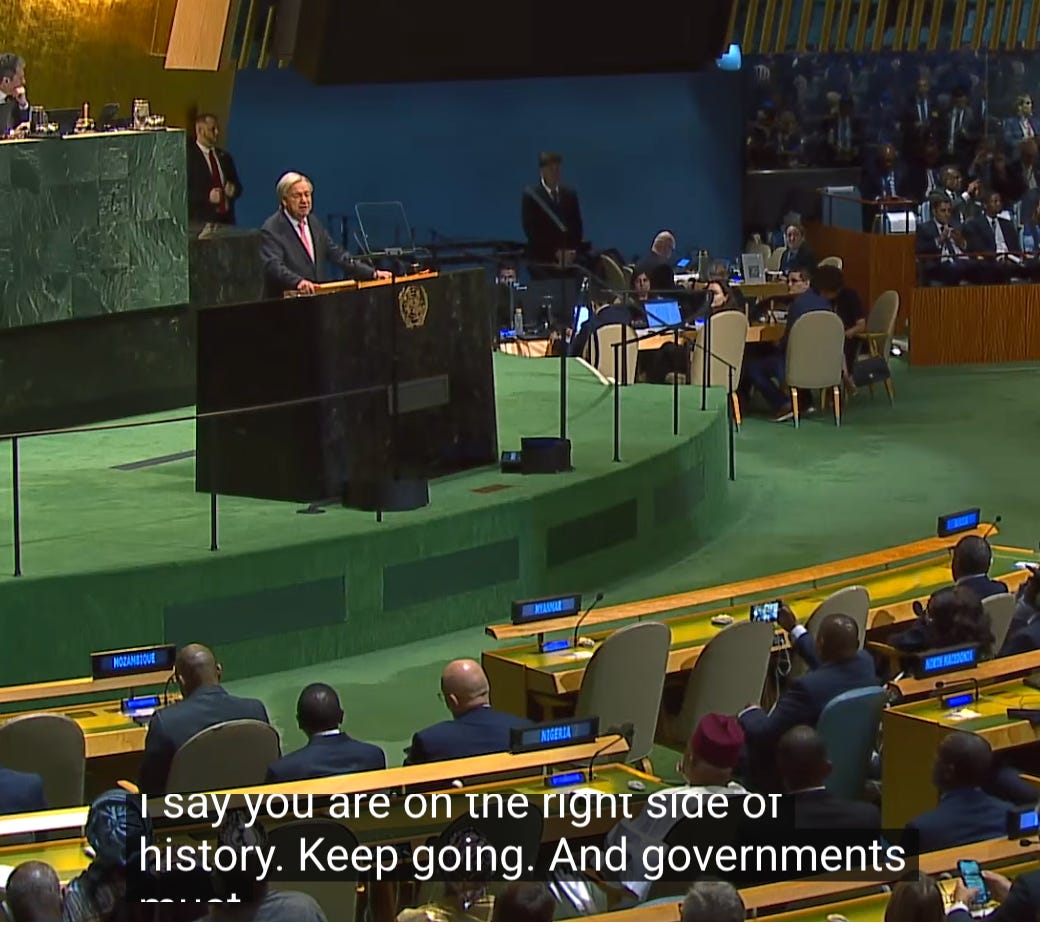
Screen shot of UN Secretary-General António Guterres addressing the UN General Assembly in New York on September 22, 2026.
Last week I was in New York City attending several Climate Week events focused on climate litigation and accountability. In recent years, Climate Week has seen a handful of events each September organized around those topical themes – two years ago for example, there was a panel made up of folks from a newly formed group called Extreme Weather Survivors who told their first-hand stories of experiencing climate-related weather disasters and called for major polluters to be held accountable.
This year, the climate accountability panel discussions that took place during Climate Week (an annual event held on the sidelines of the UN General Assembly in New York) did so against a backdrop of democratic backsliding and escalating backlash to accountability efforts from corporate polluters and their allies in government, as well as ever-worsening extreme weather driven primarily by more than a century of unchecked fossil fuel combustion. These trends, starkly apparent in the U.S., are by no means limited to this country. Colombia, which in April hosted the world’s first-ever conference on transitioning away from fossil fuels, recently became the latest Latin American country to see a far-right government come into power. New Zealand, which saw a right-wing government – the country’s most conservative in decades – elected a few years ago, just passed a law banning climate tort lawsuits and shielding polluters from accountability. And Nepal recently suffered one of the latest climate-linked disasters with the deadly and devastating landslide and flash floods in late August stemming from glacial collapse that wiped out entire villages.
These are undoubtedly perilous times we’re living through, and if my piece from last week is any indication, I’m really not all that optimistic about the future for our civilization. But being in New York last week in the company of people fighting tirelessly for justice and accountability raised my spirits – and so I wanted to share some reflections here based on three events I attended during Climate Week.
I think my main takeaways boil down to three broad points: 1) It is more important than ever to come together in solidarity and unite across struggles and social justice movements and across geographic borders; 2) Related to that, the climate accountability movement, like the climate crisis itself, is global, and polluting corporations and countries will not be able to evade liability everywhere; 3) Communities and advocates pushing for accountability will keep going no matter what.
Solidarity
During a September 22 “No Immunity for Big Oil” panel organized by the Center for Climate Integrity and the Union of Concerned Scientists, several speakers connected the fossil fuel industry’s push for legal immunity to efforts to attack U.S. democracy. As former Washington Governor Jay Inslee has said, the American jury is one of the most fundamental democratic institutions that there is. Preventing climate lawsuits against oil companies from ever reaching a jury, as fossil fuel interests and their government backers are desperately trying to do, is “un-American,” Inslee previously told me in an interview. He has been one of the most outspoken opponents of Republican-led legislation currently pending in Congress, the “Stop Climate Shakedowns Act,” that would give sweeping immunity to the fossil fuel industry from climate accountability laws and litigation.
“I’m mad as hell about this,” Inslee said during last week’s panel. “Nobody should be above the law in the United States.” He said that this is “a basic issue of democracy.”
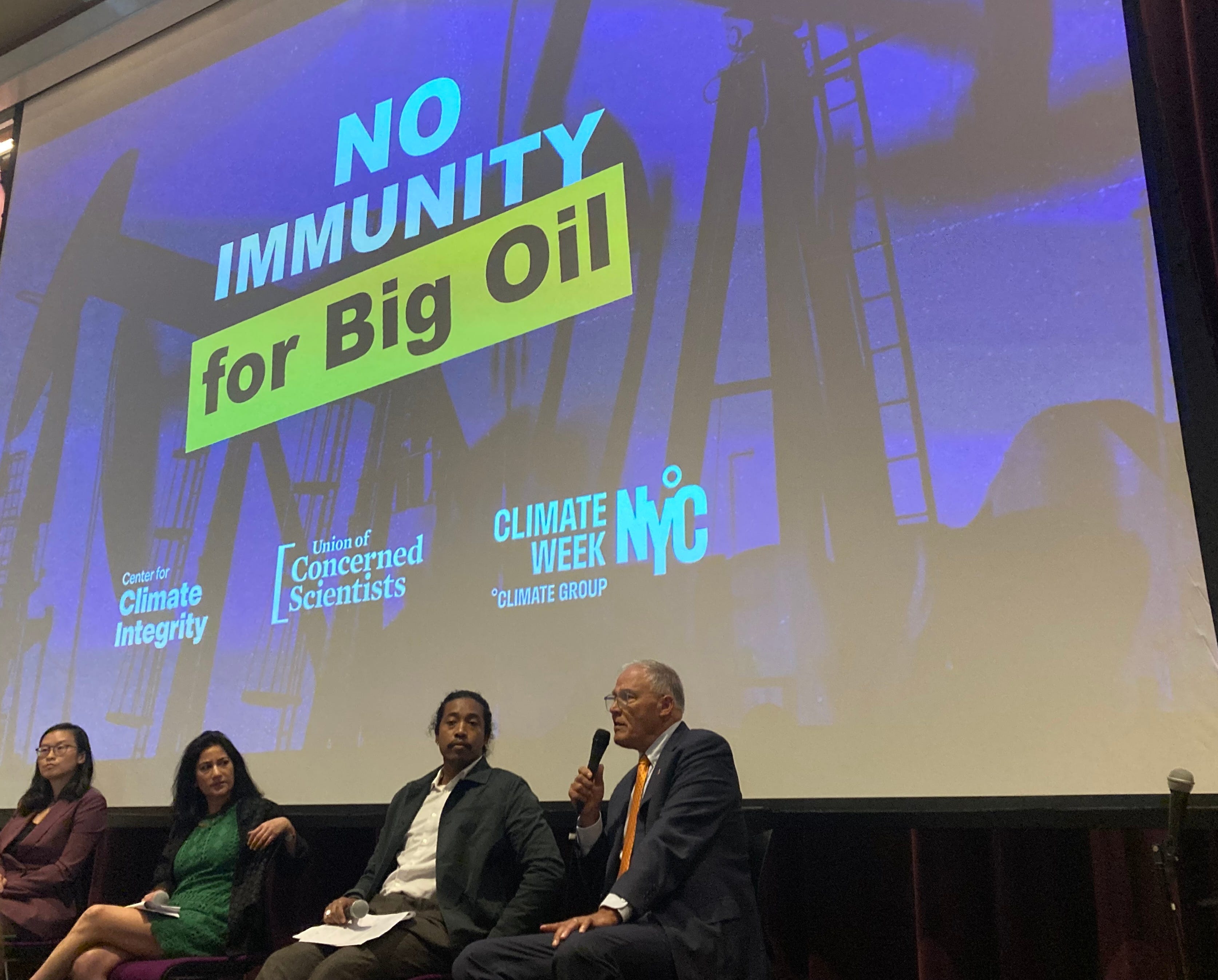
Former Washington Governor Jay Inslee speaks during a September 22, 2026 panel held during Climate Week NYC
The Stop Climate Shakedowns Act, introduced in April by Rep. Harriet Hageman and Sen. Ted Cruz, has been gaining co-sponsors in the House (so far 24 House members, all Republicans, have signed on) and was slated to come before the House Judiciary Committee for consideration on September 16. But the committee adjourned and didn’t take up the bill, at least for now. Inslee said there is a good chance that Republicans will try to push it through after the November election during Congress’ lame duck session. And Democrats, he said, should be prepared to rally to defeat it.
“[Democrats] will be united. But we’ve got to raise the profile on our outrage,” Inslee said, suggesting that opposing Big Oil immunity should be at the top of Democrats’ list of priorities. Some Democratic lawmakers are already speaking out in opposition to the immunity bill, as I previously reported.
Versions of that legislation shielding polluters from any liability for climate damage have already passed in five states, including Tennessee. Justin Jones, a Democratic state representative in Tennessee, talked about that during the panel, and he connected the fight against corporate immunity to the fight against efforts to undermine democracy (i.e., restricting voting) and to strip away civil rights and liberties.
“We have to start getting out of the silos of our movements and connecting our struggle,” Jones said.
The theme of solidarity also came up during a panel I attended on September 24 about youth climate litigation, which featured an international dialogue among young climate activists and plaintiffs from Japan, South Korea, and the U.S. Although the lawsuits these young people are involved in are different (I plan to report more on the Japanese and South Korean cases in a later piece, stay tuned), they are all connected through a shared pursuit of generational justice.
“All over the globe, we’re raising our voices towards the same goal,” said Katrin Miyazawa, a plaintiff from Youth Climate Case Japan.
“Even though we come from different countries and legal systems, many of our struggles are very similar,” she added in a post-event press release. “We can learn from each other’s experiences, strategies, and successes. The more climate cases succeed, the more examples and legal foundations we create for others to build on. Knowing that we are connected across borders, facing the same global crisis and working to hold governments and companies accountable, gives me a lot of strength and hope.”
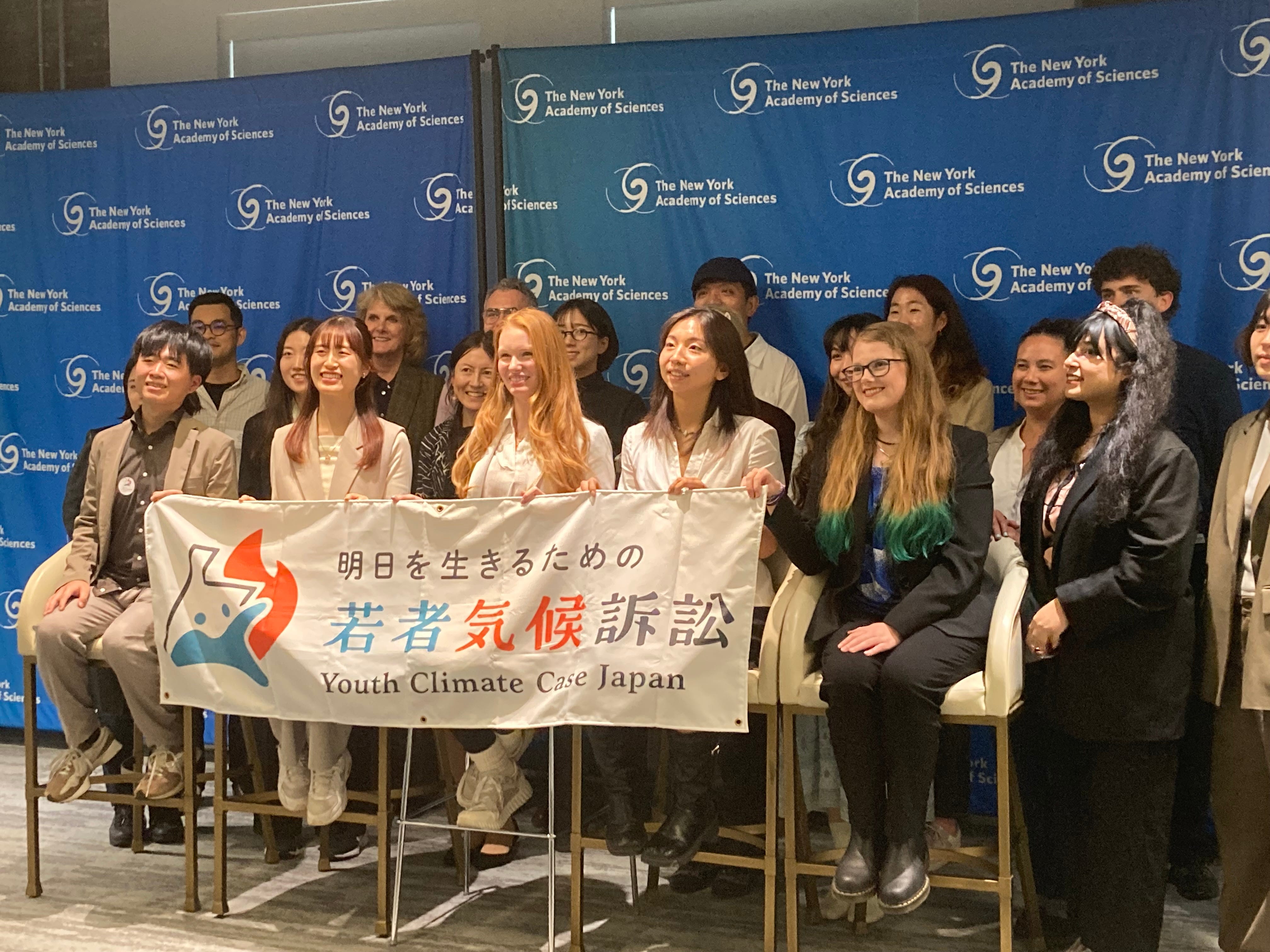
Youth climate activists (foreground) from Japan, South Korea, and the U.S. came together during a September 24, 2026 panel about international youth climate litigation.
A Global Movement
Indeed, the battle for climate justice and accountability is one that transcends borders. From youth climate demonstrations and lawsuits to campaigns and legislative initiatives demanding the polluters pay for climate harms, efforts in pursuit of climate accountability are happening all around the world.
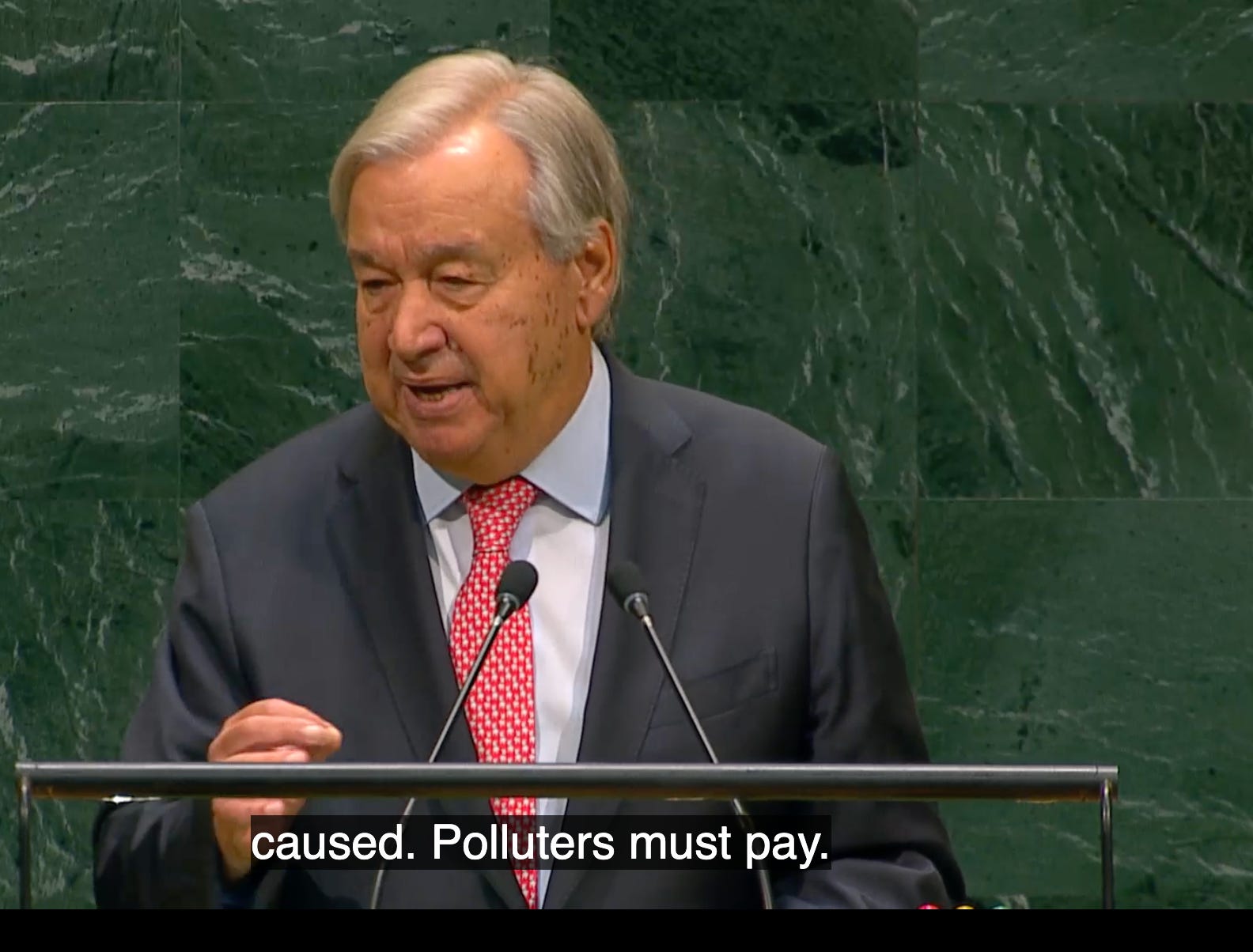
At the start of Climate Week and the UNGA, an international coalition of climate campaigners delivered petitions to the UN with over 2 million signatures from people all over the globe calling on governments to hold polluters accountable and force them to pay for the damage they have caused. UN Secretary-General António Guterres then echoed this demand during his final General Assembly speech.
“Those who polluted the most – and profited the most – must do far more to repair the damage they caused,” Guterres said. “Polluters must pay.”
The U.S. has seen a particularly intense backlash to attempts to make polluters pay through climate lawsuits and Superfund-style state laws, as the fossil fuel industry has united with the Trump administration and Republican elected officials to push back against these laws and lawsuits on multiple fronts. And they are starting to notch some wins in the courts. New York’s landmark climate superfund law, for example, was just struck down by two courts in parallel legal challenges brought by industry groups and Republican-led states as well as by the Trump administration. Last week Michigan’s pioneering antitrust lawsuit against Big Oil was dismissed by a federal court. And the U.S. Supreme Court could soon deliver a knockout blow to many of the pending climate suits filed against the industry. The court is taking up one of those cases, brought by Boulder, Colorado, in oral arguments on Monday, October 5; a broad ruling in favor of oil companies Suncor and Exxon could effectively shut down avenues for climate liability at the state and local level, shielding polluters from accountability.
Even if that does end up happening, there are other lawsuits underway against some of these fossil fuel companies in other countries that would not be affected by a decision from the U.S. Supreme Court. Shell, for example, is facing climate cases in the Netherlands and the UK, in addition to the suits it is trying to fend off in the U.S. Those cases and others against big polluters would continue regardless of what happens with the U.S. litigation.
“There are dozens of suits pending in the United States to use tort and consumer protection law to hold the fossil fuel industry accountable. And they are facing massive blowback and pushback like we’ve never seen before from the industry and its backers in power,” Nikki Reisch, director of the climate and energy program at the Center for International Environmental Law, said during a September 23 panel about global perspectives on climate litigation. “But I think the message here,” she added, “is that there are multiple channels, jurisdictions, legal theories, defendants and actors who will continue to bring these claims because the harm continues, and that cry for justice and the avenues for accountability are strong.”
And as another panelist reminded the audience, some courts and judges are starting to not only be willing to hear these cases, but to issue rulings aligned with justice and accountability that are informed by climate science. Just last year for example, the International Court of Justice handed down its historic climate change advisory opinion affirming that climate action is a legal obligation.
“The law is not static. It changes,” said Elaine Johnson, an Australian environmental lawyer. “There are courts and judges that are willing to look at the law in a new light, given what we now know communities are experiencing on the ground in terms of climate change. And the state of science now is at such a high level that we can start attributing individual projects and companies to specific climate harms. So, not all is lost.”
Keep Going
The work to advance and fight for climate accountability will continue. It must, because the stakes are too high and giving in is not an option. That was a clear takeaway message from the Climate Week events I attended.
“Youth all around the world are fighting back, fighting back against the impacts of climate change through the legal system, because we don’t have a choice,” said Delaney Reynolds, a 27-year-old climate activist from Miami and plaintiff in youth climate cases against the state of Florida and the federal government (read more about her story here). “It’s either sit back, and watch governments continue to protect the polluting ways of the fossil fuel industry, or it’s take a stand and fight to protect the planet, the environment and places we love all around the world.”
Jones, the Tennessee state representative, invoked the words of Frederick Douglas in urging people to be persistent and continue fighting in the face of oppression. “Let it inflame and embolden our resistance… We have to agitate, agitate, agitate, agitate, agitate.”
The mounting backlash by the fossil fuel industry and its political backers, Reisch said, is an indication of the strength and effectiveness of the climate accountability movement.
“We can’t forget, that not only is this a sign that what we’re doing is working, and we need to keep going. It’s also galvanizing the movement,” she said. “People don’t accept the idea that this industry, or those who are harming the climate and our rights are above the law. And people are rallying and will continue to rally together.”
Guterres also offered some words of encouragement to accountability advocates during his UNGA remarks: “And to the leaders, cities, civil society and citizens working to hold [polluters] accountable: you are on the right side of history. Keep going.”