

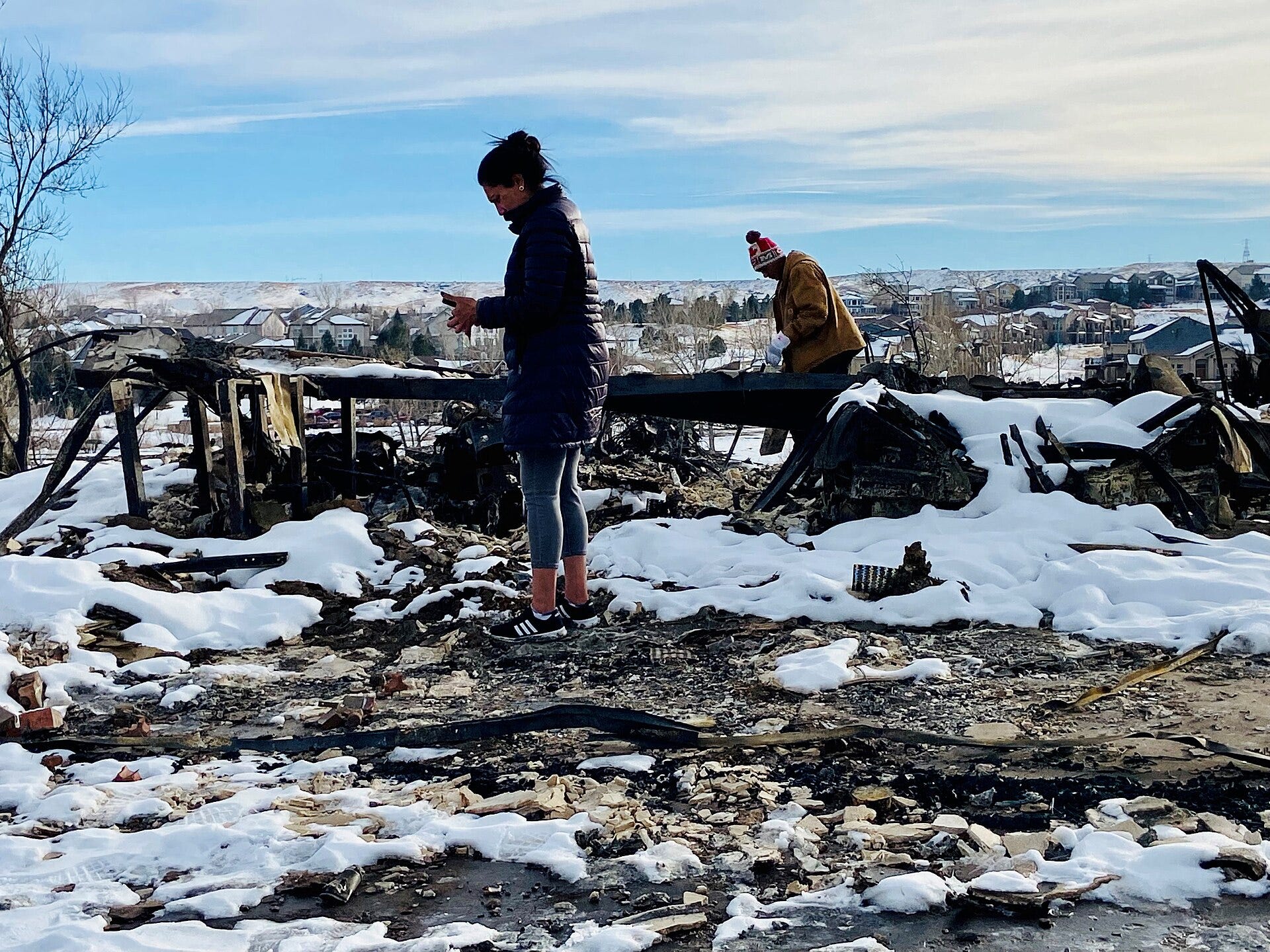
Colorado homeowners sift through the burnt remains of a house destroyed by wildfire. The Marshall fire tore through Boulder County, Colorado in late December 2021 and incinerated roughly 1,000 homes while forcing the evacuations of tens of thousands of residents. It was the most destructive wildfire in Colorado’s history. Credit: State Farm via Wikimedia Commons, CC BY 2.0
Story co-published with Climate in the Courts
When the U.S. Supreme Court returns to session this fall, the very first case they will hear is a climate accountability case. As someone who has been closely following and reporting on climate change litigation for nearly ten years now, I can tell you that this case is a big deal. Depending on the decision that the court ultimately comes out with, it could have sweeping implications not only for climate law and accountability for the fossil fuel industry, but also for constitutional federalism and state sovereignty.
The case, Suncor Energy, Inc. v. Commissioners of Boulder County, stems from litigation that the city and county of Boulder, Colorado filed in 2018 against oil companies Suncor and ExxonMobil. Boulder alleges that the companies lied about and misrepresented the climate change harms of unchecked fossil fuel use in order to inflate sales of their products and boost profits. This deception in turn drove worsening climate impacts like extreme heat and flooding, severe drought, and monstrous wildfires, the lawsuit says, and Boulder therefore wants the oil companies to help pay for some of the costs of adapting to such impacts.
Boulder is not alone. Over the course of the past nine years, dozens of municipalities and states across the U.S. have sued major fossil fuel companies like Exxon over climate deception, citing evidence reveled through investigative reporting and scholarly research. Some of the lawsuits bring classic tort claims like nuisance, trespass, and failure to warn and seek monetary damages, while others assert fraud claims under state consumer protection statutes, and in some cases they bring a combination of the two or attach other claims like racketeering or antitrust. All of the cases, for the most part, have been filed in state courts under state law, and they are slowly proceeding through initial (pre-trial) motions. Some cases have already been dismissed.
Now, however, the oil companies are looking to quash them all in one fell swoop, with the help of the Supreme Court.
Boulder’s case is set to be heard by the court on October 5. But the case the court is hearing is likely to be much bigger in impact than just this one Colorado community. “The decision may determine the outcome of the more than two dozen lawsuits pending against the fossil fuel companies by states, counties and cities for money damages,” said Michael Gerrard, faculty director at the Sabin Center for Climate Change Law at Columbia University.
So, how did we get here? What are both sides and their backers or friends-of-the-court arguing? And what is potentially at stake?
Road to the Supreme Court
Lawyers representing the oil companies have been fighting the climate liability lawsuits tooth-and-nail for years. Many of the cases, including Boulder’s, have been bogged down in lengthy procedural battles over the issue of whether the litigation belongs in federal or state courts. Oil companies wanted the cases to be in federal court, where they saw an easier path to dismissal. They argued that the lawsuits raise uniquely federal issues like interstate air pollution and therefore the claims must arise under federal law in federal court. In 2021 the Supreme Court actually heard arguments on a narrow technical question in one of the suits, a case brought by Baltimore, Maryland against oil companies. The court ruled in favor of the companies and directed federal appeals courts to consider the full range of arguments from industry lawyers on the jurisdiction question – a ruling that applied to Baltimore’s case and several others including Boulder’s.
The appeals courts then heard these additional arguments and rejected them, which prompted the oil company lawyers to run back to the Supreme Court challenging those decisions. In 2023 the court denied a handful of these petitions from the industry, involving Boulder’s lawsuit and several other climate suits. Justice Samuel Alito, who holds stock in a couple of big oil companies, at the time had recused himself from considering these petitions.
With the question of whether the cases belong in federal or state court thus settled, the litigation advanced in state courts. Some courts have sided with the companies and tossed out the suits. Baltimore’s case, for example, went down that path. But other state courts have allowed the lawsuits to move forward towards trial. A lawsuit brought by Honolulu cleared procedural hurdles in the Hawaii courts and was on track to move towards trial, but the oil company defendants lodged a petition to the Supreme Court to try to block it. The justices denied that petition in January 2025, right before the start of the second Trump administration.
Eight months later, oil companies tried again, filing another Supreme Court petition in a different climate case – the one brought by Boulder. It was the third such petition filed by Suncor and Exxon in Boulder’s case, and it was basically identical to the petition in the Honolulu case that the justices had denied.
But this time, the justices decided to take up the petition. They granted cert – meaning they agreed to review the case – in February of this year. Alito did not recuse himself this time around, either. The petition aims to reverse a May 2025 ruling from the Colorado Supreme Court allowing Boulder’s suit to move towards trial. The question presented, however, is framed in such broad terms that it is likely to apply to many of the other climate liability lawsuits pending against major oil companies.
The Arguments and Amicus Briefs
This is the question at issue: “Whether federal law precludes state-law claims seeking relief for injuries allegedly caused by the effects of interstate and international greenhouse-gas emissions on the global climate.”
In other words, does federal law shield major greenhouse emitters or other defendants from potential liability for climate change harms in lawsuits brought under state law?
When the justices granted the oil companies’ petition, they added a question of their own about whether they even have the jurisdiction or authority to hear the case at this time. Ordinarily, the Supreme Court does not hear challenges to state court decisions early on in litigation, before there has even been a trial. But we are not living in normal times.
“Boulder’s going to argue first that it’s too early to take this case,” Gerrard said. “And secondly, that states have every right to bring these lawsuits to redress in-state damages.”
Oil companies Exxon and Suncor are taking the opposite position. Gerrard said they will argue that climate change “is a matter of national and really international significance and the state courts should have no say.”
The companies say that Boulder’s lawsuit is an attempt to regulate the fossil fuel industry (by making it pay monetary damages) as well as interstate and global greenhouse gas emissions. As a result, Boulder’s state law claims implicate U.S. foreign policy and federal regulatory authority, they argue, insisting that the lawsuit is preempted or prohibited by federal law, including the Constitution and the Clean Air Act.
A flood of amicus or “friend-of-the-court” briefs, 40 in total, were filed backing the oil companies’ position. These briefs claim that Boulder is impermissibly trying to dictate national energy policy and control worldwide emissions, and they echo the companies’ warnings that the fossil fuel industry could face “ruinous liability” if it is forced to pay billions of dollars in damages. Among the parties filing such briefs – the U.S. (Trump) Department of Justice, more than two dozen Republican state attorneys general, 78 Republican members of Congress, a group of former senior foreign policy officials, two former Joint Chiefs of Staff, right-wing or “free market” think tanks and dark money organizations, conservative legal groups, major industry lobbying groups like the US Chamber of Commerce and trade associations for big insurance companies, a coalition of Indian tribes, and an association of counties in northwest Colorado.
Many of these groups have funding ties to the fossil fuel industry or the billionaire-backed climate denial apparatus, according to a new report out today from Consumer Watchdog, a public interest research and watchdog organization. “The fossil fuel industry wants the Supreme Court to believe there’s a broad, independent movement supporting Exxon and Suncor. Follow the money and you understand it’s a fossil fuel funded and coordinated echo-chamber: these groups are financed by the same fossil fuel companies, billionaire investors, and climate denial networks that spent decades disputing the industry’s role in climate change,” Jamie Court, president of Consumer Watchdog, said in a statement.
Boulder, for its part, argues that the Supreme Court should not even be hearing its case, since there has been no trial or final judgment imposing any kind of liability on the oil companies, who the Colorado municipality says are “impatient.” Boulder also says that its lawsuit is not about trying to control greenhouse gas emissions or solve climate change, and the legal claims should not be preempted by federal law.
More than two dozen amicus briefs in support of Boulder were recently filed with the court. They came from parties like climate economists, progressive and public interest advocacy organizations, youth, Native American tribes, a group of Colorado ranchers, 90 Democratic members of Congress, Colorado plus 18 other “blue” states, local government coalitions, a bipartisan group of former US government and EPA officials, law professors, climate disinformation scholars, and more. These briefs generally back Boulder’s arguments that it is too early for the justices to intervene and that the Constitution and Clean Air Act do not shield fossil fuel companies from state law claims.
“This case involves the basic question whether Colorado courts can consider common law claims that fossil fuel companies engaged in wrongful behavior that contributed to climate change. At this stage of the case, it would be an overreach and improper for the Supreme Court to prevent Colorado courts from considering the merits of this litigation,” said Colorado attorney general Phil Weiser.
“Congress carefully defined EPA’s authority under the Clean Air Act,” William Reilly, who served as EPA Administrator from 1989 to 1993, said in a statement. “The law regulates emissions, not fossil-fuel marketing, and it does not displace states’ traditional authority to apply their own tort law to conduct outside its scope. The Court should not create an immunity Congress never enacted.”
A handful of the briefs supporting Boulder also push back against specific amicus briefs backing the oil companies.
A group of Colorado ranchers, for example, argues against a brief supporting Exxon and Suncor filed by a coalition of counties in northwest Colorado, where some oil and gas production takes place. The majority of the ranchers live in those counties, and one said she was “outraged to learn that her tax dollars were being spent on a brief opposing redress for local government expenses.” The ranchers are all deeply affected by climate change impacts like drought, extreme heat, and wildfires, and they want municipal governments to be able to recoup climate-related costs so they can stay financially healthy and continue to provide local services that ranchers rely on.
Native American tribes are also on the frontlines of damaging climate impacts. “Climate change poses an existential threat to many of the Tribes, who are confronted with the need to spend staggering sums of money to protect (and in some cases rebuild or migrate) their communities and lack the budgetary capacity to do so,” says a brief filed by the Makah and Shoalwater Bay Indian Tribes along with 11 other federally recognized tribes, federal Indian law professors, and tribal organizations. The brief pushes back against an amicus brief supporting the oil companies from the Coalition of Large Tribes.
High Stakes
With so many interested parties weighing in on both sides of the case, it is clear that this is a highly significant clash with potentially enormous stakes. There is a lot of money on the line, on the order of billions of dollars, if major oil and gas companies are eventually held liable for deceiving the public about the climate harms of their products. But that is far from a foregone conclusion. Local and state governments would have to first win at trial, and then survive the rigorous appeals that the industry would surely mount. What is really at stake, then, in Boulder’s case is whether or not the plaintiffs should even have a chance to try to prove their case in court.
“While the case is in its infancy, with no liability yet found, [oil company] defendants are asking the Supreme Court to kill it before it can walk,” Sean Powers, an attorney who authored an amicus brief backing Boulder for an organization called WHEN Justice, wrote in a LinkedIn post. “Their argument for doing so is both sweeping and provocative. At bottom, the defendants believe the Constitution gives polluters special immunity not only with respect to climate change, but in all cases involving interstate pollution. If they succeed, it could significantly limit the ability of states, communities and individuals to seek compensation when they are harmed by pollution (and potentially other acts) that cross state lines.”
“Regardless of where you stand on climate policy, this case raises important questions about federalism, accountability, and who gets to decide whether injured parties have access to remedies,” Powers added.
The impacts from a sweeping ruling could reach even beyond environmental matters, potentially limiting the ability of local and state governments to protect their residents from widespread harms that involves out-of-state conduct. Local governments’ “traditional authority to seek redress in their own courts, under their own states’ law, is at stake in the jurisdictional and preemption questions presented,” an amicus brief filed by the Local Government Legal Center and several other municipal associations in support of Boulder argues.
As Pat Parenteau, emeritus law professor at Vermont Law and Graduate School, told me, an extremely broad ruling from the Supreme Court in favor of the oil companies “would be attacking state sovereignty.”