

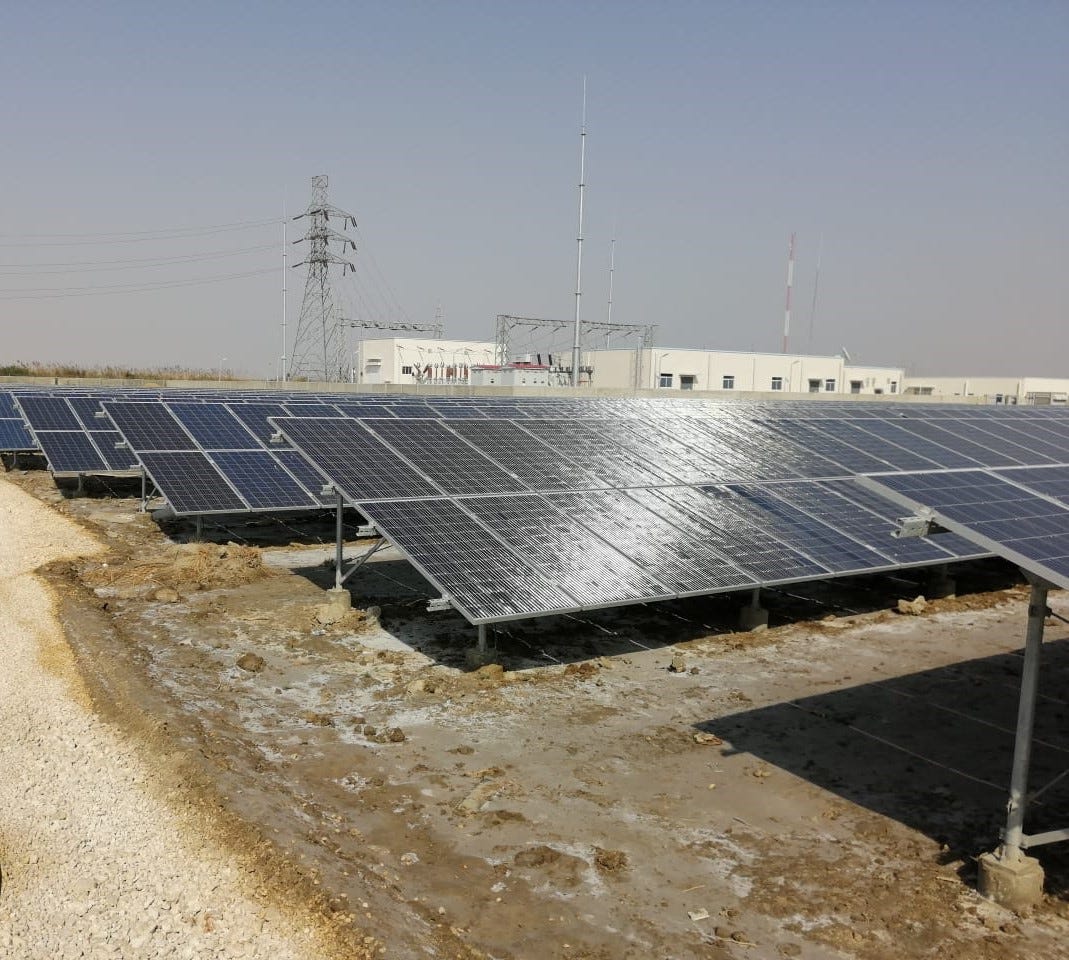
Solar park at Gharo, near Karachi, Pakistan. Credit: شہاب via Wikimedia Commons, CC BY-SA 4.0
First off, a sincere apology for the delay in posting new content. While I strive to put out a new article of One Earth Now roughly once a week, I cannot promise that I will always stick to this schedule. In all honesty, I’ve been struggling a bit these last few weeks in trying to find anything remotely positive or uplifting to report on. The news on the planetary-scale, existential crises that are already underway has been beyond grim – from the UN report “Limiting Overshoot” that officially acknowledges that global heating will exceed the Paris Agreement’s 1.5°C goal, to the hair-on-fire warnings from AI industry insiders that this technology has the potential to wipe out humanity within this decade. Whether we’re talking about catastrophic climate breakdown or rogue AI super-intelligence setting in motion some cataclysmic, humanity-destroying event, it is becoming somewhat harder to imagine that our species has much of a long-term future on this beautiful planet. Or at least, a future that is sustainable and just and one that allows the global population not just to survive, but to thrive.
That doesn’t mean that such a future is impossible or that it’s not worth fighting to try to turn things around. With so much at stake, giving up at this point is foolish and self-defeating. While the forces destroying the world have an enormous amount of money and political power, the other side has the collective power of the masses, or people power. When it comes to climate action, for example, research has shown that the vast majority of people around the world – up to 89 percent – want their governments to do more to address this crisis. And there are many, many people from all corners of the globe who are pushing hard and taking action on climate and environmental sustainability. Some prominent, high-profile folks are recognized here, on The Independent’s Climate 100 List for 2026.
Circling back to the UN report on 1.5°C overshoot, I will say that the report did get quite a bit of press coverage (see here and here, for example), though not nearly as much as the new alarming AI warnings did. But also, and this is evident for those of us who work on climate issues, the fact that global heating is on track to surpass the 1.5°C target isn’t exactly news. This has already been clear for some time. Warnings issued by climate and Earth system scientist have grown increasingly dire over the years – and yet it hasn’t yet led to the kind of systemic and urgent action necessary to avert the worst outcomes. Still, as the report points out, “every fraction of a degree matters.” Actions that are happening today around the world, to build out renewable energy and implement resilient and regenerative agriculture, for example, help prevent greenhouse gas emissions and therefore reduce risks and damage.
The transition to clean, renewable energy is underway, but it needs to go much further and much, much faster. That is the message of a new report released today titled “Delivering on the UAE Consensus: Tracking progress toward tripling renewable energy capacity and doubling energy efficiency by 2030.” As the title suggests, the report examines progress on the goal, established at COP28 in Dubai in 2023, of tripling installed renewable energy capacity and doubling energy efficiency by 2030. There is still a long way to go to reach the renewables goal, even as renewable energy grows at a record pace. As the press release accompanying the report states: “To meet the global target of tripling renewables to 11.2 TW by 2030, installed capacity must more than double today’s levels. Despite a record 693 gigawatts (GW) of new renewables power added in 2025, the annual growth rate would have to accelerate to 1 200 GW on average between 2026 and 2030.”
What is urgently needed is more debt-free financing and support from governments, investors, and the international community to accelerate this transition.
“Energy security is not compatible with fossil fuel dependence,” Anne Jellema, executive director of 350.org, said during a recent webinar. “Governments need to show us the proof of how they will accelerate renewable electrification, make that electricity not only clean but also affordable and accessible for everyone, and turn promises to end fossil fuels into credible, time-bound national plans.”
The webinar, titled “Renewables are Energy Security,” featured frontline stories from people working to implement the renewable energy transition on the ground, from Pakistan and the Philippines to Africa and Brazil.
In Pakistan, for example, Omais Abdur Rehman, of a group called Renewables First, spoke about how the country has deployed 38 gigawatts of solar power since 2018, saving some $12 billion dollars in imported fossil fuel costs. “It was a citizen-led revolution,” he said. “Pakistan’s energy transition is no longer waiting on the government, with households and businesses importing 55 GW of solar and deploying 38 GW since 2018 while battery storage imports surged 220 percent in a single year.”
In the Philippines, Noel Rosal, governor of Albay province, talked about how his community has launched a renewable energy roadmap and strives to meet its goal of reaching 100 percent renewables by 2030.
“Albay is ready to lead, but we cannot do this alone,” he said. “To the global community, to partners and to investors: support Albay not because it is easy, but because it is necessary. That means making green finance directly accessible to provincial and local governments, with simpler procedures and fairer terms. It means democratizing technology, sharing knowledge, transferring skills and building local capacity so renewable energy serves people, not just markets.”
“And it means backing community-led models,” Rosal added. “When communities have a meaningful role in owning and shaping their energy future, they are better placed to protect it and sustain it. Albay has the ambition to deliver a 100% renewable future. What we need now are the tools, resources and partnerships to make it possible and to show the world what a genuinely community-led energy transition can look like.”