

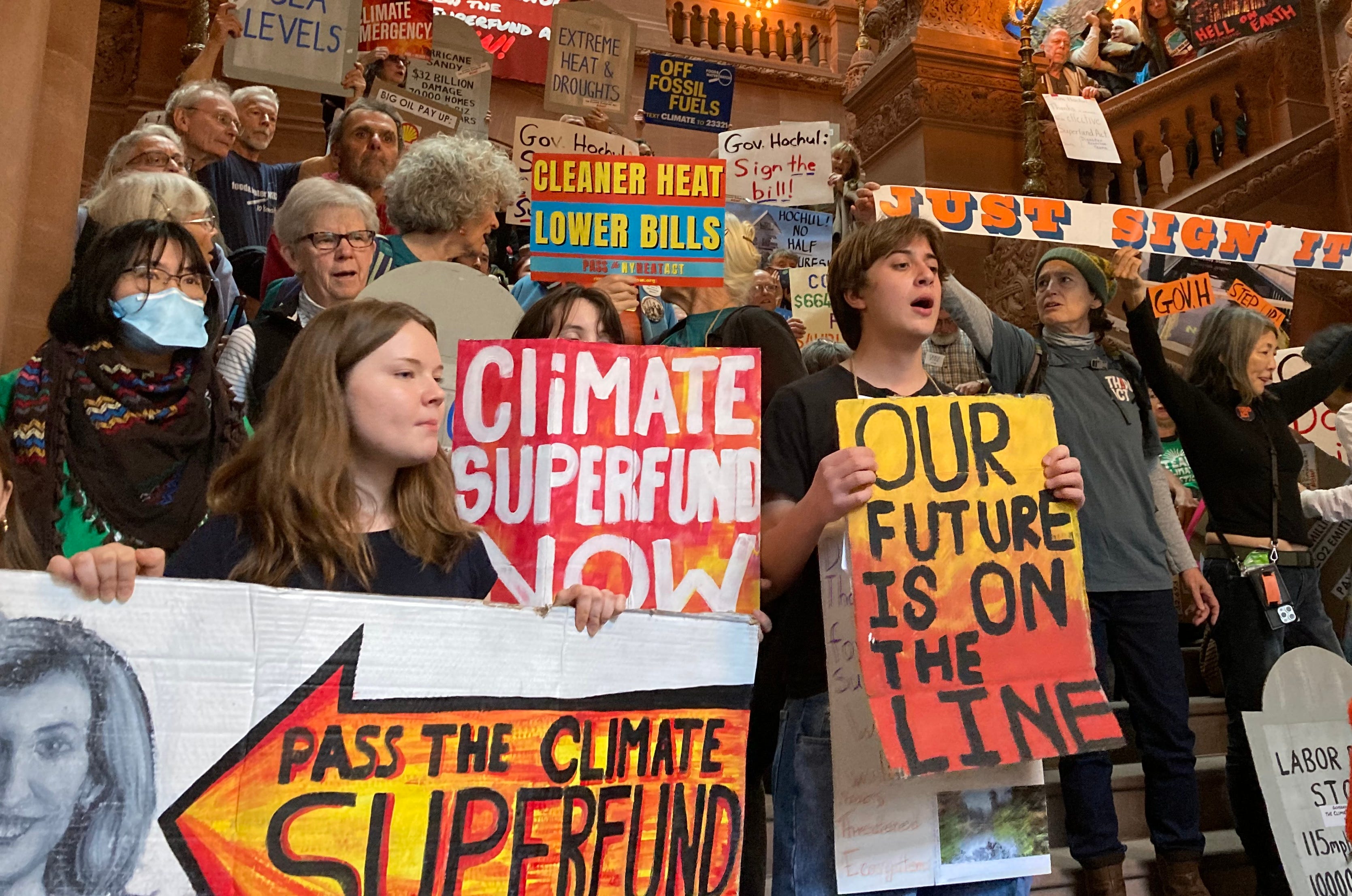
Climate activists rally inside the New York statehouse in Albany, New York in December 2024, calling on Gov. Kathy Hochul to sign the New York climate superfund bill into law. Credit: Dana Drugmand
Story co-published with Climate in the Courts
State efforts to hold major fossil fuel producers liable for their role in driving the climate crisis and to force them to pay for the resulting damage have run into a roadblock with a federal court striking down New York’s Climate Change Superfund Act on Monday. The court’s decision was hailed as a victory by West Virginia Attorney General JB McCuskey and by the U.S. Chamber of Commerce, both of whom led legal challenges aiming to overturn New York’s $75 billion polluter pays climate law.
Those lawsuits, launched in February 2025, alleged that New York’s law was unconstitutional and barred under federal law, arguing that the law acted as a de facto regulation of interstate and global greenhouse gas emissions. West Virginia led a 22-state coalition of Republican state attorneys general, joined by several fossil fuel industry groups, in suing New York state officials to block the law. The U.S. Chamber along with the American Petroleum Institute, the National Mining Association, and the Business Council of New York State, Inc. brought a separate legal challenge that made similar arguments, and the two cases were thus consolidated.
Following a hearing on July 30 during which the court appeared skeptical of New York’s defense of its climate superfund law, Chief U.S. District Judge Brenda K. Sannes of the Northern District of New York delivered her ruling on August 31, finding the state’s law to be invalid. According to the court, New York’s law would effectively regulate greenhouse gas emissions and is therefore preempted by the Clean Air Act, the federal statute that authorizes the EPA to regulate interstate air pollution. The court also found that New York’s law is preempted by the foreign affairs doctrine, since climate change is a problem of global concern.
Sannes indicated that her decision was guided by a 2021 ruling from the Second Circuit Court of Appeals affirming dismissal of a climate tort lawsuit brought by the City of New York against a handful of big oil companies. The Second Circuit held that the City’s state tort claims seeking a damage payment were regulatory in nature and thus preempted by federal law. While some legal scholars have criticized that ruling, fossil fuel industry lawyers have leaned on it heavily in arguing against attempts to impose liability on energy companies, whether through state common law (tort) litigation or through state statutes like the superfund law. That argument, that there is no distinction between a common law claim seeking damages and a state cost recovery statute, resonated with Sannes, who wrote: “there is very little daylight left to distinguish [New York’s] Climate Act from the common-law claims in City of New York.”
New York’s Climate Change Superfund Act, signed into law by Governor Kathy Hochul in December 2024, sought to recover $75 billion from major fossil fuel producers – companies that generated over one billion tons of greenhouse gas emissions between 2000 and 2024. That money would go towards supporting climate change resiliency and adaptation projects in New York. The law left it up to state regulators to determine which companies would have to pay and how much each one owed, a process that was just starting to get underway.
Sannes’ ruling blocks that implementation from moving forward, at least for now. The New York Attorney General Office declined to say whether it plans to appeal, referring a request for comment to the governor’s office and the New York Department of Environmental Conservation (DEC).
In a statement, DEC Commissioner Amanda Lefton, who was a defendant in the legal challenges along with New York Attorney General Letitia James, said that the work of helping New York prepare for and respond to damaging climate change impacts would continue.
“Despite rollbacks in Washington, New York State will continue efforts to help communities become more resilient to severe weather and reduce climate change pollution,” Lefton said. “While we are reviewing the decision and do not comment on pending litigation, we can say that New York will press ahead and work with partners at every level to advance climate action and resilience that delivers for New Yorkers today and for future generations.”
Ken Lovett, senior communications advisor on energy and environment for Governor Hochul, said in an emailed statement: “Taxpayers shouldn’t have to foot the bill for damages caused by polluters. We are reviewing the decision to determine possible next steps.”
Is An Appeal on the Way?
Environmental groups and proponents of New York’s climate superfund law are calling on AG James to appeal the court’s decision, arguing that it is unfair for state taxpayers to shoulder the entire burden of climate change-related costs.
“New Yorkers are footing a massive and growing bill for climate adaptation and mitigation to keep communities safe from deadly floods, fires and heat waves. Big Oil must pay its fair share, relieving the burden from everyday New Yorkers who are suffering the consequences of this industry’s decades of recklessness,” said Food & Water Watch’s senior staff attorney Erin Doran. “We are grateful to Attorney General James for defending this law and we urge her to continue to fight for the Climate Change Superfund Act by appealing this unfortunate decision.”
“What New Yorkers know for sure is that the damages caused by the worsening climate are hammering their wallets and unless this decision is reversed, they will face higher taxes or reduced public services – or both – to the tune of $75 billion,” New York Public Interest Research Group senior policy advisor Blair Horner said in a statement. “NYPIRG urges New York State Attorney General Letitia James to file an appeal, not only to protect the public’s health and wellbeing, but to protect taxpayers too.”
If the ruling is appealed, it will go up to the Second Circuit – the same appeals court that decided that the City of New York’s climate tort case against Big Oil was preempted by federal law, a decision that ultimately influenced Sannes’ ruling.
A statement issued by New York state senator Liz Krueger, a lead sponsor of New York’s climate superfund law, suggests that an appeal is more than likely and asserts that the judges that take it up would be different this time around.
“I have always said that there would be many rounds of legal wrangling before the Climate Change Superfund could begin to provide relief for New Yorkers,” Krueger said. “It is unfortunate that Judge Sannes failed to recognize the clear distinction between a tort lawsuit, which was at issue in the New York City v. Chevron decision, and a state legislature exercising its constitutional powers to raise revenues and protect its citizens. Regardless, this case will now move up to the Second Circuit, where a new panel of judges will have the opportunity to acknowledge the difference between this case and Chevron, or, failing that, to revisit the Chevron decision, which has been widely criticized on both the left and the right.”
Will This Deter Other States?
While New York officials consider their next steps in the battle to defend their climate superfund law, climate accountability advocates say that the fight to make polluters pay for climate damage and adaptation costs will continue.
“Other states should move forward with fair legislation that makes polluters pay for their damage. With the Trump administration gutting climate protections, our campaign for a California climate superfund bill is gaining momentum every day,” said Maya Golden-Krasner, a senior attorney at the Center for Biological Diversity, a group that has supported efforts in California to pass a climate superfund law.
Besides New York, Vermont is the only other state to have enacted a climate superfund law. Vermont was the first state in the U.S. to do so, passing its climate superfund bill in May 2024 following a round of devastating summer flooding the year before. Climate superfund legislation has been introduced in multiple states in recent years, though the legislative momentum seems to have stalled a bit amidst the legal challenges to the New York and Vermont laws. A decision in cases seeking to overturn Vermont’s climate superfund law remains pending.
According to Michael Gerrard, founder and faculty director of the Sabin Center for Climate Change Law at Columbia Law School, the ruling striking down the New York law is not binding on the Vermont court. “But I’m sure the Vermont judge will take it seriously,” he added.
It remains to be seen whether the ruling against New York’s climate superfund law will deter other states from moving forward with their own versions of the legislation. But, as Gerrard pointed out, an upcoming Supreme Court review of a climate tort case brought by Boulder, Colorado against big oil companies could end up foreclosing the approach of state climate superfunds altogether. The Supreme Court’s decision on the preemption question “could well be determinative of the state superfund cases,” Gerrard said.
The Supreme Court is set to hear the Boulder case on October 5.