

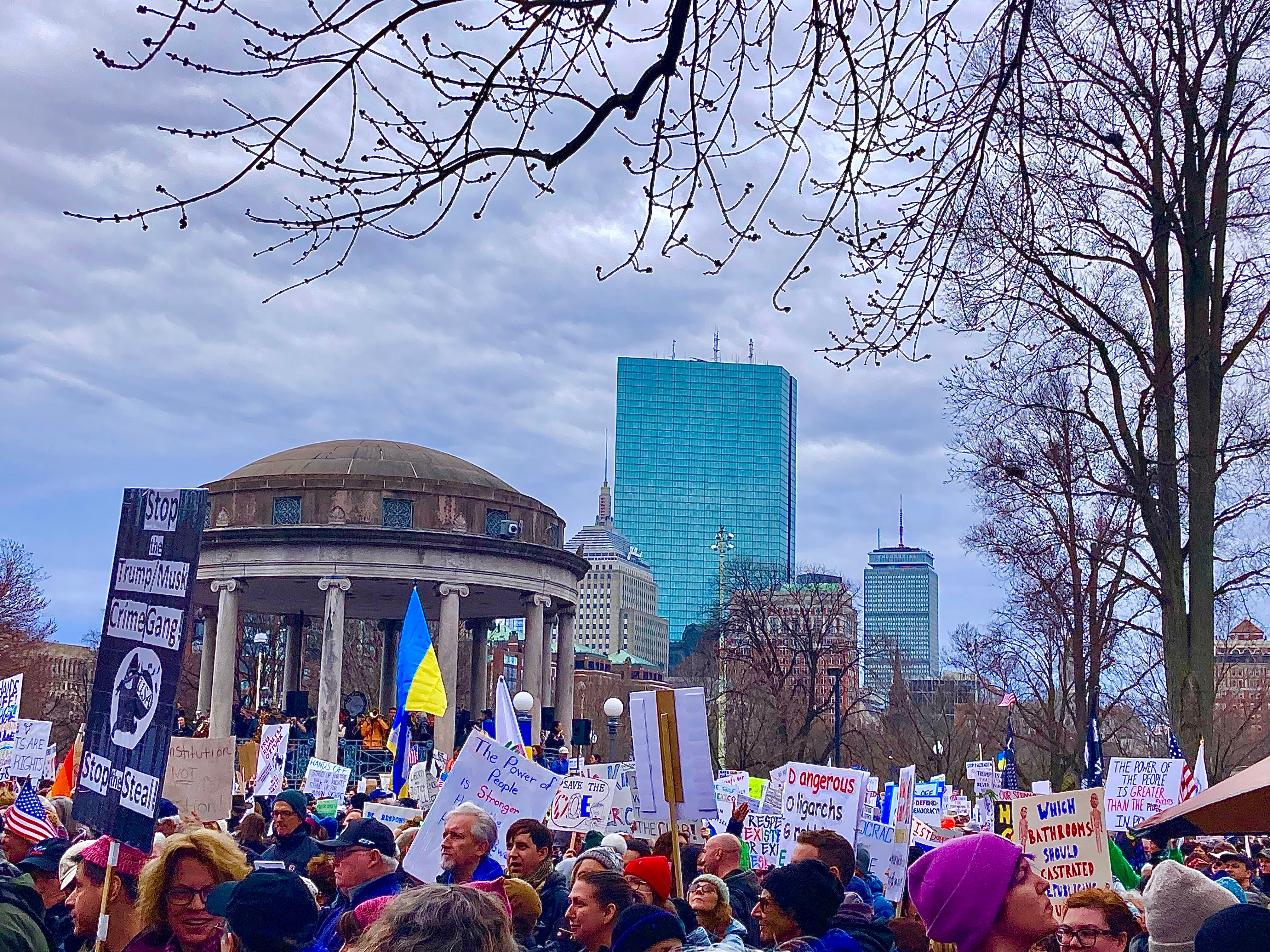
Folks gather in Boston Common for the Hands Off! national day of protest against the Trump administration on April 5, 2025. Millions of Americans took to the streets in displays of “No Kings” democratic resistance over the past two years, culminating in voters’ historic repudiation of Trump and MAGA Republicans in the 2026 midterm election.
It has been a remarkable past two weeks for climate action and accountability, from a seismic electoral rejection of the US climate-denier-in-chief’s politics of cruelty and corruption to significant victories for clean energy and advances for accountability in the courts. And while the struggle of course continues, it is important to acknowledge and celebrate the bright spots – the sparks of hope and signs of progress – especially at a time of accelerating and converging societal crises.
First off, the “blue tsunami” that was the 2026 US midterm election was a clear repudiation of Trump and MAGA’s fascist politics and of the oligarchy and corruption that sees the ultra-rich get even richer while the public pays the price. As Indivisible’s Ezra Levin said in remarking on the election results: “Today the United States joins Hungary, and Brazil, and Serbia, resoundingly rejecting authoritarianism in a national election.”
Climate may not have been a central issue in this election, but the affordability crisis and government corruption certainly were, and climate advocates say these things are all linked. “Americans are struggling with high gas prices, rising energy bills, and mounting climate disaster costs while Big Oil rakes in record profits and spends millions buying influence in Washington,” said Cassidy DiPaola, spokesperson for the Make Polluters Pay campaign. “Trump and Republicans were elected to cut energy costs and instead they cut clean energy,” noted Pete Maysmith of the League of Conservation Voters. “They stuck the American people with the bill while pocketing the profits for themselves and Big Oil CEOs.”
Manish Bapta of NRDC Action Fund, speaking during a post-election presser, said that the corruption and “crony capitalism” that has left Americans footing the bill was “arguably best epitomized by Trump’s collusion with the fossil fuel industry.”
“The Trump administration has worked nonstop to throttle clean energy, even as energy bills soared,” he said. “They declared a wind ban. They grinded renewable energy permitting to a halt. They froze funding to help low-income households get rooftop solar. And they even used taxpayer dollars to buy off companies so they cannot develop offshore wind projects. And instead of relief, they doubled down on the dirtiest and most expensive energy sources. They opened up our public lands and waters to oil drilling. They gave coal plants millions of dollars in federal bailouts. And they even let coal plants and chemical plants email in to get a free pass to pollute.”
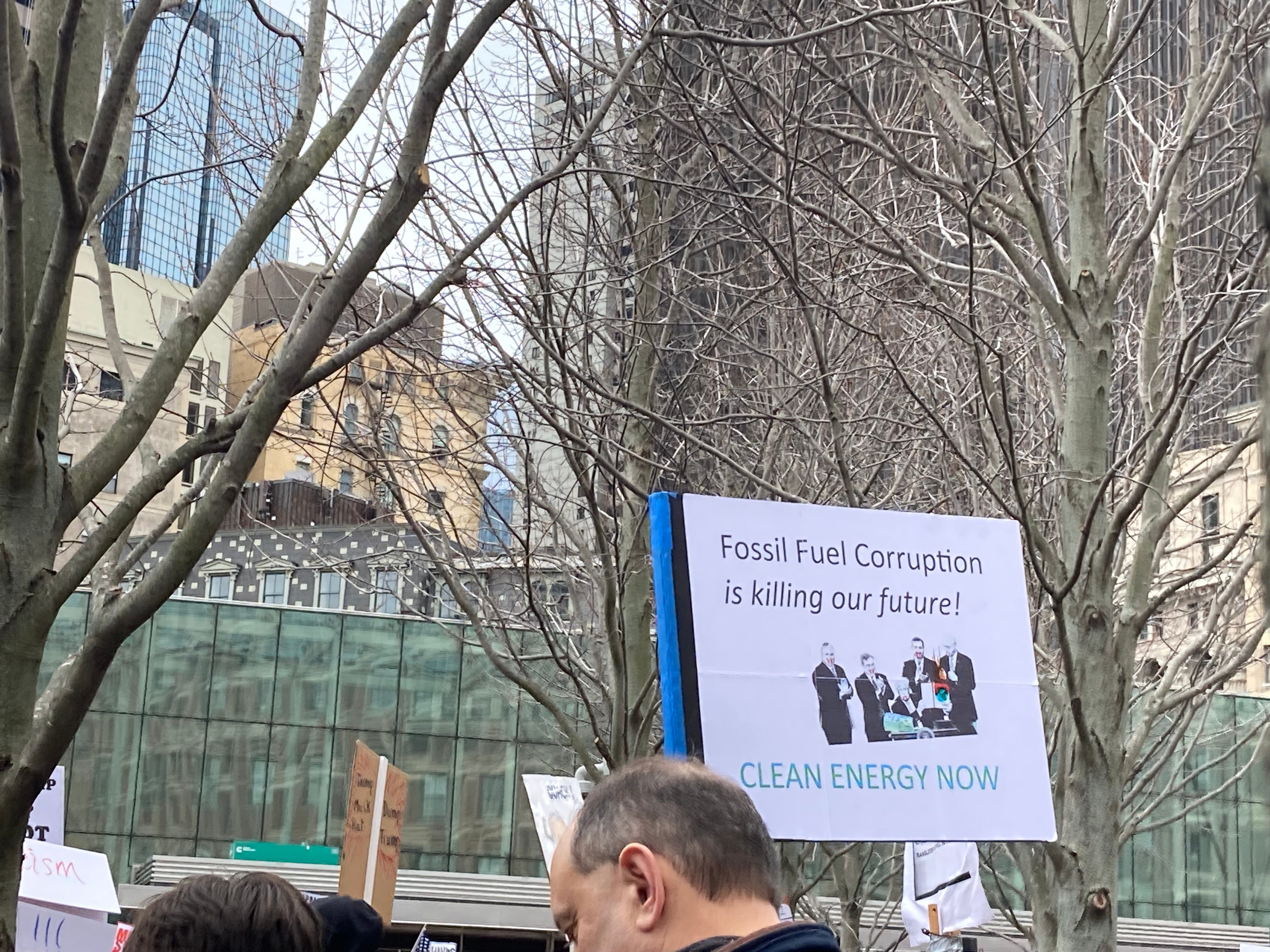
For more on what the election results may mean for climate action, check out this brand-new story I wrote for Sierra. Basically, from what I’ve heard from advocates and policy experts, there seem to be two main avenues for Democrats to advance their agenda. One is at the state level, where Democrats will now be in control of a majority of state legislative chambers and governorships. And with a handful of new trifectas (control of the state legislature and governorship), Democrats are anticipated to be in complete governing control in 23 states. This is where we could see real progress in terms of action on decarbonization and clean energy. As former Washington governor and prominent climate advocate Jay Inslee said: “States can move the ball.”
The other main avenue, at the federal level, is through congressional oversight. That’s not to say Democrats in Congress won’t try to get legislation passed (in the immediate term, it’s looking like there’ll be a fight over the BAAJA permitting bill in this lame-duck Congress). But Trump is expected to veto pretty much anything coming out of a Democrat-controlled Congress. Democrats will have some important leverage on appropriations. Oversight, though, is where Democrats can really start to bring some scrutiny and accountability to a lawless Trump administration and to a slew of industries engaged in alleged corporate malfeasance and profiteering, from Big Tech to Big Oil.
“On congressional oversight, we’d love to see Democrats launch a major investigation into Big Oil’s relationship with the Trump administration, particularly the industry’s political spending, massive windfall profits from the Iran war, and their ongoing efforts to secure special legal immunity,” DiPaola told me. “There are a lot of questions worth asking about how much influence the industry has had over Trump’s agenda and who’s getting rich off his policies. We’d like to see oil executives hauled before Congress to answer some of those questions. I also think this could be a really powerful opportunity for newly elected Democrats who want to make a name for themselves as fighters for working families and against corporate greed -- I mean, what better way to do that than taking on one of America’s wealthiest and most politically connected industries.”
Industry interests seem to be expecting that they will be targeted by Democratic oversight in the 120th Congress. “Energy companies should expect a renewed slate of congressional hearings and investigations, particularly in the House,” the corporate PR firm Edelman wrote in a recent memo warning a number of industries that they should prepare for enhanced congressional scrutiny. Energy in Depth, a blog and communications platform run as a project of the Independent Petroleum Association of America, wrote in a recent post: “Producers should expect oversight hearings on the regulatory rollbacks and on the industry’s ties to the administration.”
New Wins for Offshore Wind
Clean, renewable energy certainly came out as a winner in the election results with many Democratic candidates having ran on platforms that included supporting cheaper, cleaner energy. Inslee said he was confident that Dems who were elected “are going to be really strong champions of clean energy.” Commenting on the election results, Solar Energy Industries Association CEO Tim Pawlenty said in a statement that the solar and storage industry “looks forward to working with newly elected federal and state leaders to bring more affordable, reliable power online and deliver the energy savings Americans are demanding.”
Another win for renewable energy in the US came in the form of operational project milestones for two new commercial-scale offshore wind farms in the New England region. Vineyard Wind – located about 15 miles offshore of Massachusetts’ Martha’s Vineyard island – and Revolution Wind (about 15 miles south of the Rhode Island coast) both became fully operational right around the same time at the end of October. These two projects had already started delivering some power to the grid, but reaching full commercial operation is a notable achievement especially in the face of relentless attacks by the Trump administration. Just last month, Trump’s Department of Justice asked a federal court to allow the administration to reconsider Revolution Wind’s approval, even though the project at that point was fully built.
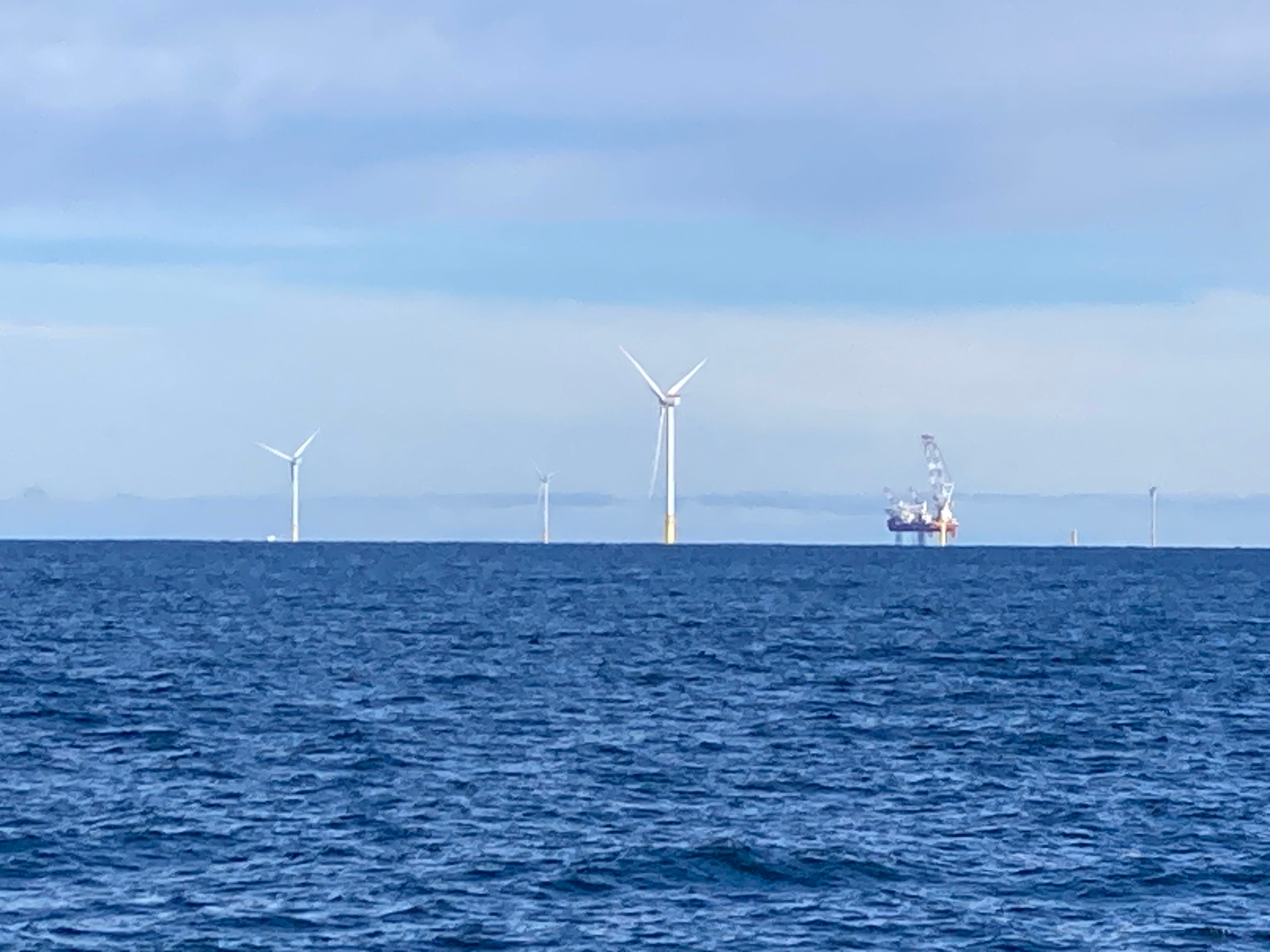
“New England is better off now that we have not one but TWO fully commercially operational projects,” Katie Segal, senior director of offshore wind at Environmental League of Massachusetts, said in a statement. “We are in for a difficult winter and wind will help with costs and reliability.”
Vineyard Wind is a 62-turbine wind farm capable of generating 800 megawatts of clean electricity, or enough to power about 400,000 Massachusetts homes. Revolution Wind is a 704-megawatt, 65-turbine wind farm that is expected to power the equivalent of about 350,000 homes across Rhode Island and Connecticut.
“These clean energy projects create jobs, deliver locally generated power, and help provide an affordable, stable source of electricity at a time when families and businesses are struggling with rising fossil fuel costs,” Conservation Law Foundation staff attorney Anxhela Mile said in a statement.
Polluter Accountability Advances in the Courts
In the courts, plaintiffs fighting for accountability against major polluters notched some recent procedural wins. Just days before the midterm election in which trillionaire Elon Musk – who poured nearly half a billion dollars into Republican candidates – got trounced, a federal court in Mississippi denied a bid from Musk’s company xAI to dismiss a Clean Air Act citizen lawsuit brought by the NAACP challenging the company’s unpermitted operations of gas turbines at its Colossus 2 data center. The ruling came on the heels of the same court rejecting the Trump DOJ’s claim that the administration has the unilateral authority to block the NAACP’s citizen suit under the Clean Air Act.
“The Clean Air Act promises that communities that have been failed by federal, state, and local leaders have the right to go to court to protect themselves from illegal pollution, and this ruling makes it clear that this right cannot be tossed aside simply because a massive corporation finds it inconvenient,” Kym Meyer, litigation director for the Southern Environmental Law Center, said in a statement. “This decision is a victory for communities across the nation, but especially for those in South Memphis and North Mississippi that have been forced to breathe the unlawful air pollution being spewed from xAI’s unpermitted power plant. We will continue to fight to hold the tech company accountable in court.”
Then on Nov. 2, a state court in Oregon denied fossil fuel industry defendants’ motions to dismiss a climate accountability lawsuit filed by Multnomah County against ExxonMobil and other big oil firms and trade associations. The lawsuit, filed in 2023, aims to hold defendants liable for alleged deception on climate dangers and seeks more than $51 billion in damages for past climate-related harms, like the deadly 2021 Pacific Northwest heat dome, as well as for future adaptation expenses.
“The Court validated what we have been saying from day one. This case deserves to be heard on the merits and Multnomah County wants its day in court,” County Chair Jessica Vega Pederson said in response to the ruling from the Multnomah County Circuit Court.
Notably, the court rejected the industry defendants’ federal preemption argument (claiming that the Clean Air Act bars the county’s suit), recognizing that while the case involves interstate greenhouse gas emissions, the alleged wrongdoing is deceptive conduct or fraud. That distinction is important not just to Multnomah County’s case but to the more than two dozen other climate accountability suits pending against Big Oil, including one brought by Boulder County, Colorado that is currently before the US Supreme Court. Oil companies are making the same federal preemption argument in the Boulder case, and if the Supreme Court accepts that argument, it could seriously undermine these cases and make it harder to hold the fossil fuel industry accountable for climate damage. But at least for now, the Multnomah County case is moving forward, as are several other climate deception cases against Exxon and its industry peers.
And finally, there is the landmark climate lawsuit brought by 15 young Canadians against their federal government where a historic full evidentiary trial is currently underway. Over the past week, experts in climate science, economics, climate policy, and international law all testified in support of the youth plaintiffs, many of whom testified themselves the week prior. The Canadian government will start presenting its defense on Monday and is expected to call upon four expert witnesses.
Regardless of how the case ultimately turns out, just having an open trial like this where the climate policies of a national government can be scrutinized, climate science can be brought into the courtroom, and young people can talk about how they are experiencing real harms today, is a big step towards advancing accountability and justice.
Further Reading
Check out my latest published articles:
“What the Midterm ‘Bluenami’ Means for Climate Action and Environmental Protection,” Sierra, https://www.sierraclub.org/sierra/what-midterm-bluenami-means-climate-action-and-environmental-protection
“The Midterms Are Finally Here. So Are Surging Costs and Corruption, Which Remain Top Concerns for Voters,” Sierra, https://www.sierraclub.org/sierra/midterms-are-finally-here-so-are-surging-costs-and-corruption-which-remain-top-concerns
“A Landmark Youth Climate Trial Against the Canadian Government Is About to Begin,” Inside Climate News, https://insideclimatenews.org/news/23102026/a-landmark-youth-climate-trial-against-the-canadian-government-is-about-to-begin/
“Trump Administration Renews Effort to Block the Nearly Completed Revolution Wind,” Sierra, https://www.sierraclub.org/sierra/trump-administration-renews-effort-block-nearly-completed-revolution-wind