

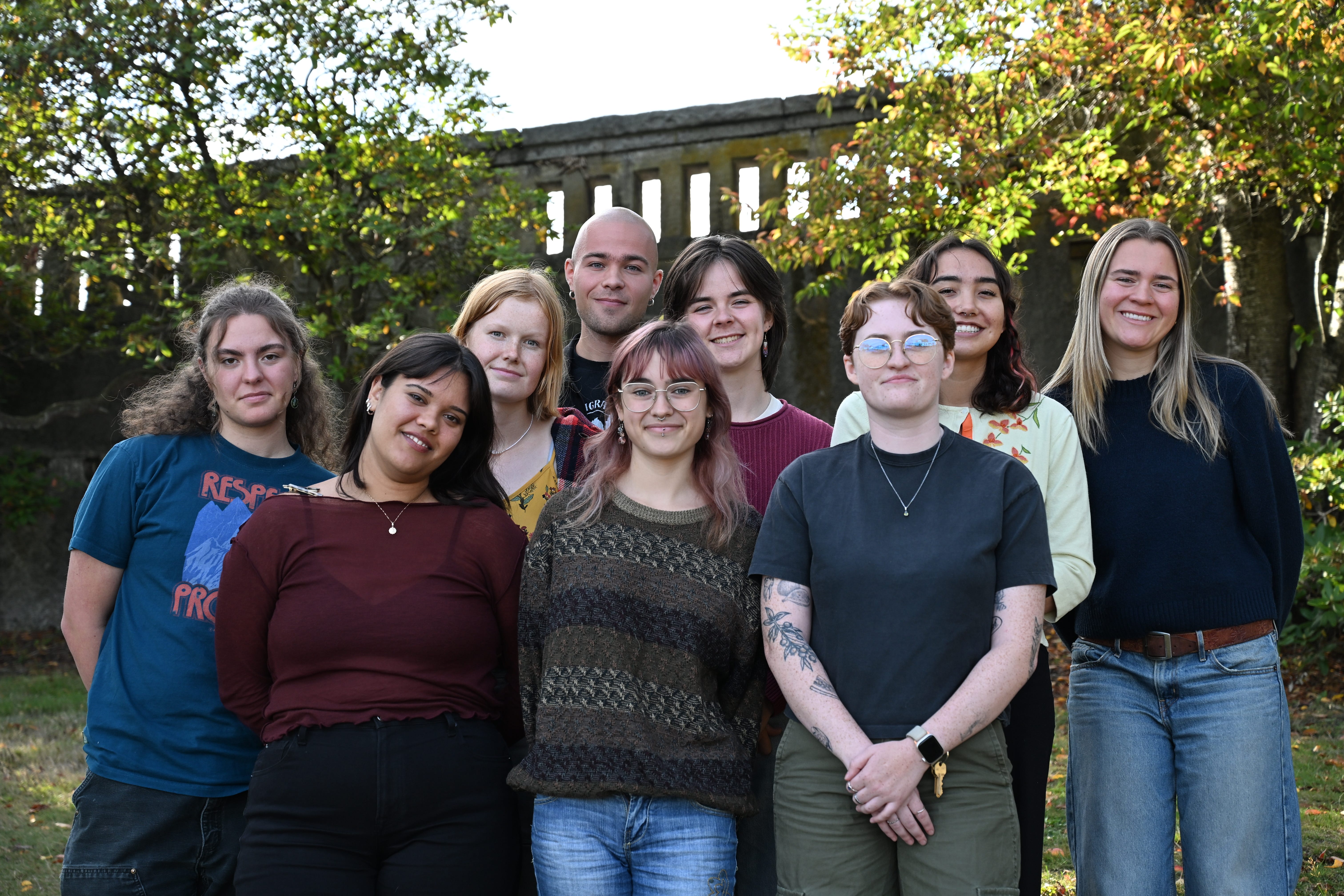
Youth plaintiffs in the climate case La Rose v. His Majesty the King. Credit: Photo courtesy of Our Children's Trust.
Story co-published with Climate in the Courts
A historic climate trial kicked off on Monday at Canada’s Federal Court in Vancouver in a case brought by young Canadians against their federal government over what they say are insufficient climate policies that violate their constitutional rights. It is the first federal youth climate trial in Canadian history, and marks one of the first times anywhere in the world that national government is facing this type of full evidentiary trial in a climate change legal action from youth activists.
The case, La Rose v. His Majesty the King, was first filed in 2019 by 15 children and teens from across Canada who have all directly experienced extreme weather events and adverse health and quality of life impacts linked to a rapidly warming planet. Their amended complaint, lodged in 2024 after the court initially tossed out their original case, challenges Canada’s framework greenhouse gas emissions reduction statute (called the Net-Zero Emissions Accountability Act) and 2030 climate plan. Plaintiffs say these policies enable an emissions trajectory that is incompatible with a stable climate system, in violation of their rights to life, liberty and security of the person under section 7 of the Canadian Charter of Rights and Freedoms. They seek not only a court declaration of rights’ infringement by the government, but also an order for the government to develop and implement a science-based “climate recovery plan” for swift decarbonization.
“This case is about the most fundamental rights of children in Canada,” plaintiffs’ counsel Catherine Boies Parker told the court in her opening statement, “and how those rights are affected by what the Supreme Court of Canada has called an ‘existential threat.’” Parker outlined the legal argument that the government’s conduct – including setting inadequate emissions reduction targets and failing to meet them – contributes to dangerous climate change and thus constitutes breaches of young Canadians’ fundamental rights. Plaintiffs also argue that Canada has an affirmative or positive obligation to take action to protect their constitutional rights in the face of grave climate harms – a novel claim that Canadian courts have not yet grappled with in the context of climate change.
The government contends that it has no such obligation at all. The Canadian Charter, part of Canada’s constitution, “was never intended to solve existential crises,” BJ Wray, counsel for the federal government defendants, told the court.
Wray repeatedly emphasized the global nature of the climate crisis in arguing that Canada cannot solely tackle the problem and eliminate the harms to the young plaintiffs. “It would be impossible for Canada to fulfill the obligation of ensuring a safe climate system on its own,” Wray said. “Climate change is a global problem that can only be remedied with a global solution.”
“The evidence in this case will show the harms are not inflicted by the government,” Wray added, an assertion that was met with skepticism by the judge, Justice Simon Fothergill. “At all?” he questioned in a tone of disbelief. Wray responded by repeating that the climate problem is global, and noted that Canada has been reducing its greenhouse gas emissions over the last 20 years.
Canada further argues that the challenged policy, the Net Zero Act, is not unlawful and does not require specific levels of emissions reductions, nor does it require the government to achieve the targets it sets. “The Net Zero Act is a procedural statute, full stop,” Wray told the court.
The Net Zero Act, enacted in 2021, requires the Canadian government to set periodic targets intended to achieve net-zero greenhouse gas emissions by 2050 and to develop plans for meeting those targets. Canada is nowhere close to meeting its 2030 target of a 40 to 45 percent emissions reduction, and many of the measures in its 2030 plan have been scrapped or weakened under Prime Minister Mark Carney. Climate Action Tracker, a project that assesses countries’ alignment with the Paris Agreement goal for limiting warming to well below 2°C, recently rated Canada’s policies and action as “critically insufficient.”
“The Government of Canada is committed to fighting climate change and reaching net-zero emissions by 2050. As this matter is before the courts, we cannot comment further,” Keean Nembhard, senior strategic communications advisor in Canada’s Office of the Minister of the Environment, Climate Change, and Nature, said in an emailed statement.
Under current global climate policies, Canada is projected to experience 5°C of average warming towards the end of the century, according to the government’s own updated climate assessment report released last month. That level of temperature increase, Parker noted, would be “catastrophic.”
Parker told the court that just because climate change is a huge issue, and one that is inherently political, does not mean that courts should have no role to play. “Courts around the world have concluded they can and must address this greatest crisis of our lifetime,” she argued. She referenced the International Court of Justice’s landmark 2025 climate advisory opinion that affirmed that all countries have stringent due diligence obligations, under existing international law, to reduce their greenhouse gas emissions in accordance with the best available science.
Justice Fothergill expressed interest in understanding how Canada’s international legal obligations should inform its domestic law duties when it comes to climate. The La Rose case is the first of its kind in the world to go to trial following the ICJ’s climate advisory opinion.
“We’re going to see how international law is going to fold into domestic law [on climate change] for one of the first times,” said Kelly Matheson, deputy director of global strategy at Our Children’s Trust, one of the organizations supporting the youth plaintiffs.
“It is going to be a long trial where the evidence is going to be put out in open court, and being able to build that robust trial record is rare in climate litigation,” Matheson added. “There have been other cases around the world that have presented limited amounts of evidence, but not that robust trial record.”
In the U.S., a youth climate lawsuit against the state of Montana went to trial in 2023, and the plaintiffs in Held v. Montana ultimately won their case. That trial, which featured testimony from plaintiffs and experts in climate science, medicine, policy, Indigenous affairs, and the renewable energy transition, ran for a week and a half.
The Canadian trial is expected to run for four weeks, with a closing session slated for February. The format will be similar to the Montana trial, with youth plaintiffs and their experts taking the stand, followed by government defendants presenting their case.
Plaintiff Kira Young was the first to testify on Monday. Young, who grew up in Yellowknife in the Northwest Territories, discussed her personal experience during Canada’s record 2023 wildfire season, including a mandatory evacuation from her home that she described as “terrifying.”
“I worry often about what the future will look like for Yellowknife and the North,” Young said, adding that she is “so scared” that the pain and hardships she talked about are “just the beginning” as the climate crisis rapidly worsens.
The court will hear more testimonies this week from plaintiffs and several of their experts.
Matheson said a decision could come sometime in early 2028. And if the Canadian plaintiffs, like their counterparts in Montana, end up winning, she said it would be highly significant.
“With Canada being a major historic emitter and one of the top producers of oil and gas today, if we’re able to secure a robust win in Canada, which I think we will be able to, that has global implications, both legally and for the fossil fuel sector,” Matheson said.
Climate science is clear that fossil fuels must be phased out to avert catastrophic and irreversible climate consequences. While the court will not require Canada to follow a specific policy pathway, it could order the government to develop a plan guided by climate science, which would seemingly imply that Canada must swiftly transition away from fossil fuels.
“If Canada is judicially required to fast track off of fossil fuels, that is going to have global implications,” Matheson said. “It’s going to set a precedent, or be persuasive, all over the world.”