

Credit: Dana Drugmand
In New England, two commercial-scale offshore wind farms reached important milestones on Friday in a significant step forward for clean, renewable energy at a time when the conflict in Iran is upending global energy markets and exposing once again the painful costs of fossil fuel dependency.
Revolution Wind, a 704-megawatt offshore wind development located roughly 15 miles off the Rhode Island coast, began delivering power to the grid for the first time on March 13, according to an announcement from the developer Ørsted. The project, now over 90 percent complete, is designed to generate enough electricity to power the equivalent of more than 350,000 homes across Rhode Island and Connecticut. It is expected to strengthen grid reliability by bolstering supply at a time of rising demand, and the power will be delivered under a fixed price, 20-year contract with utility companies. A preliminary analysis from Connecticut’s Department of Energy and Environmental Protection estimates that the project, once fully operational, will save ratepayers up to $500 million per year in wholesale energy costs.
“This project is key to diversifying our energy supply and lowering utility costs for families and businesses,” Connecticut Governor Ned Lamont said in a statement.
“As we’ve seen from the harsh winter we’ve had, and the impacts to fossil fuel prices as a result of the Iran war, having diverse sources of stable, reliable power that both perform strongly in the winter and are insulated from geopolitical events is beneficial to Connecticut ratepayers,” said Katie Dykes, commissioner of the Connecticut Department of Energy and Environmental Protection. “These first power deliveries are an important milestone, with greater benefits yet to come as the project heads to completion and full operation later this year.”
Also late on Friday, workers completed the finishing touches on construction of Vineyard Wind – an 806-megawatt offshore wind project located about 15 miles south of Martha’s Vineyard. The project is designed to power the equivalent of 400,000 homes across Massachusetts. Some of the project’s 62 turbines had already been generating power, and as WBUR notes, the completion of construction “is a milestone for the project and the U.S. offshore wind industry, which has faced years of economic and political headwinds.”
Massachusetts Governor Maura Healey applauded the news of the project completing construction, saying in a statement (as reported by WBUR): “The affordable, homegrown power it delivers to Massachusetts residents and businesses will bring costs down as President Trump throws global markets into disarray.”
As Trump wages a new war in the Middle East that is having severe consequences for global oil markets – the International Energy Agency labeled it the “largest supply disruption” in the market’s history – he has also effectively waged war here at home against renewable energy, especially wind power. His escalating attacks on wind energy culminated in a blanket stop work order issued in December on five offshore wind projects under construction along the East Coast, including Vineyard Wind and Revolution Wind as well as Sunrise Wind and Empire Wind offshore of Long Island, New York and Coastal Virginia Offshore Wind off the Virginia coast. All five projects sued the administration over the move and won preliminary relief that allowed construction to resume.
Now the projects are reaching key operating and construction milestones. The Virginia project, which at 2.6-gigawatts would be the country’s largest yet, is slated to start generating initial power by the end of this month, according to the project’s developer.
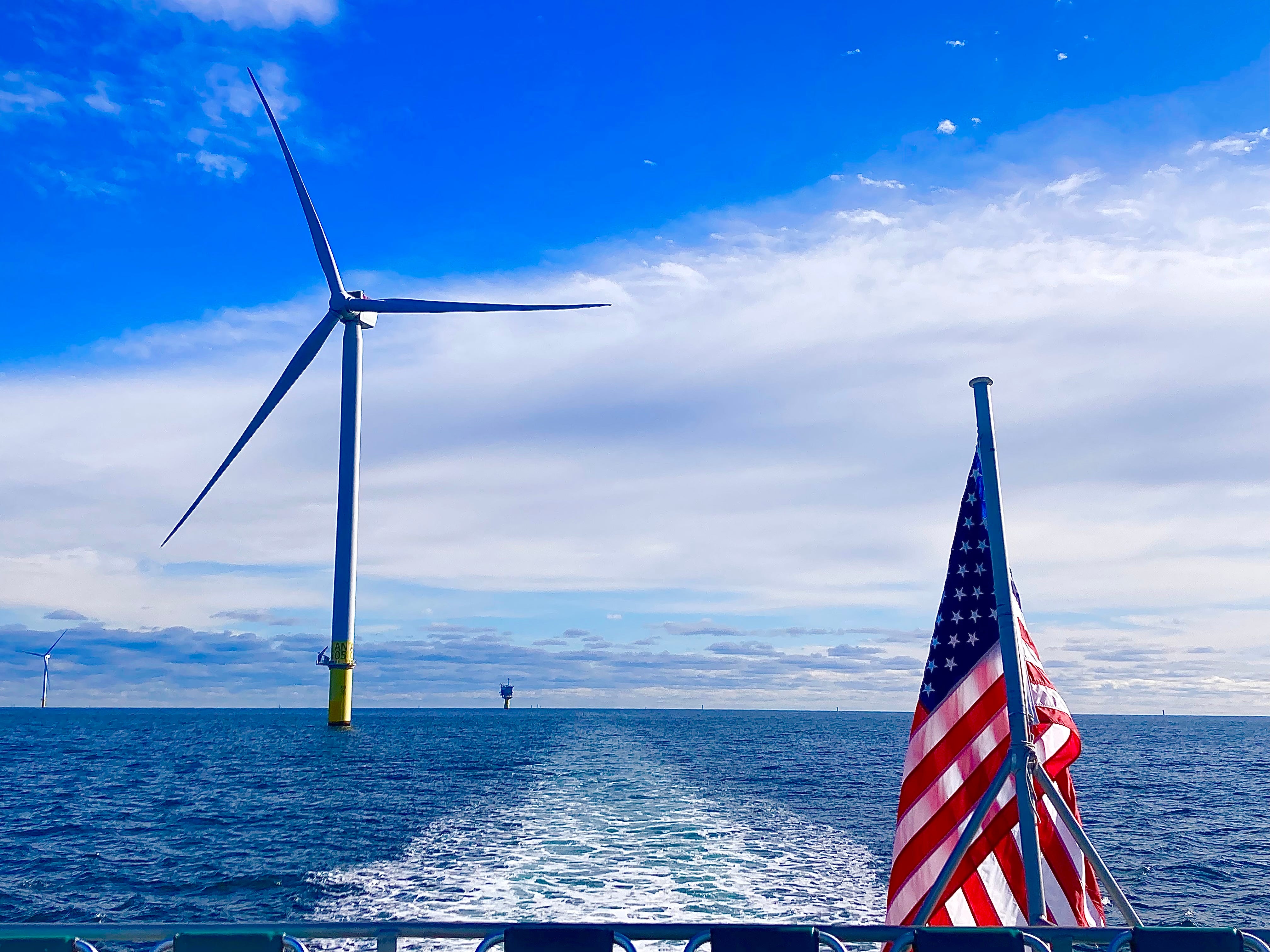
In November I had an opportunity to see an offshore wind project up close – South Fork Wind, the first fully operational large-scale offshore wind farm in the US located south of Rhode Island adjacent to the Revolution Wind project. The 132-megawatt project has been delivering clean power to the Long Island grid for more than a year now, and performance data shows that it is working splendidly, particularly during the cold winter months when wind speeds tend to be highest. In January, for example, South Fork Wind reported a capacity factor of 52 percent, which is on par with New York state’s most efficient gas plants. And during January’s Winter Storm Fern, Vineyard Wind, which was partly operational, had a 75 percent capacity factor according to reporting by Canary. “America’s two utility-scale offshore wind farms performed as well as gas power plants and better than coal in January,” the news outlet said.
In short, offshore wind works.
But the Trump administration is not giving up in its bid to quash this clean power source. It continues to claim that offshore wind poses a national security risk. This unexplained risk was the primary justification the administration used for its blanket stop work order. In commenting on the Revolution Wind project’s milestone of its first delivery to the grid, White House spokesperson Taylor Rodgers told the AP that the administration “looks forward to ultimate victory on this issue.”
“No Embargoes on the Wind”
“Homegrown renewable energy has never been cheaper, more accessible, or more scalable. The resources of the clean energy era cannot be blockaded or weaponized. There are no price spikes for sunlight and no embargoes on the wind.” - UN Secretary-General António Guterres
While the Trump administration points to vague, supposedly classified national security concerns in its war against wind energy, Trump’s inexplicable and illegal war in Iran only further demonstrates that it is actually fossil fuels – not renewables – that pose the greatest threat to global and national security, including energy and economic security.
“Fossil fuels fuel wars,” Nina Lakhani, global climate justice reporter for Drilled, said during a recent press briefing on the topic of the Iran war and climate change. The US Department of Defense (rebranded under Trump as the “Department of War”) is the largest institutional consumer of fossil fuels in the world. And if the global military sector - which the US represents nearly 40 percent of spending – were a country, it would be the fourth largest emitter of planet-heating pollution in the world, responsible for approximately 5.5 percent of global greenhouse gas emissions.
These emissions, as Covering Climate Now’s Mark Hertsgaard explained during the briefing, “drive deadlier heatwaves, droughts, storms and other impacts that wreck livelihoods, that destabilize economies, and spur migration. And all of that makes armed conflict more likely.”
In addition to climate pollution that military operations unleash, the Iran war – like Russia’s war on Ukraine – is disrupting global energy markets and causing price spikes on everything from fuel to fertilizer and food.
As the climate action group 350.org notes: “The price of crude oil has already risen 20% this year, and is expected to spike even more now. In 2022, energy and food price shocks triggered by the war in Ukraine pushed over 70 million people into poverty in the space of only three months, according to the United Nations Development Program.”
“Once again, families will pay the price through fossil fuel-driven inflation: higher fuel costs, rising energy bills, and more expensive groceries as a consequence. All because of a system tied to a volatile, conflict-driven industry,” 350.org managing director Olivia Langhoff said in a statement. The group says these price shocks should serve as a wake-up call on the urgency of transitioning away from volatile fossil energy and toward more affordable and secure renewable power.
“Renewable energy provides home-grown power that remains secure and affordable regardless of geopolitical shocks,” Langhoff said.
UN Secretary-General António Guterres delivered a similar message, calling on countries to accelerate the energy transition as a matter of security.
“The turmoil we are witnessing in the Middle East makes it evident that we are facing a global energy system largely tied to fossil fuels, where supply is concentrated in a few regions and every conflict risks sending shockwaves through the global economy, particularly to the most vulnerable people,” Guterres said in his statement.
“Homegrown renewable energy has never been cheaper, more accessible, or more scalable,” he added. “The resources of the clean energy era cannot be blockaded or weaponized. There are no price spikes for sunlight and no embargoes on the wind.”