

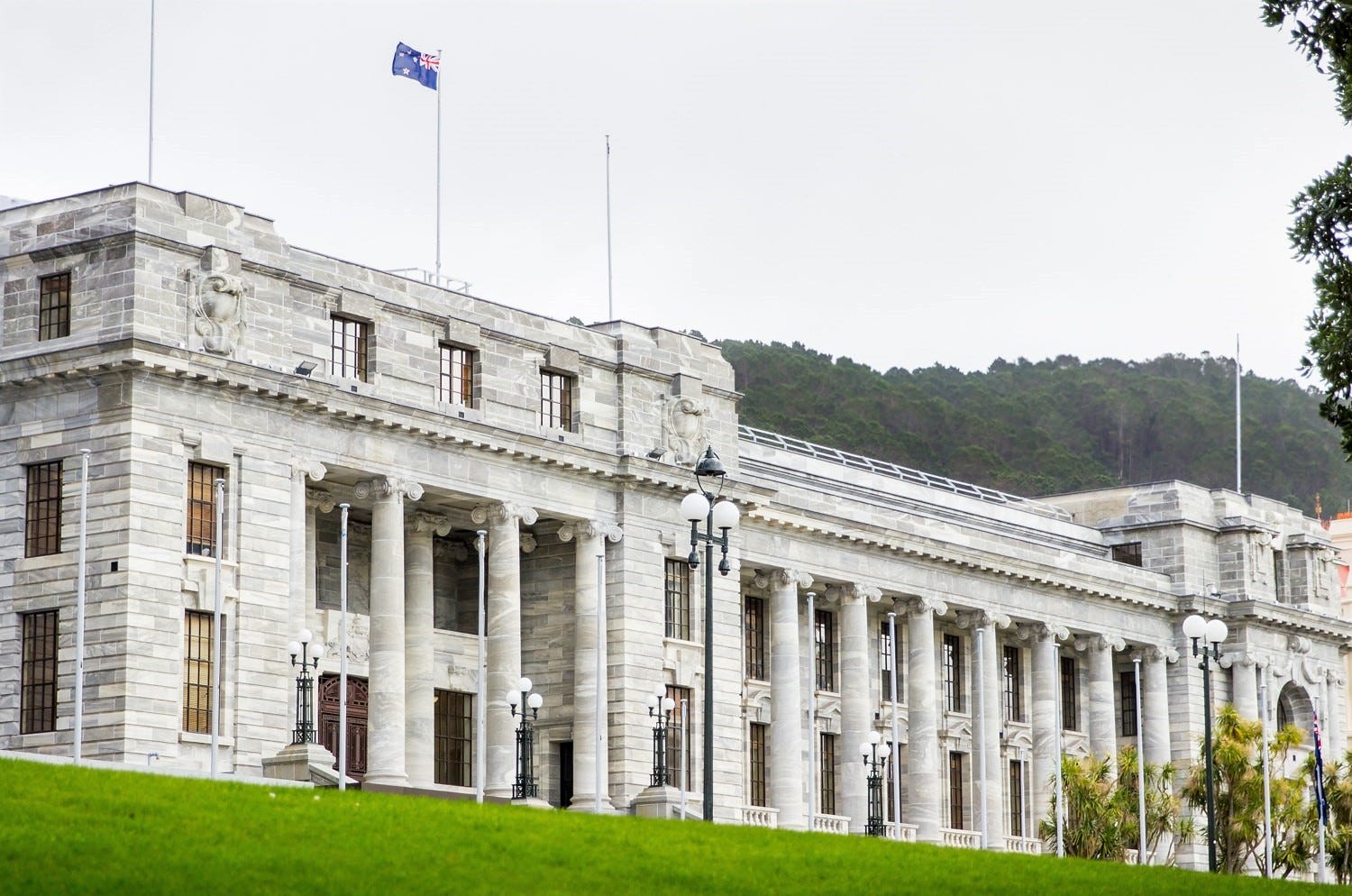
New Zealand Parliament building in Wellington. Credit: Office of the Clerk via Wikimedia Commons, CC BY-SA 4.0
New Zealand has enacted a controversial new law that explicitly prohibits climate change tort liability, effectively shielding major greenhouse gas emitters from being held responsible through the courts for their contributions to climate damage. The move makes New Zealand the first country in the world to institute a national ban on climate tort lawsuits, and it comes amidst mounting legislative efforts in the U.S. to similarly immunize polluters from any prospects of climate liability. The New Zealand liability shield, however, might be short-lived – depending on the outcome of the upcoming November election.
Last week, the New Zealand Parliament passed the Climate Change Response (Tort Liability) Amendment Bill. The bill amends the country’s framework climate change law – the Climate Change Response Act 2002 – to make it clear that matters of addressing greenhouse gas emissions should be resolved by the political branches, not the courts, and that “no person (including the Crown) can be found liable in tort for emissions-related climate change effects.” The amendment also specifically calls out a live climate change tort lawsuit against a handful of New Zealand’s largest emitters that was slated to go to trial next year. With the bill’s passage, that lawsuit is stopped in its tracks.
The suit, Smith v. Fonterra, was filed in 2019 by Māori climate activist Mike Smith against half a dozen large corporate polluters in the agriculture and energy sectors, such as dairy titan Fonterra and petroleum supplier Z Energy. The defendants together account for about one-third of New Zealand’s carbon emissions. Smith’s case, brought under tort claims like nuisance and negligence, sought to hold the companies liable for their emissions that contribute to dangerous climate change.
In 2024, the New Zealand Supreme Court overturned a lower court ruling dismissing the case, finding that Smith had alleged plausible claims that could be adjudicated through the court system. The decision allowed the case to proceed towards trial, which was scheduled to start in April 2027.
In response, the corporate defendants turned to their lobbyists to draft and push through a bill that would block the lawsuit before it could get to a trial. As Smith wrote in a recent article: “Fearing the evidence that would come out in an open courtroom, these big polluters bypassed the public and went straight through the back door to the highest office in the land.” The bill prohibiting tort liability for climate damage, he noted, was “effectively ghostwritten by the polluters themselves.” This lobbying was not disclosed, and it only came to light after the government had announced in May that it planned to make this change to the law.
“Executives from Z Energy and Fonterra had direct access to the Prime Minister’s Office. They handed over private briefing documents suggesting exactly how the law should be rewritten to exempt them from accountability,” Smith wrote in his article. “When investigative journalists and watchdogs asked for these documents under official transparency laws, the Prime Minister’s Office hid them, keeping the corporate collusion secret from the public.”
New Zealand’s right-wing coalition government, its most conservative in decades, has taken a number of steps to roll back climate policies, such as reversing a ban on offshore drilling exploration and weakening a methane reduction target. A recent report from the country’s independent Climate Change Commission warned that, under current policies, New Zealand will not meet its emissions reduction targets.
“The Government says, on the one hand, ‘don’t worry, we have climate legislation’, but, on the other, has consistently acted to weaken that legislation,” Laura MacKay, acting executive director of New Zealand-based Lawyers for Climate Action,” said in response to the passage of the climate tort prohibition bill. “It’s abundantly clear that the current application of New Zealand’s legislative framework means we are highly likely to miss our domestic targets, fail to uphold our international obligations, and leave New Zealanders highly exposed to the impacts of climate change - and now, an accountability lever has been removed before the courts could even test it.”
The government tried to justify its move by arguing that climate lawsuits like Smith’s would create a “parallel and contradictory” regime to the legislative framework established by the Climate Change Response Act. They also said that the litigation was creating business uncertainty.
“The courts are not the right place to resolve claims of harm from climate change, and tort law is not well-suited to respond to a problem like climate change,” Justice Minister Paul Goldsmith said in a statement.
MacKay says that the government’s arguments are baseless. Ministry of Justice officials have acknowledged that there is no evidence that Smith’s case is actually creating business uncertainty, she noted. And the existing climate law, she explained, does nothing to hold polluters accountable for climate damage.
“Without tort liability, there’s no way of allocating responsibility for climate-related harm, which leaves the question of who’s going to be responsible and who’s going to pay,” MacKay said during a July webinar.
Critics of the government’s move say that it demonstrates that the government cares more about protecting polluters and their profits than advancing the public interest.
“This abuse of power – a law change made at the request of Fonterra and Z Energy – is yet more evidence that this Government is little more than a puppet for polluting corporations and industries,” said Greenpeace Aotearoa Programme Director Niamh O’Flynn.
“The effect of this legislation is clear: it would shield major greenhouse gas emitters while restricting the public’s ability to seek justice for climate harm,” ClientEarth CEO Laura Clarke said. “This is a political choice to prioritize short-term private profit over fairness, accountability and the rule of law.”
“Every week brings fresh images of forests on fire, towns underwater and families fleeing disasters that scientists have warned about for decades. The climate emergency is no longer measured in scientific reports. It is measured in funerals, evacuations, destroyed homes and shattered livelihoods,” Smith said in a statement.
“There is a profound moral failure in allowing the companies that have profited from climate pollution to use their political influence to avoid answering before a court,” he added. “Communities are paying the price while powerful corporate interests seek immunity from accountability.”
Liability Shield Efforts in the U.S.
That trend is already evident in the U.S., where the fossil fuel industry and its political backers have been ramping up efforts to shield the industry from climate accountability and litigation. As I reported last fall for Inside Climate News, these efforts are unfolding across multiple fronts, bolstered by a Trump administration that is going all out to “unleash” fossil fuels and protect the industry from any threats of regulation or liability. Trump’s Department of Justice, which recently renamed its environment division as the “energy” division and welcomed a senior lawyer from ExxonMobil onto its team, is currently suing several states over their climate accountability lawsuits and climate superfund laws targeting Big Oil.
The conservative majority on the U.S. Supreme Court could soon deliver a knockout blow to climate tort lawsuits brought (mostly) by state and local governments against fossil fuel companies. The court is slated to hear what’s being billed as a “blockbuster” climate case – Suncor Energy v. County Commissioners of Boulder County – on Oct. 5, in which oil companies are aiming to block Boulder, Colorado’s climate tort lawsuit and all similar cases pending against their industry on the proposition that federal law broadly precludes state law climate claims. “What [oil companies] advocate for is nothing less than a judicially crafted liability shield for the fossil fuel industry,” an amicus brief filed by 19 states led by Colorado and California in support of Boulder argues.
Industry lobbyists have also been active in the halls of Congress and statehouses in pursuit of a legislative climate liability shield. Sen. Ted Cruz (R-TX) and Rep. Harriet Hageman (R-Wyo.) introduced a bill called the Stop Climate Shakedowns Act in April that would grant sweeping legal immunity to the fossil fuel industry, prohibiting climate lawsuits and climate superfund laws. It is framed in even broader terms that New Zealand’s liability shield bill, as it would ban not only climate tort claims but other types of claims like consumer protection brought against energy companies as well. Thus far, the bill has not gotten a lot of traction in Congress, and if Democrats succeed in gaining control of at least one chamber after the November election, it could likely end up just fading away. But the fossil fuel industry, it seems, already has a contingency plan.
It involves passing climate liability shield laws at the state level. Five states – Utah, Tennessee, Oklahoma, Iowa, and Louisiana – have already passed legislation shielding polluters from climate accountability. More Republican-led states could soon follow. The American Legislative Exchange Council (ALEC), an organization that connects corporate lobbyists to conservative state lawmakers, recently adopted a model bill that would essentially ban climate liability and immunize big polluters from legal claims, both civil and criminal. The Center for Climate Integrity, an advocacy group that supports efforts to hold climate polluters accountable, said that this model bill “would put Big Oil above the law.”
Could the New Zealand Law Get Repealed?
What is happening in the U.S. and in New Zealand with this backlash to climate lawsuits suggests that major polluters feel very threatened by the litigation. That is an indication that climate litigation is an important strategy for confronting the forces that are obstructing climate action and profiting from predatory delay. It also underscores the point that political choices, and elections, have consequences.
The battle over climate accountability is nowhere near over. In New Zealand, there is a real possibility that the new law banning climate tort suits will get repealed if a new, more progressive-leaning government gets elected in November. During the July webinar hosted by Lawyers for Climate Action, Smith said he has been in talks with some officials from the Labour Party and had received reassurance that they would reverse the law change if they regain power.
Smith, for his part, said that he is determined to continue his fight for climate justice.
“We’re not dead. We’re feeling strong,” he said. “It certainly isn’t game over.”