

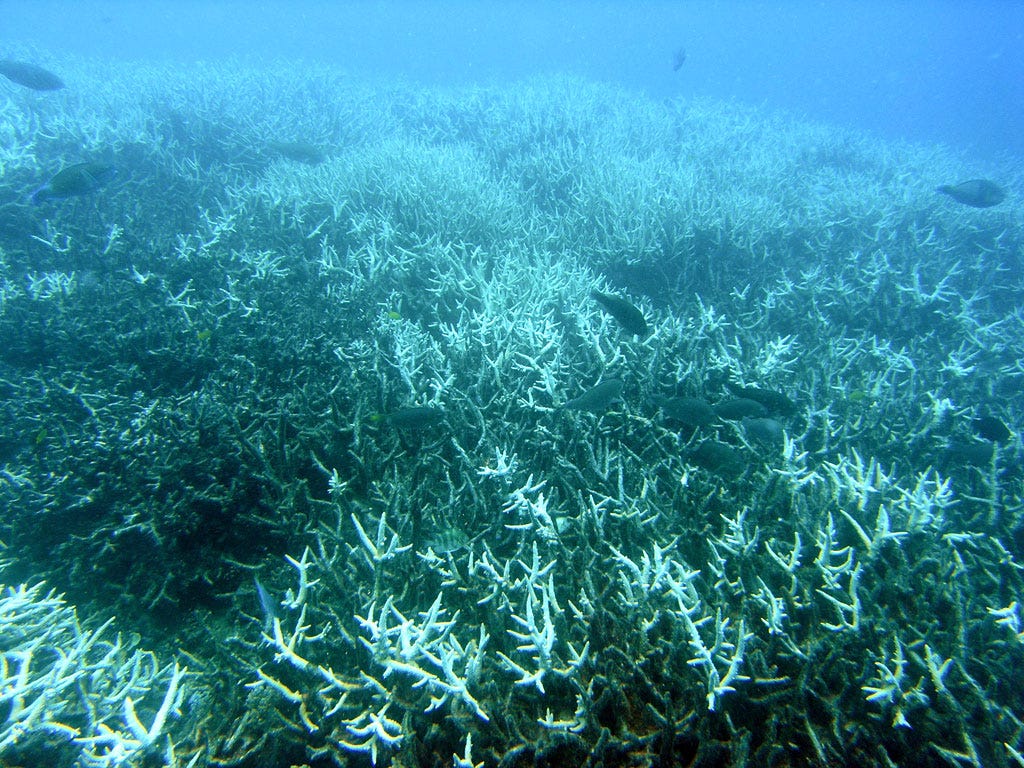
Credit: Acropora at English Wikipedia/J. Roff via Wikimedia Commons, CC BY-SA 3.0
One of the casualties of the fossil fuel-driven climate emergency will be the world’s coral reefs – which are on track to be largely wiped out of existence as the planet continues to heat up. Last October scientists warned that widespread mortality of warm water coral reefs is already underway, following a series of mass bleaching events, and that this coral dieback marked the crossing of the world’s first major climate tipping point. “Warm-water coral reefs have experienced the worst bleaching event on record over 2023-2025 and the central estimate of their thermal tipping point of 1.2°C global warming has been crossed,” the scientific assessment states.
The world has already lost half of its coral reefs, and as the Intergovernmental Panel on Climate Change stated in a 2018 report, “climate change has emerged as the greatest threat to coral reefs.”
Now, a new study has confirmed that climate change is the main culprit responsible for virtually every widespread coral reef bleaching event over the past 40 years.
“Our analysis shows that global warming is the main driver of bleaching and that global coral bleaching simply would not occur without human-caused climate change,” the authors of the study, published in the journal Oceanography, explain.
Bleaching happens when corals expel symbiotic algae (called zooxanthellae) living in their tissues. The algae provide corals with essential nutrients and give them their vibrant colors, so when the algae are expelled due to environmental stressors like heat, the corals turn pale. Elevated ocean temperatures are the leading cause of coral bleaching.
“Without immediate emissions reduction, coral reefs as we know them will disappear.” - Andrew Pershing, Climate Central
Four periods of global mass coral bleaching have occurred in the last 30 years – first in 1998, then in 2010, followed by 2014 – 2017, and then 2018 – 2025. During the most recent period, 84 percent of the world’s coral reefs were impacted, making it the most widespread and severe mass bleaching episode thus far.
That episode, according to the new study, “is entirely due to human-caused warming.” And all of the previous mass bleaching events “had strong fingerprints of anthropogenic climate change.”
Researchers applied a multi-model extreme event attribution method to examine the influence of climate change on sea surface temperatures. They also used a bleaching risk model developed by NOAA’s Coral Reef Watch to study how the temperatures (both observed and a counterfactual) matched up to bleaching risk. This approach allowed them to assess the role of climate change in mass coral bleaching.
Results indicate that anthropogenic warming is the primary driver of the observed mass bleaching, and is a more significant factor in ongoing bleaching risk than El Niño (a natural climate cycle associated with increased ocean temperatures). “Under current warming rates, the effect of rising temperatures due to human-caused climate change will outweigh the impact from El Niño in all coral-containing regions by 2028,” a press release accompanying the study explains.
“Our study shows that without climate change, coral bleaching would be a rare and isolated event, and global mass coral bleaching simply would not occur,” said Andrew Pershing, chief program officer at Climate Central and lead author of the study. “Millions of people and entire countries rely on healthy coral reefs for livelihoods and food security. But our emissions of carbon pollution are causing increasingly widespread damage and death to these vital and vibrant ecosystems. Without immediate emissions reduction, coral reefs as we know them will disappear.”
Tropical coral reefs provide critically important ecosystem services, such as protection of coastlines from storms and erosion and supporting fish that feed a substantial share of the world’s population. Reef ecosystems are home to at least a quarter of all marine species, and around one billion people living in coastal regions around the world depend upon these ecosystems for their livelihoods and food security.
But as the oceans heat up and acidify, absorbing around 90 percent of the excess heat trapped in the climate system by greenhouse gas emissions as well as nearly a third of human-caused CO2 emissions, coral reefs like the Great Barrier Reef face an existential threat.
“Continued emissions and additional warming raise the potential that human actions may soon eliminate coral reef ecosystems as we know them from the planet,” the new study warns.
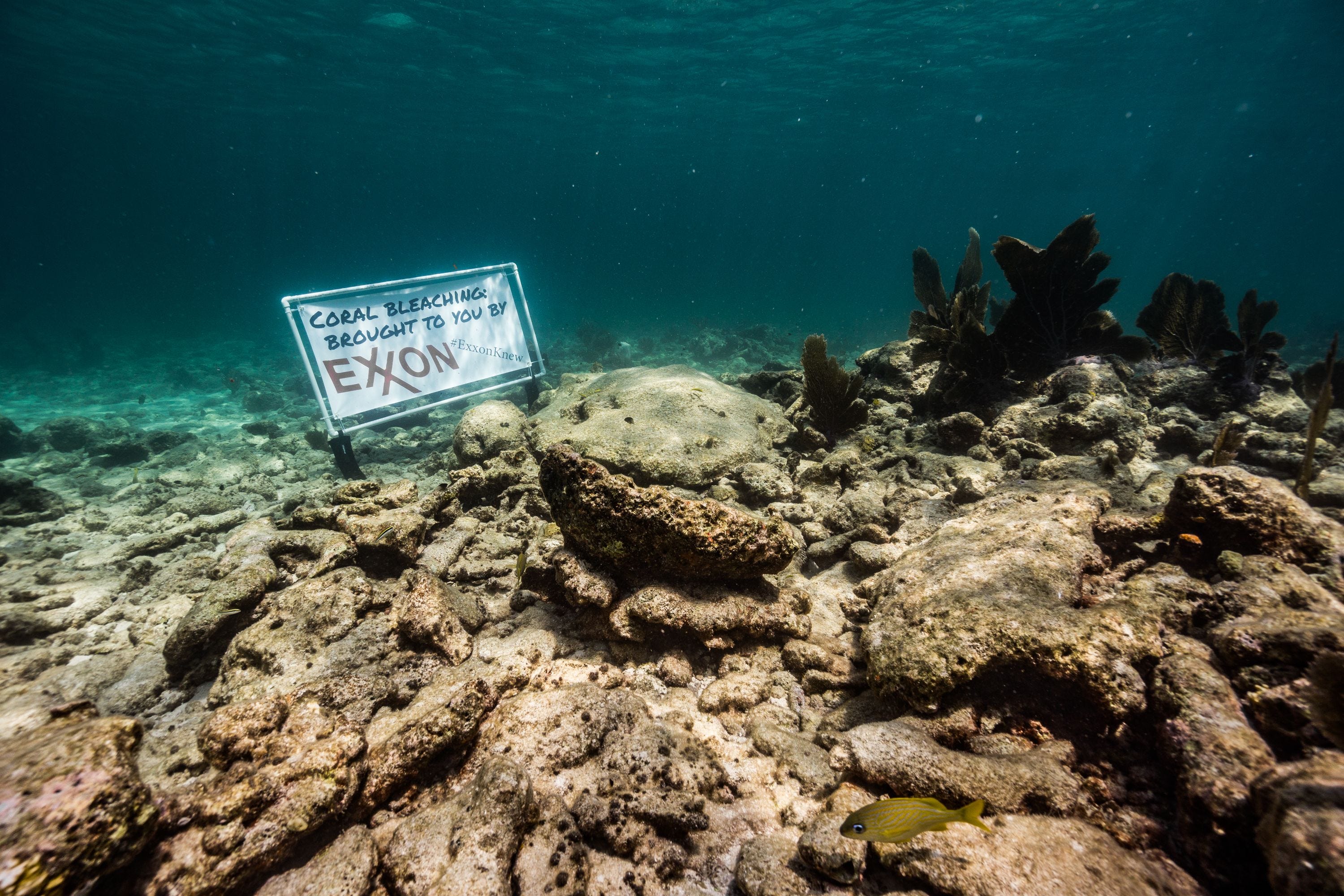
Credit: Frank Gibson, courtesy of 350.org
Climate change, of course, is primarily driven by fossil fuel combustion, with the vast majority of the world’s CO2 emissions traceable to the products and production activities of a relatively small number of entities – the “carbon majors.” They include nation states and state-owned firms as well as investor-owned oil giants like ExxonMobil and Shell.
Investigations and scholarly research have revealed that Big Oil long ago knew about the climate dangers and potential “catastrophic” risks of unchecked use of their products, and instead of warning the public and supporting action to transition away from fossil fuels, the industry promoted climate denial and disinformation.
A recent study from researchers at the Oxford Sustainable Law Programme has now shed some light on what and when major oil companies knew specifically about the harms to coral reefs associated with their hydrocarbon products, and what they did with that knowledge.
“We searched historical documents using a large-language-model-based agent, finding that carbon majors were aware by the 1980s of prospective impacts of fossil fuels on corals from ocean acidification, marine heatwaves, sea-level rise, and intensified storms and later funded efforts downplaying such impacts,” says the study, published last month in the journal npj Ocean Sustainability.
A 1988 internal study from Shell discussing projected impacts of climate change, for example, noted that rising CO2 levels in the oceans would be detrimental for corals and other shell-forming marine organisms. “Dissolution of shells and corals and subsequently local but massive deaths of organisms on a local scale is therefore not unrealistic,” the document states.
In another document cited by the Oxford researchers, scientists discussed the anticipated impacts of increased ocean temperatures on corals during a 1988 climate change conference that was co-sponsored by commercial fossil fuel interests including the American Petroleum Institute. These discussions from that conference, the researchers argue, “illustrate how the petroleum industry had information available by 1988 that global warming from fossil fuels could injure coral reefs by raising average ocean temperatures, increasing the likelihood of marine heatwaves, and causing more frequent and intense tropical storms.”
Yet despite having this advanced knowledge, Big Oil funded think tanks and propaganda campaigns that undermined climate science and downplayed global warming risks, including risks to coral reefs. The study points to a 2012 climate report published by the fossil fuel funded Cato Institute that downplayed the severity of the threats to coral reefs.
“Even decades later, the fossil fuel industry supported public-facing disinformation denying and downplaying the destructive effects of their products on coral reefs,” said Benjamin Franta, study lead author and senior research fellow in climate litigation at the Oxford Sustainable Law Programme.
“As coral reefs around the world are killed by marine heatwaves and other effects of climate change -- destroying ecologies, cultures, livelihoods, and enormous economic value -- the fossil fuel industry’s historical awareness of this global tipping point is increasingly important,” he added. “Already, climate lawsuits are pointing to the devastating impact of global warming on reefs.”
The researchers say their findings could help “inform legal and policy efforts to protect corals, seek compensation for reef damage, and define the liabilities and responsibilities of fossil fuel producers as they cause the collapse of the world’s tropical coral ecosystems.”
I saw effects of this on The Great Barrier Reef in 2012…so much dying coral. 🪸