

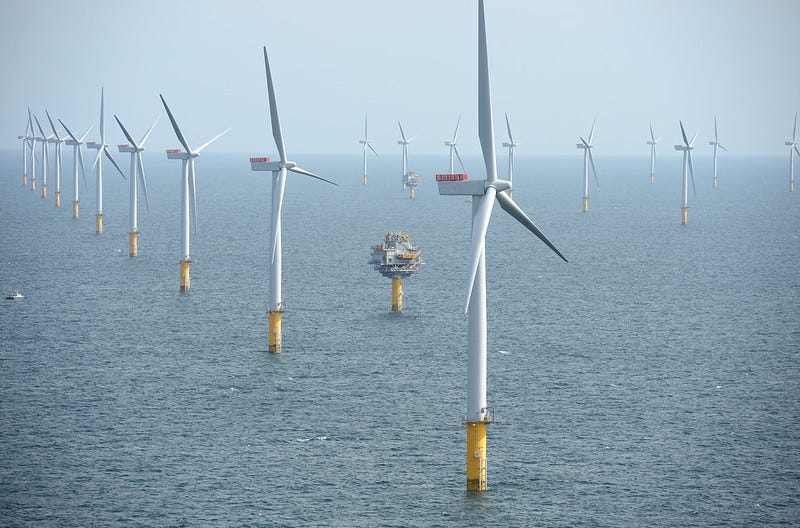
Sheringham Shoal offshore wind farm, a UK wind farm in the North Sea. Credit: NHD-INFO via Flickr (Photo by Harald Pettersen/Statoil), CC BY 2.0
As US President Donald Trump continues to try to shut down wind energy here at home while maligning it on the world stage, Europe is embracing the renewable energy resource as a key instrument for not only decarbonization, but energy security at a time of rising geopolitical instability.
Nine European countries plus the United Kingdom reached what is being called a “historic clean energy security pact” on January 26 to support the buildout of offshore wind in the North Sea and to turn the region into “the largest clean energy hub in the world.” The Hamburg Declaration, signed at the North Sea Summit in Hamburg, Germany, reaffirms a pledge to develop 300 gigawatts of offshore wind by 2050. And it includes a new commitment to deliver 100 gigawatts through “cross-border cooperation projects” that involve grid connections to more than one country.
According to an accompanying Joint Offshore Wind Investment Pact, governments will work together to help de-risk investments and work towards facilitating up to 15 gigawatts per year of offshore wind development between 2031 and 2040. The offshore wind industry in turn is committing to driving down the cost of electricity from offshore wind by 30% while mobilizing 1 trillion Euros in economic activity for Europe and creating 91,000 additional jobs.
Danish energy company Ørsted, a leading developer of offshore wind, called the deal a “giant leap towards powering Europe with renewable, reliable, and cost-competitive electricity.”
“By turning targets into turbines, the pact will boost European energy security, competitiveness, and decarbonization,” Ørsted said. “Today, 58% of EU’s energy is imported. With the pact to help secure 300 GW of offshore wind in the North Sea, the offshore wind industry – which already employs around 100,000 people across Europe – is set to help save Europe around EUR 70 billion on fossil fuel imports, cut electricity prices, and reduce European carbon emissions by 15%.”
The countries supporting this landmark offshore wind deal include Germany, Belgium, France, Ireland, Iceland, Luxembourg, Denmark, the Netherlands, and Norway, plus the United Kingdom.
European officials say the deal is a key step towards strengthening their energy security and reducing dependency on volatile fossil fuels, including imports that are controlled by authoritarian regimes, whether that is Russia or, now, the US.
“We are standing up for our national interest by driving for clean energy, which can get the UK off the fossil fuel rollercoaster and give us energy sovereignty and abundance,” UK Energy Secretary Ed Miliband said in a statement.
Politico reports that the EU is now looking to reduce its reliance on imports of US liquified natural gas given Trump’s threats to take over Greenland.
“In these turbulent geopolitical times, Europe must stand strong and united — and choose independence,” EU Commissioner for Energy and Housing Dan Jørgensen said at the North Sea Summit. “That means doubling down on clean, safe, home-grown energy. It means building on our natural strengths, and few are greater than the North Sea and its vast offshore wind potential.”
By forging ahead with offshore wind in the North Sea, the EU and the UK are defying Trump. The US president has urged the UK to abandon its clean energy pursuits and instead double down on North Sea oil drilling. During his recent speech at the World Economic Forum in Davos, Switzerland, Trump repeated his attacks on wind energy. “There are windmills all over Europe,” he said. “There are windmills all over the place, and they are losers.”
Having seen wind turbines up close myself, I would tend to disagree with that claim. As One Earth Now previously reported, the one fully operational, commercial-scale offshore wind farm in the US, called South Fork Wind, is performing exceptionally well. A handful of other offshore wind projects on the US East Coast are being built and due to come online soon, despite the Trump administration’s dogged attempts to try to stop them. Following a December order from Trump’s Department of Interior to halt construction on five offshore wind projects, courts have now allowed four of them to resume construction, and the fifth project could get the go-ahead from a court on Monday.
Trump can try to bully other countries into clinging to fossil fuels and can try to thwart the energy transition here and abroad, but he cannot stop it. In the US, the Energy Information Administration reports that utility-scale solar is the fastest growing source of electricity, and projects that the combined share of generation from solar and wind will rise from 18% in 2025 to 21% in 2027. In the EU, meanwhile, wind and solar generated more electricity than fossil fuels for the first time in 2025, according to Ember.
“The next priority for the EU should be to put a serious dent in reliance on expensive, imported gas,” said Beatrice Petrovich, senior energy analyst at Ember. “Gas not only makes the EU more vulnerable to energy blackmail, it’s also driving up prices.”
By committing to develop offshore wind in the North Sea, the EU could be starting to make such a dent.
Climate advocates praised the move.
“The Trump administration may be doing everything it can to keep the fossil fuel ‘rollercoaster’ going, but people are no longer buying tickets. Some European political leaders are beginning to recognize that energy security and economic stability won’t come from oil and gas, but rather, a renewable energy system that can lower electricity bills and can’t be switched off by dictators or disrupted by global conflicts,” said Clémence Dubois, 350.org global campaign manager.
“This isn’t just about switching energy sources” Dubois added, “it’s about ending a rigged system where fossil fuel companies pocket the profits and the public picks up the bill through higher energy costs, climate disasters, and government handouts.”
I wish the U.S. would strive to innovate with the rest of the world rather than do everything in its power to worsen the economic life, security, and health of its people.