

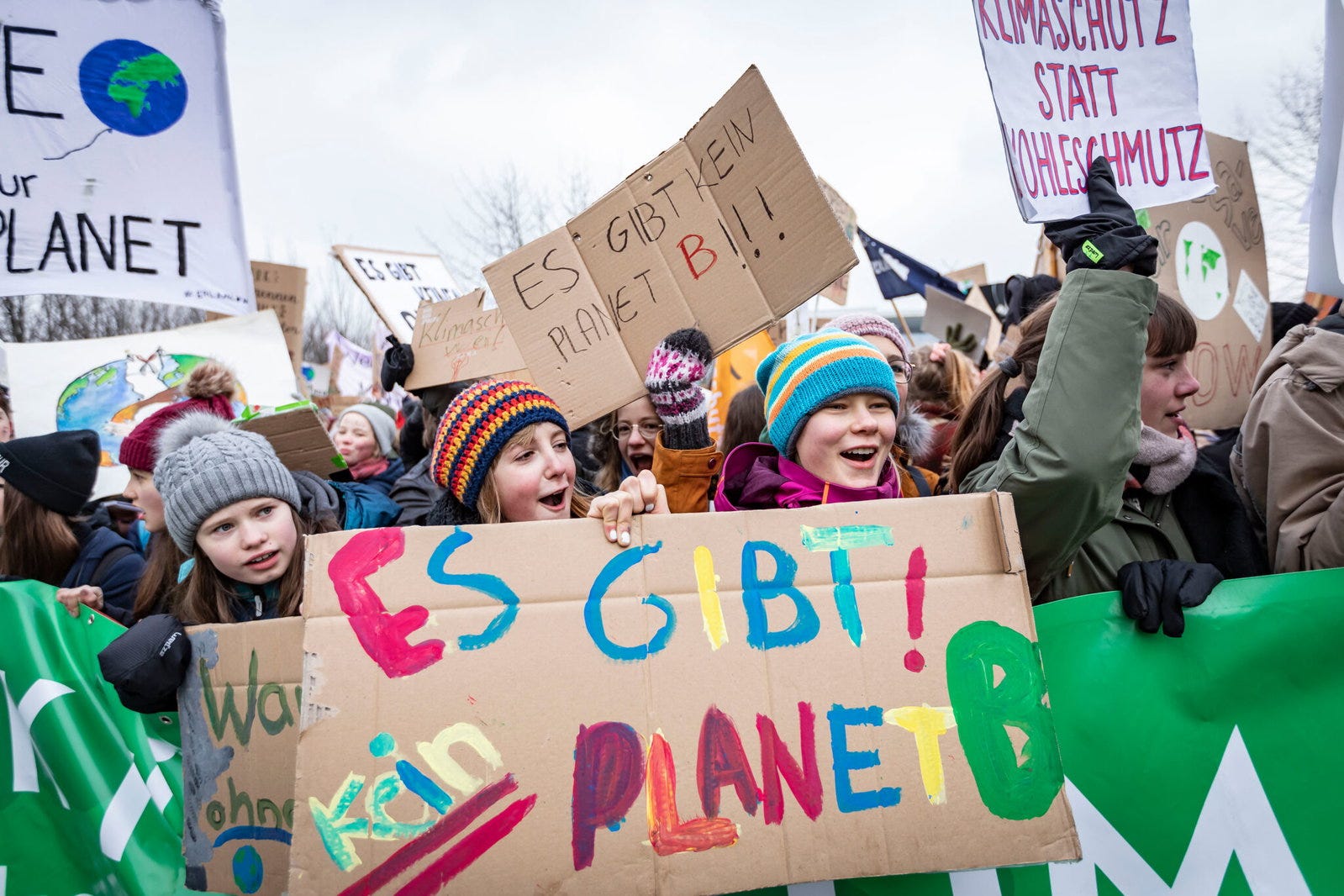
Children at a Fridays for Future protest in Germany demanding climate action. Credit: Jörg Farys / Fridays for Future, CC BY 2.0
Over a billion children across the globe – or nearly half of the world’s children – are exposed to at least three overlapping climate hazards like extreme heat, drought, fires, floods, and tropical storms. And almost every child is vulnerable to at least one of these dangers.
That’s according to a new report released this week by UNICEF – “a report which should serve as a wake-up call to world leaders,” as the UN agency’s executive director Catherine Russell writes in the foreword. The Children’s Climate Risk Report maps children’s exposure to eight climate change hazards and reveals for the first time where they are most at risk and how overlapping threats are affecting them, threatening their health, safety, education, and even their lives.
“The lives of children continue to be upended by the impact of heatwaves, wildfires, droughts, and floods. Half of the world’s children are now living with at least three overlapping climate threats shaping their daily lives,” Russell said in a press release.
The impacts are not distributed equally as children in poorer countries, especially in the Global South, are generally most at risk. “In the Sahel region of Africa, one of the hardest hit, more than 4 million children face the triple threat of heatwaves, extreme heat, and sand and dust storms, while in countries across Asia, for example Bangladesh, Myanmar, and Pakistan, children are exposed to more climate hazards at once and at a higher intensity than anywhere else in the world,” the press release states.
Children in high-income countries may also be exposed to climate dangers too, of course. Nowhere on Earth is truly safe at a time of accelerating climate breakdown.
“This is not a warning of what is to come. It is a recognition of our current reality. And an acknowledgement of how much worse it could get for children,” UNICEF’s Tom Slaymaker said at a press briefing on Tuesday in Geneva. “Children have done the least to cause the climate crisis, yet they are paying the highest price.”
The report also examined children’s exposure to vector-borne diseases like malaria and air pollution, risks that are compounded by climate change. According to the data, around one billion children are vulnerable to malaria, and 2.3 billion or almost all children live in areas with polluted or unhealthy air.
So over 2 billion children, or nearly every child on Earth, is exposed to at least one climate change hazard and to detectable air pollutants. That is the reality and consequence of a global economy powered by dirty fossil fuels.
While politicians delay meaningful action to address this crisis, or in the case of the Trump administration deny that it’s even happening, “fossil-fuel pollution keeps accumulating in the atmosphere like a metastasizing cancer,” William Becker, a former Department of Energy official and executive director of the Presidential Climate Action Project, writes in a recent opinion piece in The Hill.
“Our failure to get global warming under control is the greatest betrayal that any generation has ever imposed on its children,” Becker says. “We are letting oil oligarchs get rich by robbing our children’s future.”
Youth Turn to the Courts
For years, children and young people have been at the forefront of the climate justice movement. They have gone on strike and marched in the streets, lobbied elected officials and organized to change the politics on this issue, and sued their governments and campaigned to get the world’s highest court to weigh in.
The latter campaign led by Pacific Island Students Fighting Climate Change culminated in the International Court of Justice delivering a historic advisory opinion last year, unanimously affirming that climate action is not a political aspiration or option, but a legal obligation. All countries are required under multiple sources of existing international law to do their utmost to reduce greenhouse gas emissions and to protect the climate system from further ruin. Last month the UN General Assembly voted on a resolution endorsing the court’s opinion, and an overwhelming majority – 141 countries – voted in favor of it. Only eight countries voted against it. The United States was one of them.
The US government has for decades actively supported the fossil fuel industry and its dominance over the energy system while rejecting any notions of legal responsibility or liability for being the world’s largest historical emitter of carbon pollution that is driving the climate emergency. That pattern has persisted regardless of whether a Democrat or Republican has occupied the White House. Gus Speth, a prominent environmental and systems change advocate who served as chair of the Council on Environmental Quality during the Carter administration, calls it “the greatest dereliction of civic responsibility in the history of the Republic.” As he writes in his book They Knew: The US Federal Government’s Fifty-Year Role in Causing the Climate Crisis: “And it is worse today than ever. This shocking historical conduct, government malfeasance on a grand scale, has left current and future generations enormously vulnerable to substantial danger.”
Speth’s book was published in 2021, before the disastrous trainwreck that is the second Trump administration, and it documents the actions of more than a half dozen presidential administrations to perpetuate the fossil fuel system despite their knowledge of the calamitous climate consequences. The book constitutes the expert witness report Speth submitted backing the 21 young Americans who sued the US government over climate change in the landmark Juliana v. United States case.
Juliana alleged violations of the US Constitution and was as much a civil rights case as it was a novel climate lawsuit. The case never made it to trial despite repeated rulings from the trial court judge that allowed it to proceed towards that stage. In fact, it was just days away from a trial in 2018 when the government lodged an emergency request to the Supreme Court to intervene, which the court did by temporarily pausing the case and derailing the trial.
The procedural roller-coaster of Juliana is too complex to detail here. Basically, the first Trump administration went out of its way to stop it, filing an unprecedented number of emergency appeals until the courts finally gave in; the Ninth Circuit Court of Appeals issued a 2-1 decision in January 2020 that the case should be dismissed. But after the trial court tried to revive the case, it was the Biden administration that put the final nail in the coffin in continuing the unprecedented obstruction of its predecessor.
Last year the young plaintiffs and their attorneys petitioned the Inter-American Commission on Human Rights to take up their case, arguing that the US government’s longstanding conduct is a violation of international human rights law. That petition is still pending.
“Courts Cannot Keep Slamming the Doors on Us”
Meanwhile, several of the Juliana plaintiffs along with ten of the youth activists from the successful Held v. Montana climate case and other young Americans brought a constitutional climate lawsuit against the second Trump administration. But unlike Juliana which lasted for ten years, this case has been swiftly dismissed by federal courts.
Lighthiser v. Trump, filed on May 29, 2025, challenged three executive orders issued by President Trump that are intended to “unleash” fossil fuels, undermine renewable solar and wind energy, and suppress climate science. The district court judge held a hearing in September that featured live testimony from a few of the youth plaintiffs and their expert witnesses. And although the judge acknowledged the harms that the executive orders would inflict upon young people – calling climate change and fossil fuel exposure a “children’s health emergency” – he still dismissed the case because of the precedent set by Juliana (holding that courts cannot supervise government energy policy and remedy sweeping climate change injuries).
“Our government cannot treat our lives as an acceptable price for its fossil fuel agenda. And the courts cannot keep slamming the doors on us while it opens them to the fossil fuel industry to protect its profits.” - Eva Lighthiser, lead plaintiff in Lighthiser v. Trump
The Ninth Circuit Court of Appeals, the same court that established this precedent, unsurprisingly upheld the dismissal in a ruling earlier this month. In an unpublished opinion, the court said that the link between Trump’s executive orders and the plaintiffs’ alleged harms is “too speculative” – a statement that attorneys for the youth say ignores the evidentiary record that even the district court recognized.
“Not only is the court ignoring and turning a blind eye to the evidence before it – it’s turning a blind eye to the reality that we’re seeing every single day,” said Nate Bellinger, a senior staff attorney at Our Children’s Trust.
Given that federal courts, especially the Ninth Circuit, have repeatedly slammed the doors shut on youth bringing climate-related challenges against the government, I asked him if this pattern suggests there is a larger problem with the courts protecting the status quo and powerful interests.
“It does seem like the courts are more interested in protecting business interests than the rights of children and youth,” Bellinger answered. “It’s contrary to the very purpose of our Constitution, and I think it’s also grossly unjust.”
“We are heartbroken. We are outraged,” lead plaintiff Eva Lighthiser said in a recent commentary piece published in the Daily Montanan. “To grow up safely in a livable climate is not a political preference. It is the foundation on which every other right depends. Our government cannot treat our lives as an acceptable price for its fossil fuel agenda. And the courts cannot keep slamming the doors on us while it opens them to the fossil fuel industry to protect its profits.”
Avery McRae, a 20-year student at Eckerd College in St. Petersburg, Florida, was a plaintiff in both the Juliana and Lighthiser cases against the federal government. She told me that she is feeling “pretty rageful” and frustrated. “I’m trying to use the anger to fuel my activism and to fuel my motivation to continue,” McRae said.
“With the Juliana case we were before multiple panels of judges, and we were in the courts for ten years,” she added. “Even though we didn’t go to trial, there was still for me a sense of accomplishment just with the longevity of our case. With this [Lighthiser] case it feels like it is being so strongly dismissed early on.”
Bellinger suggested that the US government is afraid to face the evidence and climate science in a court trial setting.
“The government is just fighting so, so hard to keep these cases from getting to the merits,” he said. “Because I think they know they lose once the evidence comes out. Like we saw in Held v. Montana when we got to trial and got a chance to present the evidence, it was an overwhelming win for the plaintiffs. So [defendants’] only chance to defeat these cases is to prevent the evidence from coming out.”
“We’re going to keep fighting, keep telling the stories of these courageous youth, and do everything we can to bring this evidence to the courtroom to get decisions and recognition of these youths’ rights that are being violated,” Bellinger added.
While Trump may dismiss climate change as a hoax, the harms that are already occurring and that disproportionately affect the nation’s and the world’s youth are very real. As the UNICEF report states, the climate crisis “is a child rights crisis.”
“The climate crisis is threatening children’s fundamental rights to life, survival and development; to protection and social services; and to a safe, clean and healthy environment,” the report says. And it calls for “urgent action” to reduce emissions and protect the lives of children and young people everywhere.