

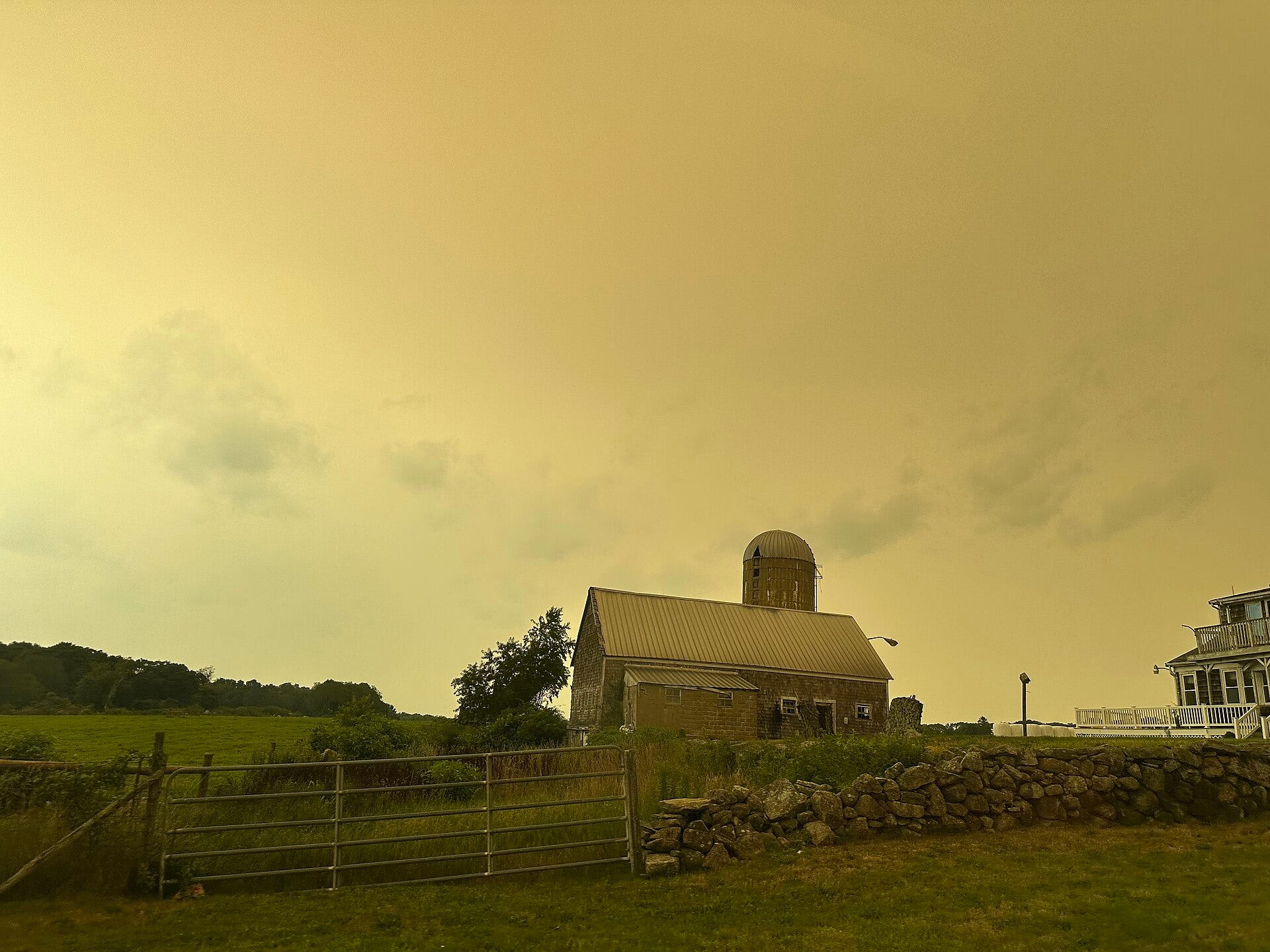
Smoky skies create an eerie, sepia-tinted sight over a farm in Westport, Massachusetts in mid-July 2026. Credit: Will y theweatherguy473737 via Wikimedia Commons

More than 800 wildfires are currently burning across Canada, bringing a blanket of eerie haze and dangerous smoke down into parts of the U.S., including the upper Midwest and Northeast regions. By Thursday, communities in Minnesota and Michigan had among the worst air quality in the world due to the smoke, at levels considered beyond hazardous. New York City residents were advised to stay indoors, multiple states issued statewide air quality alerts, and outdoor activities from concerts to sporting events were cancelled.
Meanwhile, flash flooding has once again hit Texas’ Hill Country and killed at least two people. Much of area is still recovering from last year’s deadly floods, with many flood survivors saying they feel abandoned by their government that is supposed to be protecting them, according to recent survey results.
Then there’s the extreme heat. Parts of the U.S. choked by wildfire smoke are simultaneously sweltering under blistering hot temperatures. This is obviously a perilous situation, especially for people with pre-existing health conditions. “Extreme heat and wildfire smoke each carry major risks, especially for people with chronic health conditions including heart disease. The combination of the two is extremely dangerous,” said Dr. Manesh R. Patel, volunteer president of the American Heart Association. Just two weeks ago, large swaths of the U.S. were under a brutal heat dome, which has already been linked with dozens of deaths.
That heat wave, as well as the one in Europe in late June that has resulted in thousands of additional deaths, both would have been “virtually impossible” without fossil fueled climate change, according to scientists with World Weather Attribution (WWA).
WWA, an initiative based in the UK, examines the influence of climate change on specific extreme weather events around the world. This field of climate science is known as extreme event attribution. And it has advanced significantly over the last ten years.
That advancement is the top-line message of a new report published Thursday by the U.S.-based National Academies of Sciences, Engineering, and Medicine (NASEM). The report provides an updated assessment from the National Academies’ 2016 report on attributing extreme weather events to climate change. While the new report cautions that the field of extreme event attribution still faces challenges, it finds that the science overall has greatly strengthened and matured.
“Significant progress has been made over the last decade, with major advancements in methods and modeling that allow for more robust assessments of extreme events,” James Hurrell, chair of the committee that wrote the report, and Scott Presidential Chair of Environmental Science and Engineering at Colorado State University, said in a statement.
“Attribution science confirms what billions of people around the world have experienced firsthand—deadly events like extreme heatwaves are occurring more often and tropical cyclones are more intense due to climate change,” Carly Phillips, senior scientist at Union of Concerned Scientists, said in a statement commenting on the report. “Despite efforts by the fossil fuel industry and its cronies to intimidate panelists and misrepresent the research, the Academies’ report affirms the scientific consensus: attribution science is based on rigorous peer reviewed methods and provides critical information about how climate change is driving increases in the frequency and/or severity of extreme events.”
The report itself is quite technical, and according to climate scientist Michael Mann, overly conservative. “If anything, the academy understates the strength of the science linking increasingly extreme weather events to climate change,” Mann wrote in a social media post.
As an example of just how far climate attribution science is advancing, some researchers are now starting to link extreme weather events like heat waves not just to climate change, but to the carbon emissions associated with the world’s largest fossil fuel and cement producers – the “carbon majors.”
“Over the last 6 months a series of papers has advanced our understanding of the culpability of fossil fuel firms for climate change impacts,” climate scientist Christopher Callahan wrote in a Bluesky thread last September. Callahan along with Dartmouth researcher Justin Mankin, for example, published a landmark paper last year finding that trillions of dollars in economic damages globally from extreme heat can be attributed to the carbon majors. Another 2025 study found that the world’s largest fossil fuel firms are playing a significant role in driving heat waves.
This kind of scientific research is quite threatening to fossil fuel interests, as it is expected to be used as evidence in climate liability lawsuits seeking billions of dollars in damages from major oil and gas companies. The fossil fuel industry is already facing dozens of these suits in the U.S., as well as state polluter pays or “climate superfund” legislation that directly imposes liability on major climate polluters and requires them to help pay for climate adaptation costs. New York and Vermont have enacted climate superfund laws, which will draw upon climate attribution science in their implementation – if they can survive initial court challenges from the industry and its political backers, that is.
The battle lines are already being drawn and the fight over climate accountability – just like the climate itself – is heating up fast.
On the one side is the fossil fuel industry – one of the wealthiest and most politically powerful on Earth, and its allies in government, which in the U.S. includes the Trump administration and the entire Republican party. These forces have mounted an escalating assault – on climate science (and science writ large), on climate policies and regulations, and on any and all efforts to hold polluters accountable for climate harms.
As part of this endeavor, Republican lawmakers in Congress introduced legislation in April that explicitly aims to protect fossil fuel entities from climate liability laws and lawsuits. The bill, called the “Stop Climate Shakedowns Act,” would grant sweeping legal immunity to the industry, shielding it from accountability at a time when climate-fueled disasters and damages (including deaths from impacts like extreme heat) are rising. The bill also rejects climate attribution science, claiming that “efforts to attribute local weather patterns and the local harms that result from meteorological events, such as floods, droughts, hurricanes, wildfires, or heat waves, to persons engaged in the energy business lack scientific credibility and are, therefore, arbitrary.” The new National Academies’ report contradicts this claim, but evidence-based science does not appear to matter much to Republican climate deniers who are deep in the pockets of the fossil fuel industry. The House version of the bill picked up four new co-sponsors in just the last week, the same week that the NASEM report dropped.
On the other side of the battle are climate activists and scientists, physicians and public health professionals, Democratic lawmakers and officials, extreme weather survivors and communities impacted by climate-driven disasters, and a sizeable share of the public that wants to see climate action and accountability. With the latest bout of extreme weather in the U.S. and the release of the new NASEM report on extreme event attribution, demands for accountability for the fossil fuel industry are once again pouring in.
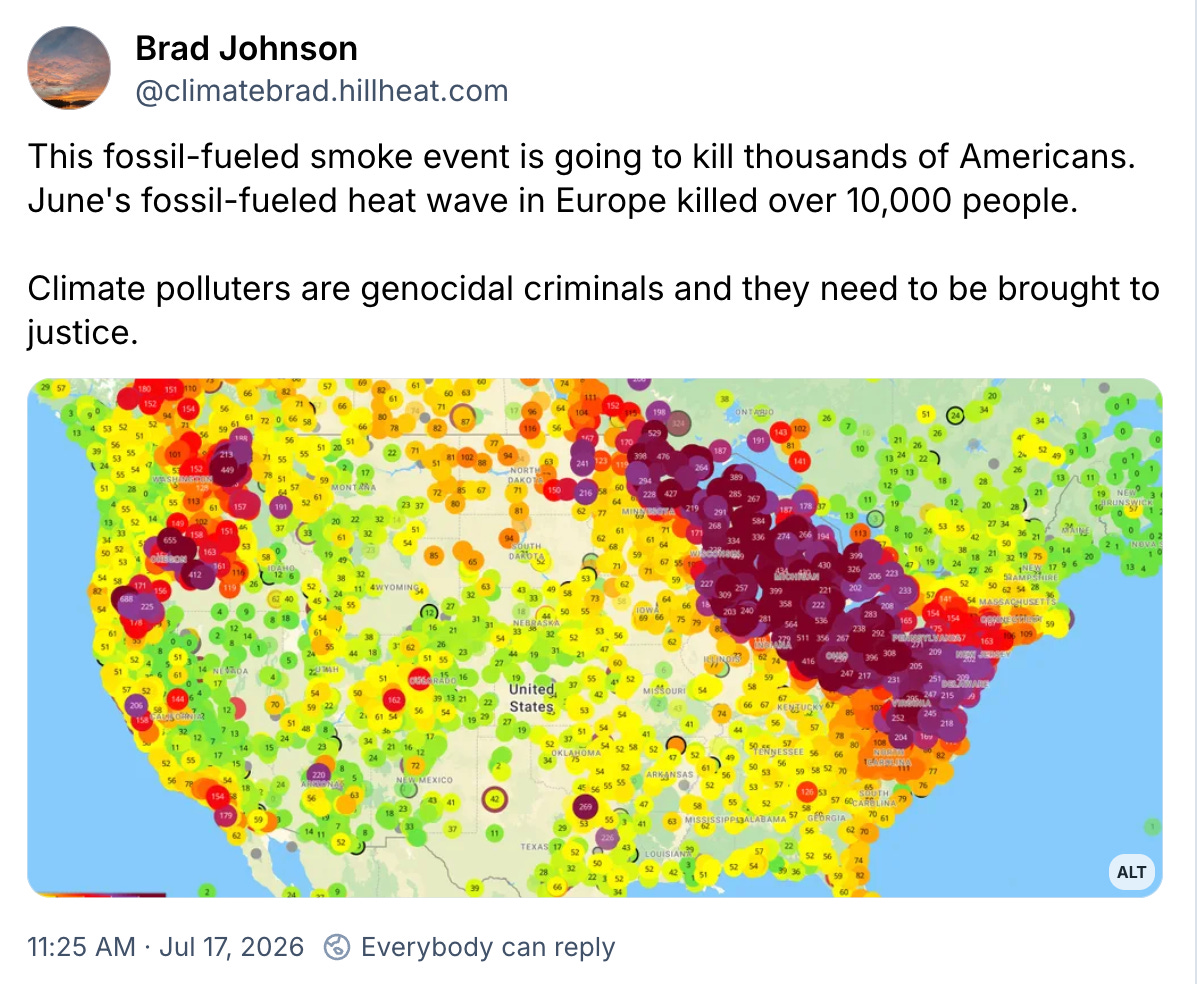
Youth climate activist groups Sunrise Movement and Climate Defiance posted on social media calling for “Nuremberg trials for Big Oil.”
“Nuremberg style trials are in order for the fossil fuel executives who knew what they were doing to our children’s futures and did anyway,” Climate Defiance wrote on X (formerly Twitter).
In response to Climate Defiance’s post, director of Public Citizen’s Climate Accountability Project Aaron Regunberg wrote on X: “I’m all for this, but we don’t actually have to wait. We have criminal laws on the books right now to prosecute Big Oil’s lethal conduct.” Regunberg has for several years now been advocating for criminal prosecution of fossil fuel industry executives, arguing that charges like homicide or reckless endangerment would be applicable, given that the climate crisis that they largely engineered and perpetuated (for the sake of protecting their exorbitant profits) is literally killing people.
“For decades, Big Oil knowingly poisoned our atmosphere and deceived the public about the impacts of burning fossil fuels —all the while lining executives’ pockets as communities continue to suffer from extreme heat, floods and fires,” Regunberg’s Public Citizen colleague Stephanie Brancaforte said in a statement on Thursday responding to the new National Academies’ report. “The science is clear: the extreme heat killing thousands of people in the northern hemisphere this summer is neither an unpredictable event nor an accident—it is the result of corporate crime. With the backing of the National Academies, survivors of climate catastrophes now have strong evidence to pursue justice against fossil fuel polluters to pay for the devastation they have unleashed.”
U.S. Representatives Doris Matsui, Mike Quigley, Paul Tonko, Don Beyer, Suzanne Bonamici, Sean Casten, Mike Levin, and Chellie Pingree, all Democrats and leaders of the House Sustainable Energy and Environment Coalition, applauded the National Academies’ report, which they said affirmed the science linking extreme weather events to fossil fueled climate change. “The evidence is overwhelming; climate change is driven by fossil fuel pollution, and its impacts are accelerating toward more dangerous extremes,” they said in a statement.
“The National Academies’ report highlights scientific facts and evidence that build upon what the fossil fuel industry has known since the 1950s: that burning fossil fuels would lead to global warming and a changing climate,” they added. “Yet, these polluters continue to downplay and distort the scientific evidence surrounding climate change and its associated harms. Adding fuel to the fire, the Trump Administration is silencing our very own federal scientists and covering up national climate data in order to give the fossil fuel industry a get-out-of-jail-free card for its role in the climate crisis.”
As One Earth Now previously reported, Democratic lawmakers and SEEC leaders say they oppose the effort of their Republican colleagues to shield fossil fuel polluters from climate liability through the “Stop Climate Shakedowns” bill. Rep. Tonko (NY-20) called that effort a “slap in the face to the very concept of justice and to the countless who have been harmed by the fossil fuel industry.” He vowed that he would “fight against this cruel bill that gives polluters a free pass.”
Phillips, of the Union of Concerned Scientists, said that climate attribution science “provides key evidence to hold the fossil fuel industry accountable,” and she urged members of Congress to not slam the courthouse doors shut on communities seeking to do just that.
“Congress must not grant Big Oil immunity for climate deception and the harms they knowingly caused that attribution science makes evident,” Phillips said. “Communities deserve their day in court and no one—including fossil fuel companies that have profited at the expense of people and the planet—should be above the law.”
Excellent overview of a confounding situation. Not only is the Trump administration doing everything possible to stop climate change activism, President Trump yesterday said he intended to punish Canada financially (e.g. much higher tariffs) for the wildfire smoke drifting southward into the United States.
I don't love that this is happening, but it is very, very important that more people understand how we are being hurt by continued release of green house gasses, primarily from the gas drilling industry. Gas must stay in the ground, if we can have a chance to thrive in this warming world.