

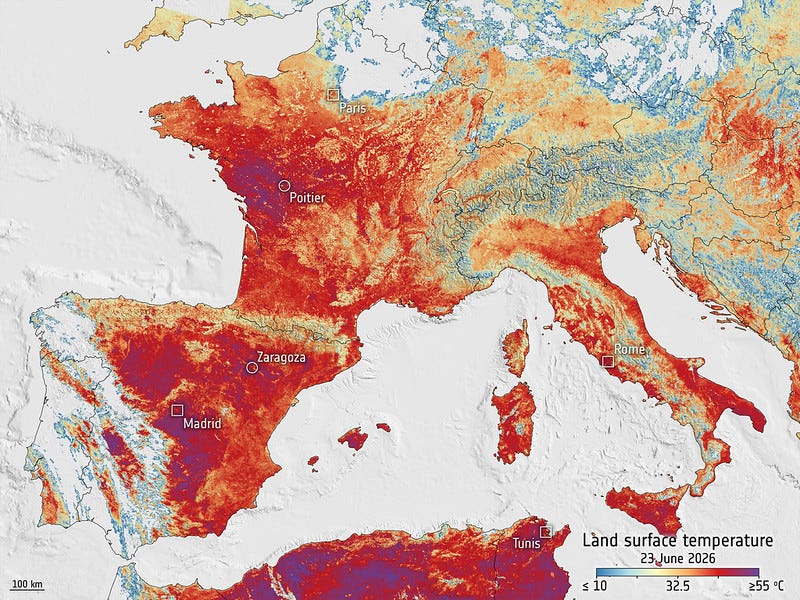
Credit: European Space Agency via Flickr, contains modified Copernicus Sentinel data (2026), processed by ESA; CC BY-SA 3.0 IGO
Dangerous, stifling heat and humidity is set to blanket large parts of the United States over the coming days, bringing oppressive conditions to some 200 million people across the Midwest and central Plains to the southeast and Mid-Atlantic and even parts of New England. As AccuWeather reports: “A heat dome will develop, strengthen and grow in size over much of the central United States for an extended period through the Independence Day weekend. It will even expand into parts of the East for several days. At its full extent, dangerous conditions will affect more than two dozen states.”
It comes on the heels of a record-shattering heat dome in Europe that, in the words of one UK-based climate researcher, “has been hugely disruptive to society.” The heat has caused cancellations of schools, public events, and train service. A June 24 event scheduled during London Climate Action Week titled “Extreme heat: Improving governance and strengthening action around the world” was called off due to the “red alert” heat warning from the UK Met Office; in other words, an event on extreme heat was cancelled due to the extreme heat – a twist that one of the event sponsors called “deeply ironic.”
But beyond just being disruptive, the unprecedented European heat wave has also been deadly. France recorded at least 1,000 additional deaths last week during the height of the heat wave.
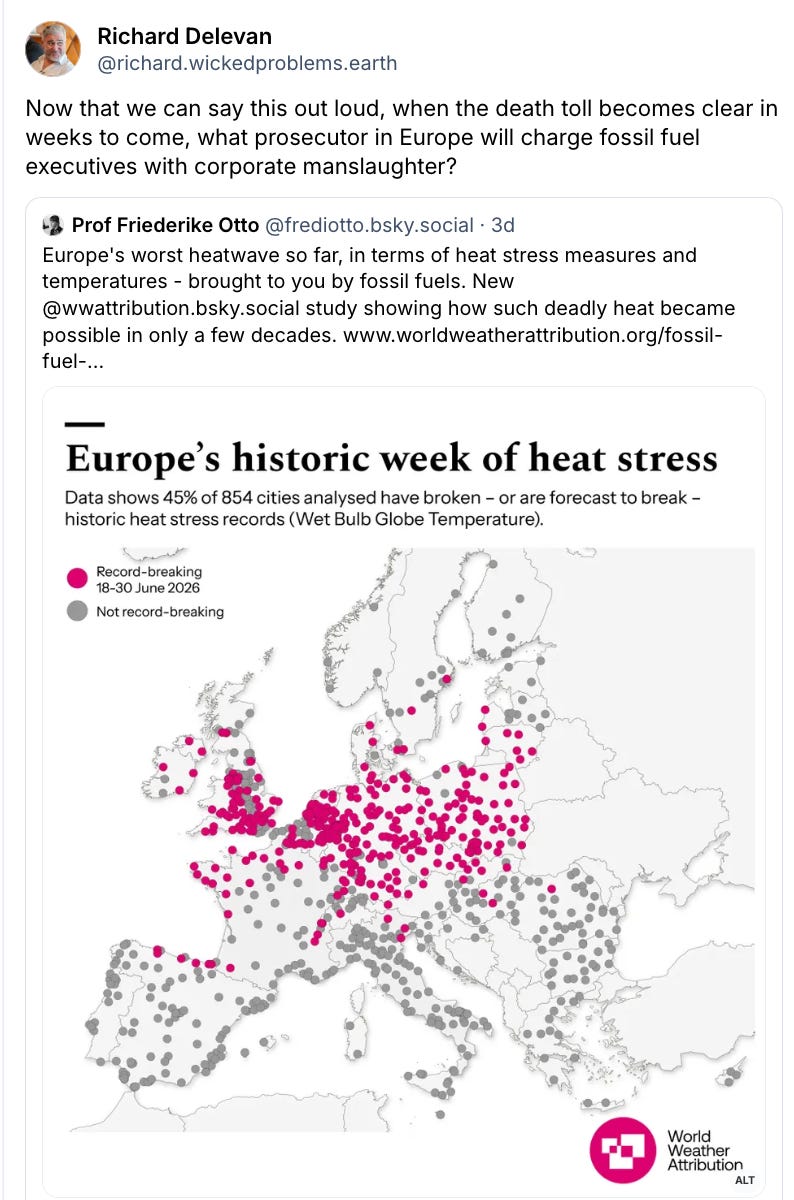
A new study reveals that human-caused climate change is the culprit behind this extreme heat event. The record-breaking heat wave affecting much of Europe would have been virtually impossible just 50 years ago, according to a rapid attribution analysis by World Weather Attribution (WWA). Researchers say that climate change is “unequivocally to blame.”
“This event would not have been possible in June without climate change,” Theodore Keeping, an extreme weather and wildfire researcher at Imperial College London, said during a June 25 press briefing. He explained that this is “the most severe and widespread heat wave to have ever affected this large a region of Europe.”
“The science of how climate change is worsening heatwaves is settled,” Keeping said. “Continued fossil-fuel emissions are directly responsible for the disruption people are experiencing this week in their homes, schools and workplaces.”
Simon Stiell, executive secretary of the UN Framework Convention on Climate Change, also pointed to fossil fuels that are the root cause of the climate emergency. “Extreme heat is shattering records across Europe, and the science is very clear about why: climate change is running rampant, caused by the world’s addiction to burning coal, oil and gas,” he said in a press statement.
This “addiction,” some would argue, has been deliberately created and perpetuated by the very industry that profits from society’s dependency on its products. In the wake of Europe’s blistering heat wave, climate advocates are once again demanding accountability for the fossil fuel industry.
“It’s time to turn the heat on the fossil fuel giants that caused this heatwave but are doing nothing to cover the costs,” said 350.org campaigner Lisa Rose. “Both science and the law are clear: polluters must answer for climate damage. Now it’s up to our leaders to make them pay.”
Commenting on the WWA study, Aaron Regunberg, director of Public Citizen’s climate accountability project, said it is clear that the deadly heat wave is not a “natural” weather disaster.
“It’s a climate crime, and one that has already killed hundreds across Europe, including a three-year-old boy in France who is believed to have locked himself inside his family’s car while his father was working in their yard. French prosecutors have announced an investigation into this death, with potential charges of involuntary manslaughter for the child’s family,” Regunberg said.
“We can’t say whether or to what extent this child’s grieving parents should be held responsible for his tragic death. But we know who else should be. The lethal heat that killed their child, and so many others, is the direct, foreseeable—and, in fact, foreseen—consequence of a small number of fossil fuel companies that knowingly generated a huge portion of all the greenhouse gas emissions that are baking our planet, and fraudulently deceived the public to block solutions that could have ameliorated this catastrophe,” he added. “If prosecutors want to seek justice for deaths like these, they should be pursuing the Big Oil companies that are actually responsible.”
Evidence does exist substantiating these types of claims, as scientists are now starting to demonstrate links between specific extreme weather events like heat waves and the fossil fuel and cement-producing entities responsible for generating a majority of the carbon emissions that are heating the planet. Last September a landmark study found that about half of the increased intensity of heat waves (since preindustrial times) can be attributed to these entities known as the carbon majors. In other words, major fossil fuel companies have played a substantial role in driving dangerous and deadly extreme heat events.
As the study’s abstract explains: “Depending on the carbon major, their individual contribution is high enough to enable the occurrence of 16–53 heatwaves that would have been virtually impossible in a preindustrial climate. We, therefore, establish that the influence of climate change on heatwaves has increased, and that all carbon majors, even the smaller ones, contributed substantially to the occurrence of heatwaves.”
The study authors say their research is likely to be directly relevant in legal proceedings as climate liability lawsuits targeting major oil companies continue to pile up on court dockets. Last year a first-of-its-kind wrongful death lawsuit was filed in the state of Washington against ExxonMobil and other large oil and gas companies, aiming to hold them responsible for the tragic death of a woman who perished in her car during the 2021 Pacific Northwest heat dome. That extreme heat event, which scientists say would have been “virtually impossible” without human-caused climate change, is also the focus of a climate liability suit filed in 2023 by Multnomah County, Oregon against Big Oil. The suit came before a court last week in a hearing on motions to dismiss filed by industry lawyers.
It remains to be seen whether this record-breaking European heat wave will spur similar legal actions against any carbon majors, perhaps even a criminal case.
Two years ago, a criminal complaint was brought in France against the CEO, board of directors, and shareholders of French oil major TotalEnergies. The three NGOs and eight individuals behind the case had hoped to set a precedent establishing criminal liability for executives and directors of a large fossil fuel company for its role in driving the climate emergency. “The managers and shareholders of TotalEnergies are fully aware that climate change kills, yet they have made the cynical choice to increase oil and gas production for one reason only: to maximize profits,” a press release announcing the complaint on May 21, 2024 stated.
The French public prosecutor, who had authority to follow through with the complaint, decided instead to dismiss it in February 2025. A few months later in May 2025, seven individuals and two of the NGOs registered their complaint directly with an investigating judge, triggering the opening of a judicial investigation. But on April 29 of this year the Paris Judicial Court issued an order to once again dismiss the case. According to a press release from BLOOM, one of the organizations that filed the complaint – “The office in charge of investigating the complaint announced that it did not intend to open an investigation against TotalEnergies, on the grounds that the alleged acts were not criminally punishable and that the events in question were not ‘directly’ linked to TotalEnergies’ activities.” BLOOM said that it, along with the seven individuals who are all victims or survivors of extreme weather events, have decided to appeal this ruling.
On the civil law side, French civil society organizations and the city of Paris won an important, if only partial, victory last week against TotalEnergies with the Paris Judicial Court ruling that the oil major had fallen short of its climate-related obligation under France’s 2017 duty of vigilance law. That law requires large corporations in France to develop plans addressing risks to human rights and the environment associated with their operations. The court ruled that TotalEnergies’ plan was incomplete because it left out the greenhouse gas emissions from customers using the company’s products. These indirect “Scope 3” emissions account for around 90 percent of oil companies’ total attributable emissions – so a court telling an oil major that it must take responsibility for them helps bolster corporate climate accountability.
The June 25 ruling came in a lawsuit that was filed against TotalEnergies in 2020. The court ordered the company to revise its vigilance plan within the next six months, and said that the case would resume in January when the court will consider whether or not the new plan is adequate. And although the court did not order Total to specifically slash its emissions or curb its oil and gas expansion, as the plaintiffs had demanded, it could do so at a later date.
The court’s decision came as France was suffering under the deadly heat wave – a point which was not lost among people reacting to the ruling.
“The timing is impossible to miss: as Europe is suffering through another unprecedented heatwave, one of the world’s largest fossil fuel companies has once again lost in court,” said ClientEarth lawyer Johnny White. “Today’s judgment adds to a growing body of decisions recognizing that the few companies most responsible for driving climate breakdown can be held responsible for their part in climate harms.”
“This is an important decision during these days of unprecedented heatwave: fighting climate change is also fighting for a livable future,” the plaintiff organizations said in a press release. “Multinationals – particularly oil and gas companies like TotalEnergies – must do their part to protect our loved ones, the regions we cherish, and those most vulnerable to the effects of climate change. We will continue the fight to ensure that this is the case.”
Further Reading
Check out my latest published articles:
“French Oil Major Failed to Fulfill ‘Vigilance’ Duty on Climate, Paris Court Rules”, Inside Climate News, https://insideclimatenews.org/news/26062026/french-oil-major-failed-to-fulfill-vigilance-duty-on-climate-paris-court-rules/
“Greenpeace’s Dutch Anti-SLAPP Against Oil Pipeline Giant Advances”, Inside Climate News, https://insideclimatenews.org/news/21062026/greenpeace-anti-slapp-lawsuit-against-energy-transfer/
“US Faces Triple Threat of Climate Crisis, Economic Hardship, and Donald Trump”, Sierra, https://www.sierraclub.org/sierra/us-faces-triple-threat-climate-crisis-economic-hardship-and-donald-trump