

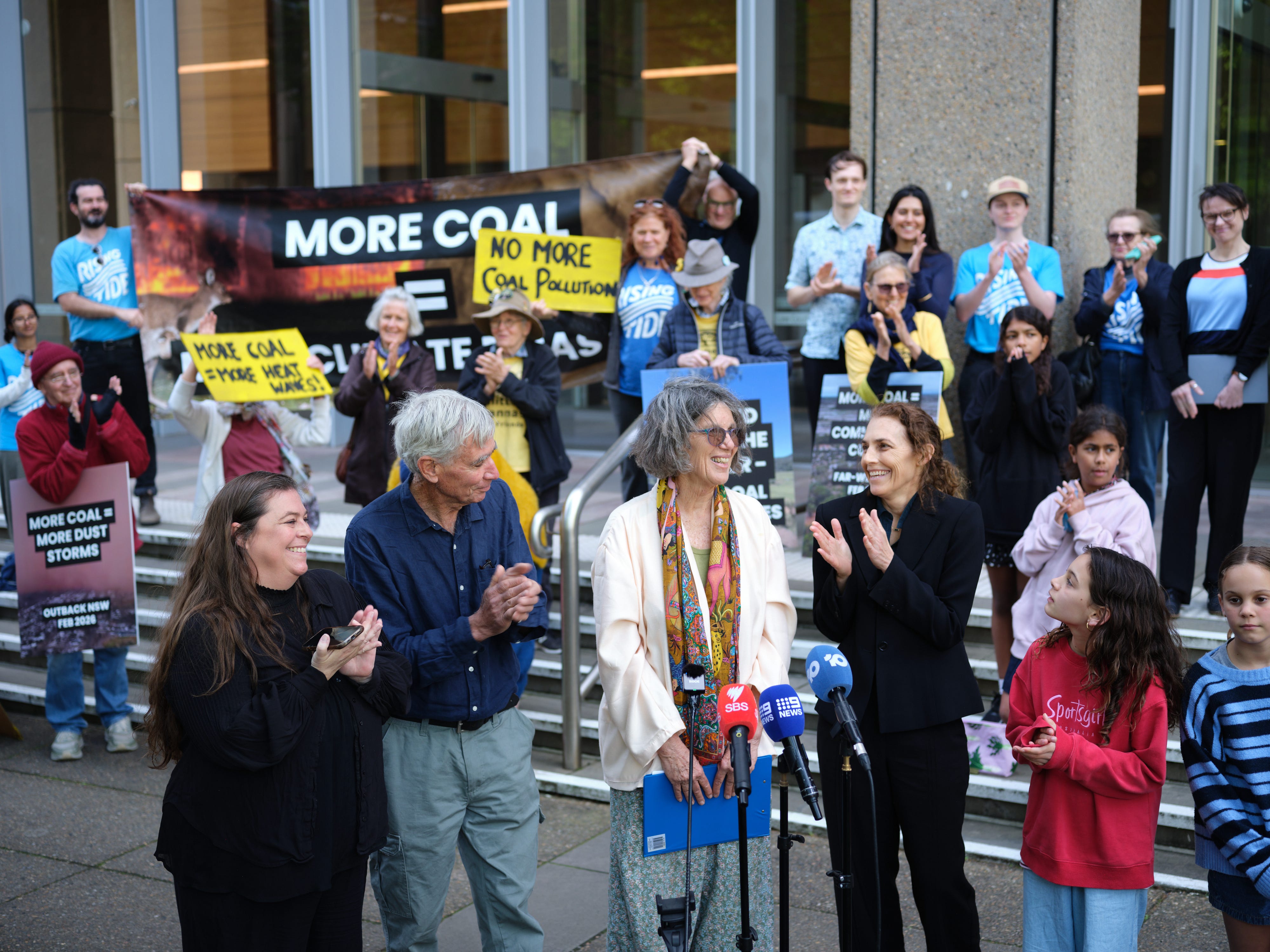
Climate accountability and community advocates in Australia celebrate a landmark climate ruling on October 7, 2026 from the country’s top court. Credit: Courtesy of Climate Media Centre via news release
It’s been a big week for climate law and accountability, with the highest courts in two major fossil fuel producing countries hearing or deciding landmark cases that could have significant implications for the fossil fuel industry.
In Australia – the world’s fourth-largest producer and second-largest exporter of coal – the nation’s top court delivered a ruling on October 7 in a case involving a legal challenge to the approval of a major coal mine expansion. The expansion project, approved by the New South Wales planning commission, would have doubled the mine’s coal output and extended its operations by more than 20 years, unleashing more than 800 million metric tons of additional carbon pollution. After an appeals court last year ruled in favor of a group of farmers and local residents challenging the project approval, the mine operator took the case to Australia’s High Court. It was the first climate case that this court has taken up.
The High Court ruled, in a split 3-2 decision, that the mine expansion’s approval was invalid because the planning commission had failed to adequately consider the downstream or “scope 3” emissions from the eventual burning of the coal or how those emissions might be mitigated. Since the extracted coal would be exported overseas, nearly all of the project’s greenhouse gas emissions (98 percent) would fit into that category. The court’s decision means that government authorities and fossil fuel developers cannot disregard these emissions even if they occur outside of Australia.
Lawyers representing the community group challenging the mine expansion called the court’s decision “groundbreaking.”
“This is an historic ruling for Australian environmental law and for the communities who have been fighting for accountability in the fossil fuel approvals process,” said Anita O’Hart, principal lawyer at the firm Johnson Legal. “This ruling will be applied by courts and planning authorities across Australia, and it will be studied internationally as one of the most significant domestic climate law decisions in the world.”
“The High Court has said what we have always known: we cannot dig up coal, ship it overseas, watch it drive climate change, and then pretend the consequences have nothing to do with us and won’t be felt by us,” said Wendy Wales, a retired science teacher and president of group that challenged the project. “We can’t ignore physics, chemistry and biology. We must live within Nature’s limits and this ruling endorses that.”
Jacqueline Peel, a climate law expert and law professor at the University of Melbourne, wrote in a piece in the Guardian that the decision “provides Australia with some much-needed climate credibility, as it faces pressure from Pacific neighbours over fossil fuel approvals at the pre-COP31 negotiations in Fiji and Tuvalu this week” and that it also “brings us in line with recent judicial findings elsewhere in the world.” Fossil fuel producers in Australia, she suggested, should be “shaking in their boots” in the wake of the court’s ruling.
Indeed, a coal industry trade association issued a scathing statement in response to the High Court decision, calling it a “further blow to Australia’s prospects of meeting continued demand for our high-quality coal from global customers.”
Legal experts say the ruling “sets a new standard for coal and gas projects” in New South Wales and potentially all across Australia, raising the prospect that the fossil fuel industry will face continued legal challenges to its development and expansion plans in that country.
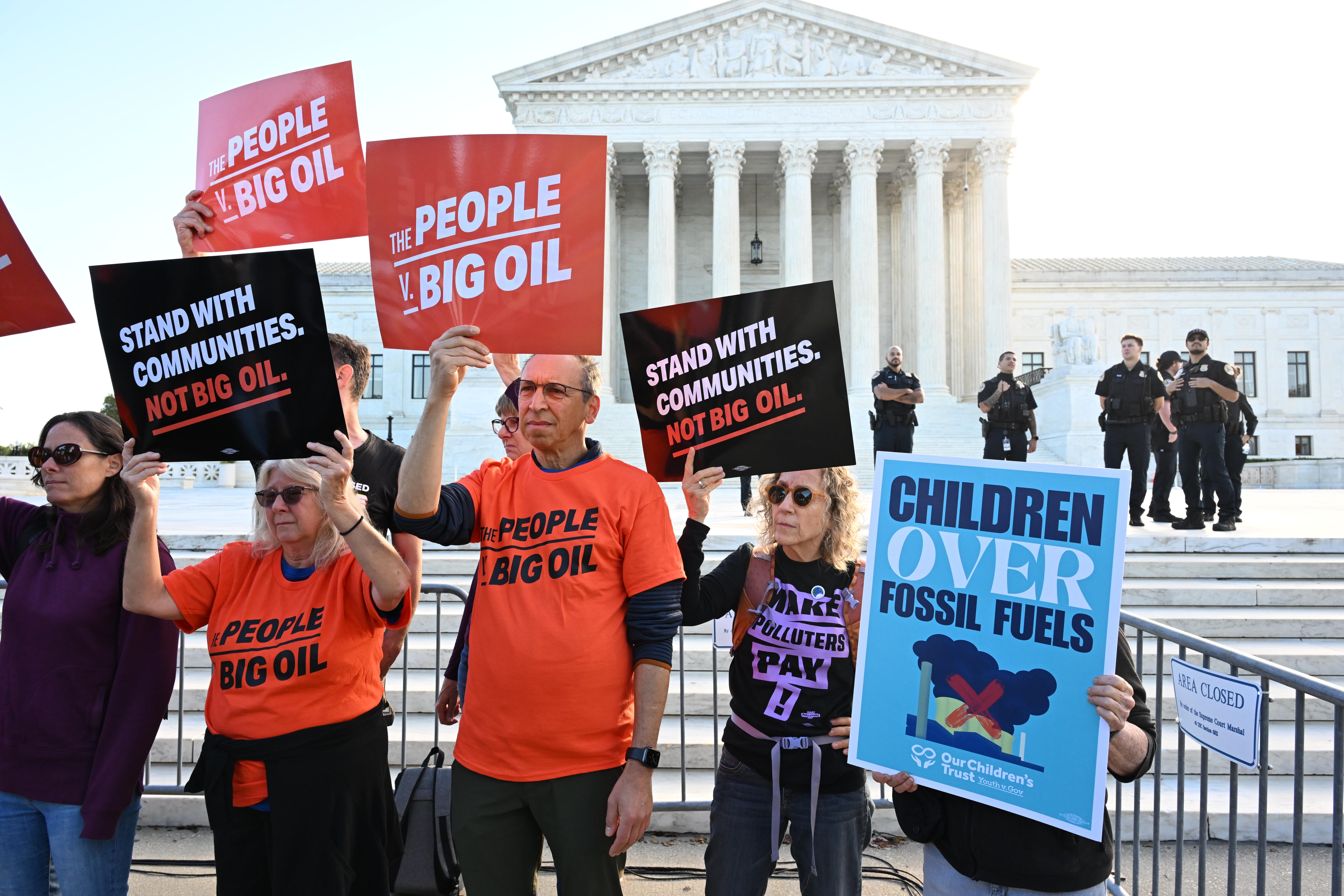
Supporters of a climate case filed by Boulder, CO against Big Oil rally outside of the U.S. Supreme Court on October 5, 2026. Credit: Kevin Wolf/AP Content Services for Fossil Free Media
Meanwhile, here in the U.S. our top national court – the Supreme Court – opened its new term on October 5 by hearing a “blockbuster” case called Suncor v. County Commissioners of Boulder, one of the most anticipated and perhaps most consequential climate cases ever to come before the court.
I previewed the case here, and since it has received widespread press coverage I won’t get into the details. Basically it is all about accountability for the widespread and worsening harm caused by fossil fueled climate change, and whether or not local or state governments can even have a chance to make the case in court that major oil and gas companies should be held liable for the climate-related damage inflicted upon their communities, given that the companies have allegedly lied about climate consequences of their products for decades and stymied climate action.
Boulder, Colorado’s case against ExxonMobil and Suncor is one of dozens of climate accountability lawsuits pending against the fossil fuel industry in courts across the U.S., and if the industry gets its way at the Supreme Court, most if not all of them would be wiped out.
The stakes are incredibly high on both sides. The oil companies warn that they are facing the threat of “ruinous” liability with a price tag on the order of billions, or perhaps even trillions, of dollars. But communities like Boulder are already facing steep costs to recover from climate disasters and adapt to worsening climate impacts, and absent accountability from the industry driving much of this damage, those costs will continue to balloon and the burden will fall entirely onto the public and local taxpayers.
“The costs are projected to climb higher for our families and our taxpayers. Faced with these rising costs, we ask, is it fair for communities to shoulder these costs alone? We believe it is not,” Marta Loachamin, a county commissioner for Boulder County, said in a statement. “For decades, the companies producing and selling fossil fuels knew that their products contribute to a changing climate. These companies are asking the Court to help them evade responsibility. “
For years, fossil fuel industry lawyers have pressed the argument that lawsuits like Boulder’s are unprecedented attempts to regulate worldwide greenhouse gas emissions. They say that addressing climate change is a matter for the federal government (even as their corporate clients have worked for decades to block federal climate policy), and that federal law defeats or “preempts” state law claims pertaining to climate. Kannon Shanmugam, counsel for ExxonMobil, made this very argument to the Supreme Court on Monday.
Part of his argument was grounded in the “extraterritoriality” principle arising from the Constitution – that individual states or municipalities cannot sue over conduct or, in this case, pollution, occurring outside of their borders. It is unclear if a majority of the justices will endorse such a sweeping constitutional theory. A more likely outcome might be a holding that the Clean Air Act preempts state law claims relating to greenhouse gas emissions. Boulder, for its part, argues that its case is not at all about regulating GHG emissions. And ironically, the EPA under Trump is now disclaiming its Clean Air Act authority to regulate climate pollution (a position that is facing legal challenges), which some legal experts say undermines the industry’s preemption argument.
The Suncor case in the U.S. and the coal mine case in Australia are very different cases, but in some respects, they raise the same important question about responsibility or accountability for greenhouse gas emissions and climate harm. Australia’s highest court has issued a pro-accountability ruling in saying that the coal industry and regulators are responsible for the full scope of an extraction project’s emissions even if they occur beyond Australia’s borders. Will the U.S. Supreme Court allow Boulder and other communities the opportunity to try to hold Big Oil responsible for the damage it has caused them, or will it shield the industry from legal accountability (having to face trial) simply because greenhouse gas emissions transcend state borders?