

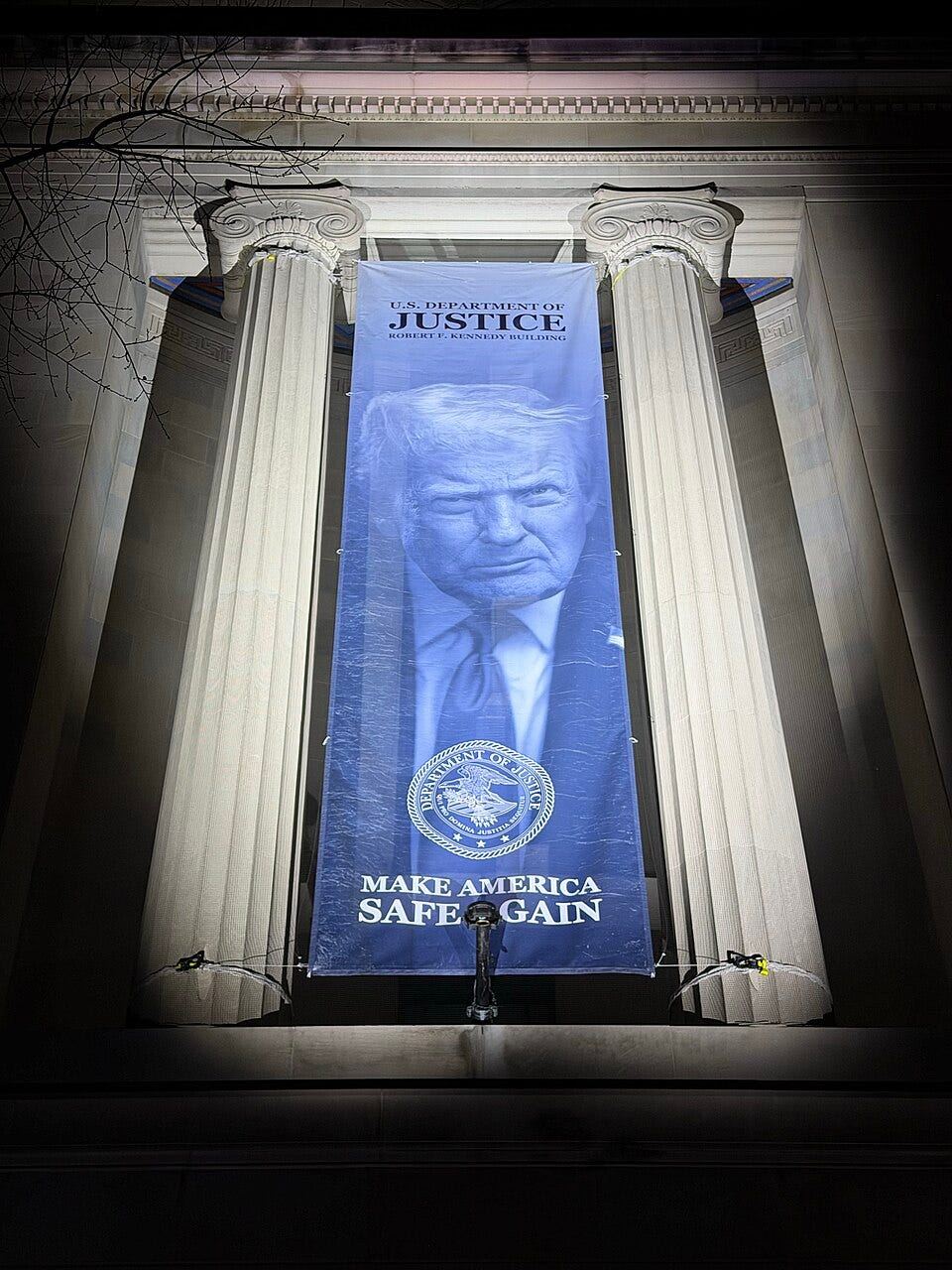
Credit: Quintin Soloviev via Wikimedia Commons, CC BY 4.0
At the end of June, the division within the U.S. Department of Justice (DOJ) charged with enforcing the nation’s environmental laws announced it was dropping the word “environment” from its name. Instead of the Environment and Natural Resources Division, this part of the DOJ – which describes itself as the nation’s “largest environmental law firm” – now goes by the title of “Energy and Natural Resources Division.”
The name change, replacing “environment” with “energy,” reflects the division’s priority under the Trump administration to serve a so-called “energy dominance” agenda of unleashing fossil fuels. “The Justice Department is defending the federal government’s efforts to advance U.S. energy dominance,” Principal Deputy Assistant Attorney General Adam Gustafson, the current head of ENRD, wrote in a June 28 Wall Street Journal op-ed titled “New Name, New Mission at the Justice Department.”
Gustafson noted that the division has changed its name several times over the course of its 100-plus-year history: “It was renamed three times in response to evolving responsibilities—most recently in 1990, when it became the Environment and Natural Resources Division to reflect its enforcement function under the environmental statutes Congress enacted in the 1970s and 1980s.”
Those environmental laws are still on the books. But the DOJ division that is supposed to be defending and enforcing them now appears to be largely stepping back from that responsibility.
“Trump’s DOJ showed its true colors when it dropped the world ‘environment’ from the Division’s name, reflecting a whole-hearted embrace of its new mission to push fossil fuels and data centers instead of protecting human health and the environment.” - Laura Thoms, director of enforcement at Earthjustice, former ENRD enforcement attorney
Last week, Inside Climate News published a story that I had been working on for much of the last month, examining the significant changes at the DOJ’s environment division under Trump II – including the recent name change. The story is based on interviews I did with half a dozen or so former ENRD attorneys, as well as reports by other news outlets. And according to the ENRD alums I spoke with, including the former heads of the Environmental Enforcement and Environmental Crimes sections, there has been a massive decline in enforcement resources and actions, to the point where environmental enforcement has essentially “collapsed,” as one former ENRD enforcement attorney described it.
“Under the Trump administration, federal enforcement of our bedrock environmental laws cratered, leaving a wide gap between what the law requires and what companies actually do,” Laura Thoms, director of enforcement at Earthjustice who previously served at DOJ’s ENRD for 19 years, wrote in a December 2025 article.
“Since taking office, the Trump administration filed only 20 civil environmental enforcement cases in court. That’s less than a third of the cases filed by the federal government during the same period in 2024, and far lower than any year in modern history, including Trump’s own first term,” Thoms continued. She wrote that this track record “isn’t a dip. It’s a collapse. And it matters for our lives, our health, and our economy.”
“To date, the Administration has hamstrung the ability of hardworking career staff to hold polluters accountable, blocking criminal investigations of Trump allies, pardoning convictions of Trump donors, and dismissing meritorious enforcement actions with prejudice,” Thoms told me in an emailed statement. “The Administration’s selective enforcement threatens to create sacrifice zones where some communities receive the benefit of environmental protections, while others are left vulnerable to harms created by illegal pollution and the government’s failure to act.”
Tom Mariani, who spent nearly 40 years at the DOJ’s ENRD and headed the Environmental Enforcement Section since 2016, shared Thoms’ concerns that the division’s enforcement has been hamstrung under Trump II.
“The Department of Justice is rapidly moving away from enforcing the nation’s core pollution control laws in ways not seen in prior administrations, including President Trump’s first term. Drastically fewer civil enforcement lawsuits and severe cuts to staffing will adversely affect our health and environment, now and into the future,” Mariani wrote in a December 2025 Substack piece published by Justice Connection, a network of DOJ alumni.
He told me that the Environmental Enforcement Section lost more than half of its attorneys over the last year and half, calling it a “massive, massive reduction.” Mariani himself was forced out last year at the start of the new administration, through an involuntary transfer to a start-up unit called the sanctuary cities working group. Instead of taking the new assignment, Mariani decided to leave the DOJ.
Three other heads of litigating sections within ENRD were also reassigned to the sanctuary cities working group, which Mariani said “seemed like sort of a fake job.” Deborah Harris, chief of the Environmental Crimes Section, told me that the working group indeed “was a complete joke.” She initially accepted the reassignment, but several months later decided that she, too, had to leave the DOJ. By late August 2025, all of the DOJ employees who were reassigned to the sanctuary cities working group had exited.
Harris told me that, like the Environmental Enforcement Section, Environmental Crimes saw the number of its attorneys cut in half, diminishing the capacity of the section to do its job effectively.
“When I was section chief we increased what we did twofold in the sense that we took in two new program areas,” Harris said. “At our max we had 42 attorneys, and to be down to 21 [attorneys] with that many practice areas under our supervision, you can’t expect there to be the same type of results.”
Harris told me it seemed “strange” to hear that the division where she once worked had decided to drop the word “environment” from its name. “To me, it doesn’t indicate any interest in our mandate, which is protecting the health and safety of the people and the country,” she said.
Indeed, the word “energy” does not appear once in ENRD’s mission statement. According to the division’s webpage: “ENRD’s mission is to protect the health and welfare of the American people, manage our precious natural resources, and conserve our nation’s breathtaking landscapes. We do this through civil and criminal enforcement of the country’s environmental and natural resource laws, defense of agency actions taken under those same laws, acquisition of lands needed for federal projects, and litigation to secure and protect the rights and resources of federally recognized Indian Tribes.”
In an emailed statement, Gustafson defended the name change and claimed that the division is continuing to enforce environmental laws.
“ENRD continues to faithfully execute its mission, which has evolved — along with the division’s name — throughout the years in response to expanding responsibilities,” he said. “We defend agency rules and other federal actions against challenges from all sides, and we are enforcing the nation’s environmental laws to protect clean air, water, and land for all Americans.”
“Both goals are consistent with the Administration’s priorities,” he added. “There’s nothing incompatible about unleashing American energy and making America healthy again. We are achieving both.”
Under the Trump administration, the phrase “unleashing American energy” of course means unleashing fossil fuels. And public health professionals and scientists would beg to differ with the contention that doing so is compatible with protecting Americans’ health.
As for the claim that ENRD remains committed to environmental enforcement, former ENRD enforcement attorneys say that this is, sadly, no longer the case.
“Trump’s DOJ showed its true colors when it dropped the world ‘environment’ from the Division’s name, reflecting a whole-hearted embrace of its new mission to push fossil fuels and data centers instead of protecting human health and the environment,” Thoms told me.
“The name change confirms the division’s operating plan and reality: Environmental protection through enforcement of the law is less of a priority than it has been in decades,” Mariani writes in a new Substack piece published by Justice Connection. “The defense and promotion of favored legacy energy sources, especially fossil fuels, is now much more important.”
The pendulum will swing back at some point. Donald Trump was a developer his whole life and I suspect resented the many environmental regulations his projects were subjected to. So, now he is slashing them. But they’ll eventually return as people again relearn their importance.