

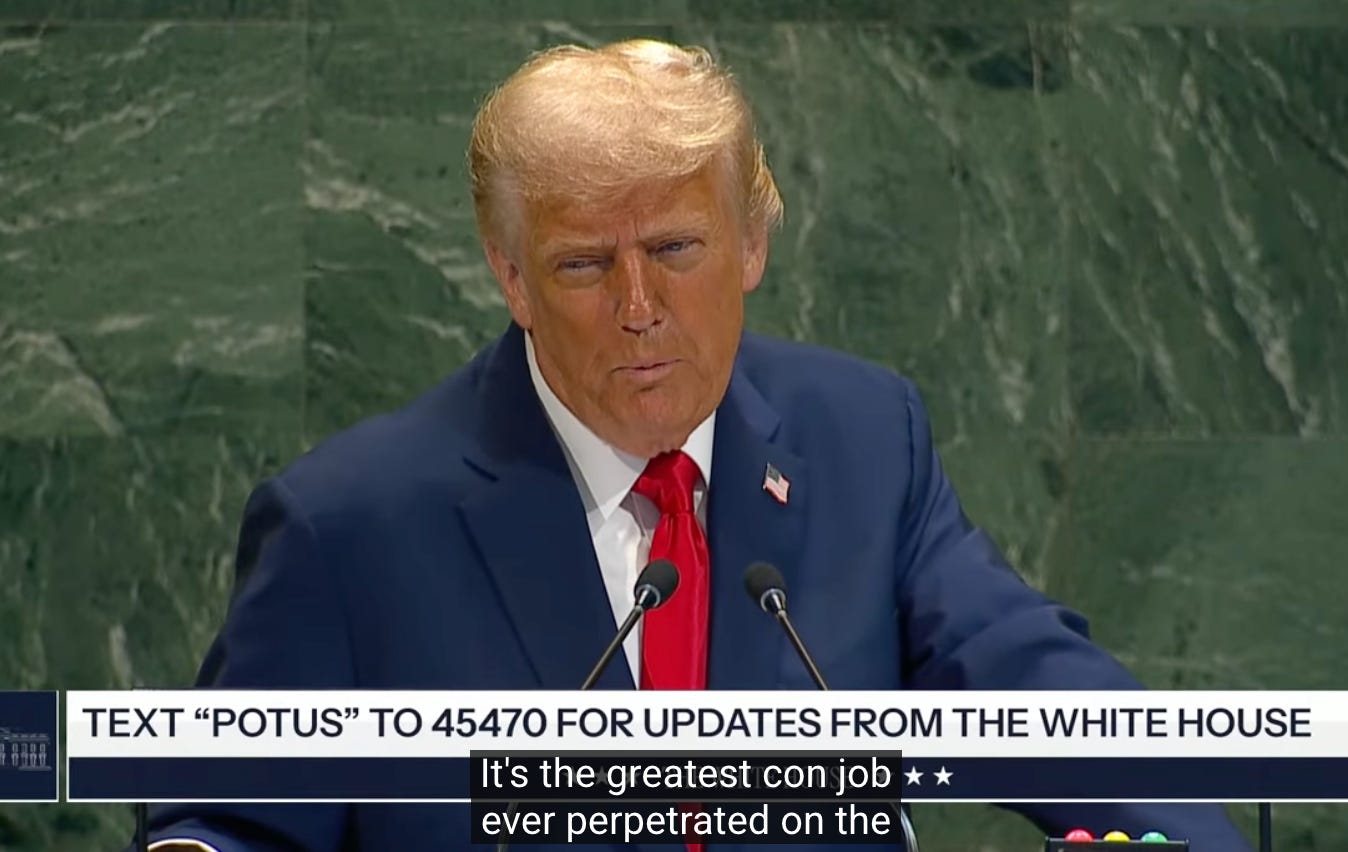
Screen shot from recording of President Trump’s speech at the UN General Assembly in New York in September 20205, when he called climate change “the greatest con job ever perpetrated on the world.”
Trump’s Environmental Protection Agency this week delivered its most sweeping attempt yet to destroy US climate action with the agency publishing a final rule in the Federal Register that eliminates the so-called greenhouse gas (GHG) endangerment finding and repeals all GHG emissions controls on motor vehicles. The 2009 endangerment finding – a science-based determination that carbon dioxide and other GHGs that cause climate change endanger public health and welfare – served as the legal underpinning for EPA rules to rein in climate pollution from sources like vehicles and power plants. In terminating the finding, EPA is now claiming it lacks the legal authority to do anything about climate change – a position that environmental and public health groups and others are now contesting through court challenges.
The rollback, these groups say, is blatantly illegal, running afoul of the Clean Air Act and Supreme Court precedent; another petition from a group of children and young Americans argues that the EPA’s move is unconstitutional. And according to the Center for International Environmental Law (CIEL), it violates not just domestic law, but international law as well.
“As the world’s highest court made clear last year, all countries, including the US, must do everything in their power to prevent further climate harm. This decision does the opposite. It heightens the risk, sacrificing environmental protection and public health for industry profits and private interest,” said Nikki Reisch, climate and energy program director at CIEL.
In its historic advisory opinion on climate change, the International Court of Justice (ICJ) said that all countries have obligations under existing law to protect the climate system. These obligations apply regardless of whether or not countries are parties to the UN climate change treaties – a clarification that is especially salient given that the US under Trump has withdrawn from the Paris Agreement and is even moving to exit the UN Framework Convention on Climate Change. Customary international law (while difficult to enforce) still provides a source of obligations that apply to climate change, the court said in its opinion.
Among those obligations is a duty to regulate industrial climate polluters. As the court stated: “A state may be responsible, where it has failed to exercise due diligence by not taking the necessary regulatory and legislative measures to limit the quantity of emissions caused by private actors under its jurisdiction.” In other words, a country may be in violation of its legal duty under international law by failing or refusing to regulate GHG emissions from private industry – precisely what the Trump administration is doing.
In refusing to regulate emissions, and also refusing to cooperate with other countries to tackle the climate problem as Trump abandons global climate treaties, the US is, as CIEL notes, defying its international duties.
“On the international stage, it cements this US administration’s position as an outlier and global pariah,” Reisch said.
But it goes even beyond that. Trump is not just attacking or shutting down climate science and policies here at home, and sidelining the US from international efforts to address this global threat. He and his administration are also actively trying to prevent other countries from adopting measures to respond to the climate crisis and to advance the clean energy transition. They are attempting to sabotage global climate action.
Just this week, for example, US Secretary of Energy (and former fossil fuel executive) Chris Wright rebuked the International Energy Agency for accounting for climate change in its energy outlook scenarios and threatened that the US would withdraw from the agency if it continued its climate focus. Following Wright’s remarks, the IEA omitted climate change from its list of priorities in a ministerial meeting summary document, Politico reported.
In another recent example, the Trump administration has reportedly been pressuring other countries to reject a Vanuatu-led draft UN resolution endorsing the ICJ’s landmark climate change advisory opinion. Vanuatu – a tiny Pacific Island nation threatened by rising sea levels – led the charge to get the UN General Assembly to vote on a resolution seeking the ICJ’s input on climate change. That resolution passed in 2023, and last year the court delivered its opinion in what many observers said was a landmark moment for climate justice. Now, Vanuatu is looking to take the next step by having the UNGA adopt another resolution that would welcome the opinion and start to translate it into “concrete multinational action.” The resolution would call on countries to take actions like adopting national climate action plans aligned with the goal of limiting global heating to below 1.5 degrees Celsius, phasing out fossil fuel subsidies, and creating an international registry to record climate damage claims.
“The resolution attempts to turn the ICJ’s interpretation of key legal standards into a practical roadmap for state accountability which is likely to trigger political pushback from higher income high emitting countries wary of their historical responsibility and financial liability,” Candy Ofime, climate justice researcher and legal advisor at Amnesty International, said in a statement.
Perhaps no country is pushing back more aggressively than the US, which circulated guidance to its embassies and consulates abroad saying that it “strongly objects” to Vanuatu’s proposal, as the AP reported. The US argues the resolution poses a major threat to US industry, and it is urging other countries to demand that Vanuatu withdraw the draft proposal.
Climate and human rights groups are urging countries to support the resolution and to not succumb to the Trump administration’s bullying.
“Vanuatu and other Small Island States are facing existential threats from a climate crisis they did not cause,” said Brad Adams, executive director at Climate Rights International. “Countries around the world—all of whom are also facing the impacts of global warming–must stand with Vanuatu at the United Nations and oppose Trump’s bullying tactics.”
In October the Trump administration worked to defeat the International Maritime Organization’s proposed fees on emissions from the most polluting ships. As Noah Gordon, a fellow and researcher at the Carnegie Endowment for International Peace, writes in a new piece published in Foreign Policy: “The U.S. State Department claimed the levies would have been the UN’s first-ever ‘global carbon tax.’ By threatening to impose tariffs on supportive countries and strip diplomats of visas, the United States was able to kill the measure.”
Gordon says that this example, along with others like the attempt to thwart Vanuatu’s UN resolution, suggest that the US under Trump has become a climate bully.
“Trump is using US power to scare other countries into reducing their climate ambition,” Gordon told me. “Europe, which relies on the US for defense and increasingly for gas, has been a big target. The White House has warned, for example, that Europe could face higher tariffs if it doesn’t walk back regulations like its Methane Regulation and Corporate Sustainability Due Diligence Directive.”
“Tariffs, or the cancellation of trade privileges, are the main tool the bullies in the White House are wielding,” Gordon added.
Today the US Supreme Court ruled that Trump’s use of emergency powers to impose tariffs is illegal. But that might not stop Trump from continuing his strong-arming abroad.
“The Supreme Court decision to invalidate Trump’s [International Emergency Economic Powers Act, or IEEPA] tariffs could complicate Trump’s plans there, though he could find other ways to implement tariffs without declaring a national emergency,” Gordon told me. “We should also expect the White House to make greater use of other tools, like visa bans on negotiators from insubordinate countries, withdrawing funding from institutions it perceives as too green or woke, like the IEA, or even threatening sanctions on countries that prefer to do business with China rather than buy US products that run on fossil fuels.”
Further Reading
Check out my latest published articles:
“Paris Court Holds Historic Climate Trial in Case Against TotalEnergies,” Inside Climate News, https://insideclimatenews.org/news/19022026/paris-totalenergies-climate-trial/
“Environmental Groups Vow to Stop Trump’s EPA From Revoking the Endangerment Finding,” Sierra, https://www.sierraclub.org/sierra/environmental-groups-vow-stop-trump-s-epa-revoking-endangerment-finding
“Michigan Tries a New Legal Tactic Against Big Oil, Alleging Antitrust Violations Aimed at Hobbling EVs and Renewable Energy,” Inside Climate News, https://insideclimatenews.org/news/15022026/michigan-alleges-antitrust-violations-against-big-oil/