

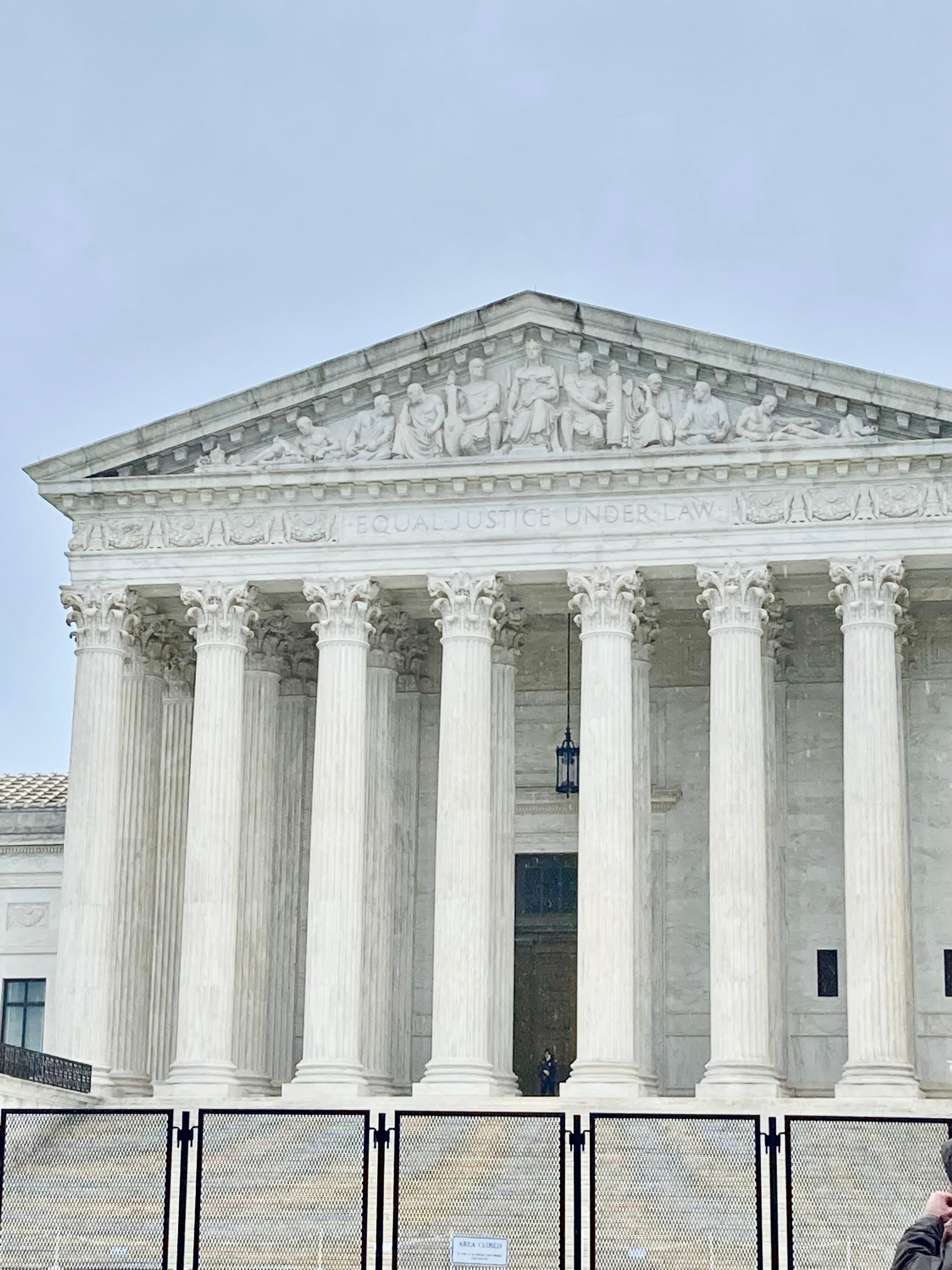
The US Supreme Court building. The Court has decided to weigh in on Big Oil’s attempt to skirt climate accountability.
Last week I wrote about how the Trump administration is trying to sabotage global climate action, actively working to try to stop other countries from adopting measures to respond to the climate crisis. At the same time, the administration is shutting down all federal avenues for climate action. The Environmental Protection Agency’s repeal of its 2009 greenhouse gas endangerment finding, along with the repeal of all controls on greenhouse gas emissions that were based on the finding, essentially strips the nation’s top environmental watchdog of its primary tool, and underlying legal authority, to mitigate climate change. As environmental legal expert Bob Sussman said during a February 27 climate law briefing hosted by the Environmental Law Institute, the recission of the endangerment finding is “the last piece to fall into place in the administration’s across-the-board push to eliminate climate change as a focus of US policy domestically and internationally. And it follows other far-reaching actions such as the US withdrawal from the 2015 Paris Agreement, and more recently the 1992 UN Framework Convention on Climate Change.”
Given that context, state and local efforts to advance climate action and hold polluters accountable become even more important, climate advocates argue. But Trump and his Republican allies are also trying to shut these efforts down. Last year in April President Trump issued an executive order titled “Protecting American Energy from State Overreach” that directed his attorney general to identify and “expeditiously take all appropriate action to stop” state and local lawsuits, policies, and practices that target or otherwise burden the fossil fuel industry. Just weeks after the order was issued, the Department of Justice brought lawsuits against the states of New York, Vermont, Hawaii, and Michigan challenging their climate liability laws and lawsuits that seek to make big oil companies pay for climate damages (though Hawaii and Michigan had not filed any lawsuits at the time the DOJ made its filings). The DOJ’s lawsuit against Michigan was recently tossed out by a federal court.
According to Attorney General Pam Bondi, the DOJ is actively considering additional actions to implement Trump’s order cracking down on state and local climate policies. During a recent oversight hearing of the House Judiciary Committee, Bondi assured Republican Rep. Harriet Hageman that her department and the entire administration are committed to “using all available legal tools to stop” state and local climate initiatives. Hageman then announced that she is working with her congressional colleagues to “craft legislation tackling both these state laws and the lawsuits” that seek accountability from large fossil fuel companies – or, as she described it, that “could destroy energy affordability for consumers.” In other words, Hageman is working on legislation that would shield fossil fuel companies from liability and block both state climate lawsuits and climate superfund laws.
Such a liability shield was included among a list of recommended actions for furthering Trump’s directive in a June letter from 16 Republican state attorneys general to Bondi. In the letter, the state AGs recommended legislation that would stop “activist-funded climate lawsuits” through a liability shield, similar to the law that granted immunity from lawsuits for gun manufacturers.
Now, it appears that the conservative-dominated US Supreme Court is positioning itself to potentially immunize fossil fuel companies from state and municipal climate lawsuits. On February 23, the court agreed to take up a petition filed by oil companies Suncor and ExxonMobil in a case brought by Boulder, Colorado against the companies.
The case, initiated in 2018, claims that the oil company defendants misrepresented the climate change risks of their products and lied about climate science in order to stave off climate policies. This deceptive conduct, the suit argues, exacerbated damaging climate impacts like extreme heat, flooding, and wildfires. Through this legal action, Boulder is seeking to recover costs to help it respond and adapt to climate change hazards. In May of last year, the Colorado Supreme Court upheld a lower court’s denial of the defendants’ motions to dismiss, allowing the case to proceed towards trial.
In response to that ruling, Suncor and Exxon petitioned the US Supreme Court to intervene, in an attempt to derail not only this lawsuit, but all other climate-related suits brought against the fossil fuel industry. Over the past eight years, cities, counties, states, tribal communities, and individuals have filed dozens of such cases against major fossil fuel industry players. Many of these cases could be blocked if the Supreme Court agrees with Suncor and Exxon on the question of whether federal law broadly prohibits state law climate change claims.
In addition to this federal preemption question, the Supreme Court will be considering whether it even has jurisdiction to take up this case. The court added this jurisdiction question in its decision to grant the oil company’s petition. Alyssa Johl, vice president of legal and general counsel at the Center for Climate Integrity (CCI), an advocacy group supporting efforts to hold climate polluters accountable, said that this indicates that “the justices do not agree whether the Court even has the authority to hear Boulder’s case at this time.”
“The Court should uphold what the Colorado Supreme Court and others have made clear: communities like Boulder have the right to seek accountability in their state courts when corporations have knowingly caused local harms,” Johl said in a statement.
While it is not yet clear whether the justices will decide that they do have authority to hear this case, the fact that they even granted the petition at all is not a promising sign for those who support climate accountability. The court denied a near-identical petition just a year ago in a different climate suit (filed by Honolulu, Hawaii against Big Oil). That denial was one of five instances where the justices have denied previous requests from oil companies or their political allies to intervene in cases against the companies since 2023, according to CCI. This time, however, the oil companies had even more political backing behind them, with amicus briefs urging the court to step in filed by the US Department of Justice, 26 Republican state attorneys general, and over 100 Republican members of the US House of Representatives.
James May, a distinguished professor of environmental and human rights law at Washburn University, told me that the court’s decision to finally accept the industry’s petition is a more impactful decision than even many legal experts realize. He warned that it “could be the beginning of the end of state-based climate claims, potentially of any flavor, statutory, common law, or constitutional.” If a majority of the justices rule in favor of the oil companies that federal law bars state law climate claims, it “potentially kills everything that the states can do” on climate, May told me.
Jean Su, an attorney with the Center for Biological Diversity, had a similar view on the consequences of the Supreme Court ruling in favor of Big Oil in Boulder’s case.
“You would have unshackled the oil and gas industry from major regulation, on both federal and state levels,” Su told me. “And that is extremely scary. It will be a Dante’s inferno.”
If Big Oil gets its way, there would be no meaningful regulation or accountability for climate change of any kind at any level – international, federal, or state and local. Trump and his political allies who are in the industry’s pocket are attempting to turn this aspiration of complete impunity into reality.
Hi Dana! I am not sure how I got your excellent and thorough blog. I am running the Illinois campaign to fight Big Oil's attempt to gain complete legal immunity. We have several actions if anyone in your reading list would like to join the fight! My email is lcderks@gmail.com. Thank you for bringing light to this very dark, destructive and deceptive industry.