

Where do we go from here? Honestly my head is spinning with the news cycle developments over the last few days – from President Trump’s illegal military intervention in Venezuela and kidnapping of its president and his claims that his administration will be “running” the Latin American country, to Trump and his energy secretary’s brazen assertions that the U.S. and its big oil companies will be taking control of Venezuela’s vast oil reserves and selling this oil “indefinitely,” to Trump’s latest directive withdrawing the U.S. from dozens (66 in total) of international organizations, treaties and conventions, many of which we had been part of for decades like the 1992 UN Framework Convention on Climate Change (UNFCCC).
The latter move of abandoning scores of international conventions and UN organizations not only further isolates the U.S. during a time of rising geopolitical tensions, but also sends a chilling message of disdain for diplomatic and cooperative global governance. According to Secretary of State Marco Rubio, such governance has become “dominated by progressive ideology” including what he calls “climate orthodoxy” – a term echoing EPA Administrator Lee Zeldin’s phrase of “climate change religion.”
This rhetoric is of course ridiculous and even dangerous, as climate change is a grave reality that more and more people are experiencing in the form of extreme weather or rising food and home insurance costs. International courts have now recognized climate change as an emergency and an existential threat, one that must be addressed through global cooperative action. The UN’s Framework Convention on Climate Change treaty was established precisely for that purpose. As the Union of Concerned Scientists explains, “Every nation in the world is party to the UNFCCC, which was adopted more than three decades ago and has been upheld by Democratic and Republican administrations in the United States alike.” No country has abandoned this bedrock climate treaty – until now. And since it was a Senate-ratified treaty, some legal experts say President Trump lacks the legal authority to unilaterally withdraw without Congressional approval. “Once the Senate has ratified a treaty, only the Senate can withdraw from the treaty,” said U.S. Senator Sheldon Whitehouse, ranking member of the Senate Environment and Public Works Committee. “This announcement is not just corrupt, it’s illegal.”
It comes on the heels of the Trump-led military operation in Venezuela to capture and abduct the country’s president Nicolás Maduro and his wife and to seize control over the country’s oil resources. Legal experts and critics say the attack was patently illegal. “The Trump Administration has demonstrated again its disregard for international law, violating the U.N. Charter’s prohibition on the use of force,” said the American Society of International Law’s Executive Director Michael D. Cooper. “In the process, the Administration has also violated United States law, which at a minimum requires consultation with members of Congress before involving U.S. armed forces in attacks like the one the world has just witnessed,” he added.
“Donald Trump has, once again, shown his contempt for the Constitution and the rule of law,” U.S. Senator Bernie Sanders said in a statement. “Trump’s attack on Venezuela will make the United States and the world less safe. This brazen violation of international law gives a green light to any nation on earth that may wish to attack another country to seize their resources or change their governments. This is the horrific logic of force that Putin used to justify his brutal attack on Ukraine.”
In the wake of the attack on Venezuela, Trump has threatened to go after other countries such as Mexico, Cuba, Colombia, and Greenland. And what’s to stop him? There is no global law enforcement institution.
With flagrant violations of international law on display – Russia’s invasion of Ukraine, Israel’s genocide in Gaza, the US abduction of Venezuela’s leader – some experts are warning that the post-World War II international legal order now faces collapse. “What the world is witnessing now is the international rules-based order being stripped of whatever value it once had,” Jorge H. Sanchez-Perez, assistant professor at the University of Alberta, wrote in a piece published this week. In another commentary published the same day in the New York Times, Oona Hathaway, a professor of law and political science at Yale and president-elect of the American Society of International Law, similarly said that the international legal system “faces total collapse” in the wake of the U.S. action in Venezuela.
“President Trump’s decision to launch a secretive predawn military operation in Venezuela to grab President Nicolás Maduro is a blatant assault on the international legal order,” Hathaway writes. “The action threatens to end an era of historic peace and return us to a world in which might makes right. The cost will be paid in human lives.” Her piece is titled “The Great Unraveling Has Begun.”
This is all happening against the backdrop of a climate system that is also unraveling, with profound consequences for humanity and all life on Earth. In the 2024 state of the climate report, leading climate and Earth system scientists warned that we are “brink of an irreversible climate disaster” and are “experiencing abrupt climate upheaval, a dire situation never before encountered in the annals of human existence.” They note that the risk of societal collapse is becoming less remote, writing: “climate change could contribute to a collapse by increasing the likelihood of catastrophic risks such as international conflict or by causing multiple stresses, resulting in system-wide synchronous failures…Climate change has already displaced millions of people, and has the potential to displace hundreds of millions or even billions more, leading to greater geopolitical instability.”
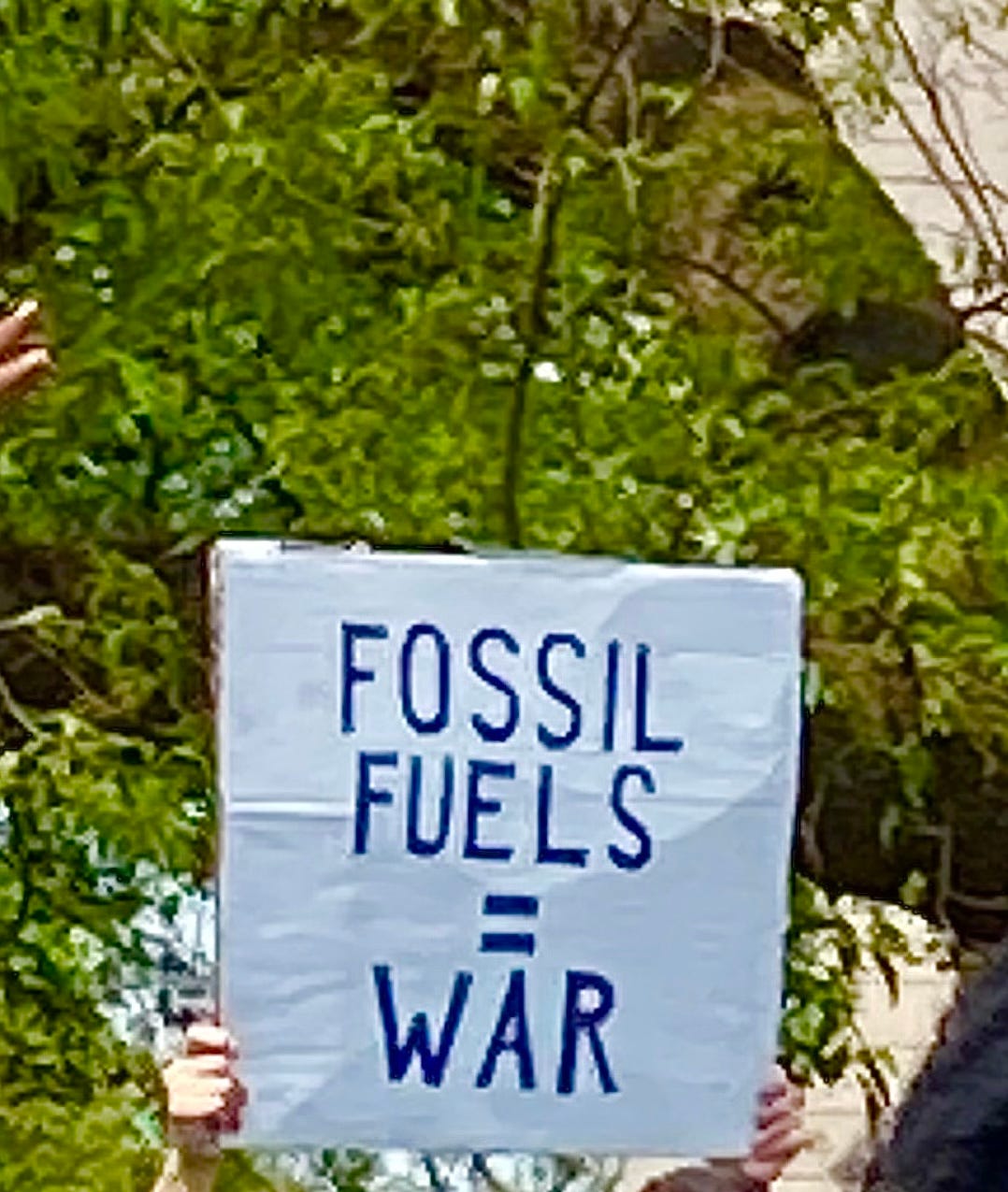
It goes without saying that, given fossil fuel combustion is the primary driver of the climate emergency, we should be accelerating the transition away from coal, oil, and gas. And yet, under President Trump, the U.S. is doing the exact opposite, boosting fossil fuels domestically and abandoning all climate policies while pressuring other countries to do the same. Now Trump is looking to exploit another country’s oil, insisting that U.S. oil companies will go in and invest billions of dollars to repair the infrastructure and “get the oil flowing.” It is unclear whether this will actually pan out.
But critics say the message is crystal clear – that Trump is putting the interests of Big Oil and his fossil fuel donors above the interests of the public. The move is also especially maddening given the worsening fossil fueled climate crisis – a reality even if Trump denies it.
“In an era of accelerating climate breakdown, eyeing Venezuela’s vast oil reserves this way is both reckless and dangerous,” Greenpeace International Executive Director Mads Christensen said in a statement. “The only safe path forward is a just transition away from fossil fuels, one that protects health, safeguards ecosystems, and supports communities rather than sacrificing them for short-term profit.”
Exploiting Venezuela’s oil reserves – the largest in the world – during a time of climate breakdown may also violate international law, as suggested by the International Court of Justice in its climate change advisory opinion issued last July. The opinion explicitly calls out countries’ continued support of fossil fuels, stating: “Failure of a State to take appropriate action to protect the climate system from GHG emissions — including through fossil fuel production, fossil fuel consumption, the granting of fossil fuel exploration licenses or the provision of fossil fuel subsidies — may constitute an internationally wrongful act which is attributable to that State.”
That may not matter much to a president that seems intent on disregarding norms and the law, both domestic and international. But it should matter to the rest of us who care about trying to preserve the rule of law and some semblance of a habitable planet – a planet that our children and future generations are inheriting and that is rapidly becoming less safe and less stable.