

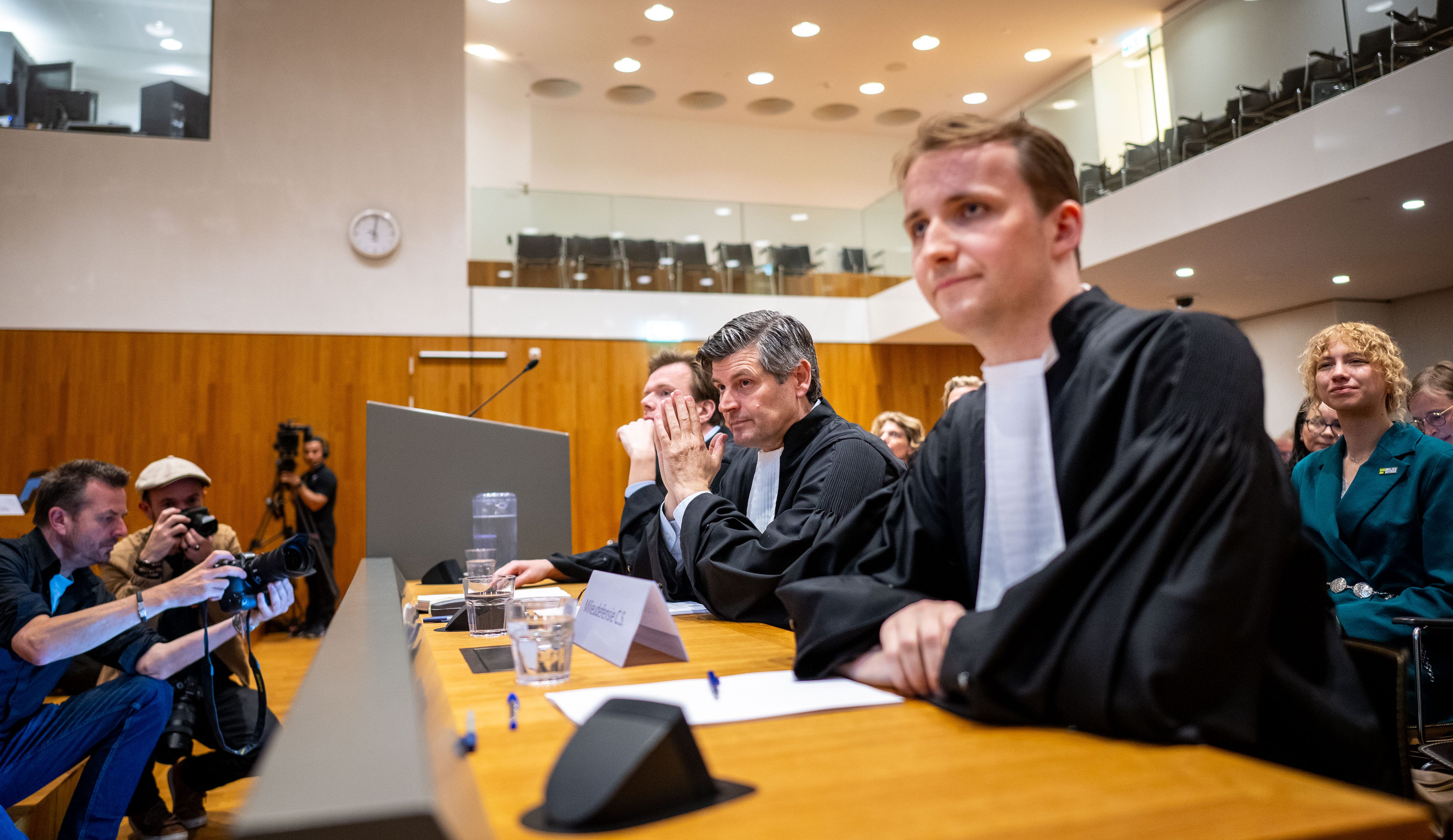
Milieudefensie’s legal team in court on May 22, 2026. Credit: Frank van Beek, courtesy of Milieudefensie
During these challenging times, it is more important than ever to speak truth to power - and to support independent journalism. One Earth Now is a 100% reader-supported publication - no billionaire backers or corporate owners here. If you have the means, please consider supporting this vital work by upgrading to a paid subscription. Thank you!
Five years ago – on May 26, 2021 – a ruling from the District Court of The Hague in the Netherlands sent shockwaves through the global oil and gas industry. The court ruled that Shell, one of the biggest oil companies on the planet, had a legal duty to act on the climate crisis in line with the goals of the Paris Climate Agreement. In a groundbreaking climate change court case brought by Dutch environmental organization Milieudefensie (Friends of the Earth Netherlands) and supported by several other NGOs and over 17,000 citizens, Shell was ordered by the court to reduce CO2 emissions across its entire supply chain by 45 percent by 2030. It was the first time a court anywhere in the world had imposed a specific emissions reduction obligation on a large carbon-emitting corporation.
Climate activists hailed the verdict as “historic” and a “watershed decision” with significant implications for major oil and gas companies.
“This is a turning point in history,” Roger Cox, a lawyer for Milieudefensie, said at the time. “This case is unique because it is the first time a judge has ordered a large polluting company to comply with the Paris Climate Agreement. This ruling may also have major consequences for other big polluters.”
On Friday, May 22, Cox and Milieudefensie were back in The Hague facing off once more against Shell in court – this time before the Netherlands’ Supreme Court. The ruling and emissions reduction order from five years ago had been overturned by an appeals court in November 2024. Milieudefensie is now asking the country’s highest court to reinstate it, because without a binding obligation for Shell to slash its carbon emissions by a specific percentage, accountability goes out the window.
“If Shell is allowed to continue like this, we must conclude that modern society and the choices made within it have created private-law entities that are more destructive than states, yet which no one can keep in check. Not through politics, nor through the law,” Cox told the Dutch Supreme Court in his closing argument on Friday. “In that case, the democratic rule of law and the international legal order will have proved more vulnerable than we thought, and we will collectively have to pay the costs for that. That price will be high, unimaginably high.”
The consequences of the fossil fueled climate crisis are already costing society a great deal, and these costs are only getting steeper as the crisis deepens. We are all paying for the destructive climate impacts of the fossil fuel industry’s business model, whether that is through higher home insurance premiums, rising food prices or adverse health impacts. Fossil fuel companies are the only ones not paying for the consequences of the pollution generated by their products. Billionaire executives profit while consumers get squeezed - a reality that is especially salient right now given the soaring fuel prices driven by the war on Iran, which has resulted in massive windfall profits for Big Oil. Shell recently reported nearly $7 billion in first quarter earnings.
But rather than invest in the energy transition, the fossil fuel industry is working to obstruct it, or at least slow it down. In addition to expanding oil and gas supply – Shell for example plans to grow its liquefied natural gas (LNG) sales by 20-30 percent by 2030 and to spend about $100 billion on upstream oil and gas – big oil companies are actively lobbying to block or weaken regulations and climate policies. As ExxonKnews reporter Emily Sanders explained in a piece last October: “While backing away from its commitments to renewable energy and doubling down on oil and gas, fossil fuel giants have spent big to escape regulation and oversight. Oil and gas companies and trade associations have continued lobbying to weaken and kill policies to reduce emissions.”
That point about how companies like Shell work to influence demand for their products and lobby to help shape regulatory policy was brought up by Milieudefensie’s legal team during Friday’s hearing. As Sébastien Duyck, a senior attorney with the Center for International Environmental Law who attended the hearing wrote in a social media thread: “The NGOs lawyer points to the fact that Shell, along with four other major oil and gas companies, has spent 250 million Euros over an 8-year period to influence the climate and corporate policies of the European Union. The scale of this figure is mind-blowing.”
“These pleadings have sought to demonstrate that Shell is not the politically neutral actor it pretends to be, supplying a public demand for energy, but rather that the fossil fuel industry holds a stranglehold over society shaping collective choices,” Duyck added.
Court Confirmed Shell “Has an Obligation to Counter Dangerous Climate Change”
When the Court of Appeal in 2024 overturned the emissions reduction order and dismissed the lawsuit against Shell, it did not let the oil major entirely off the hook. The court explicitly stated that “Shell has an obligation to counter dangerous climate change” and to reduce its CO2 emissions. “Companies like Shell thus have their own responsibility in achieving the targets of the Paris Agreement,” the court said. It also suggested that Shell’s planned investments in new oil and gas fields “may be at odds” with this responsibility.
Where the court fell short, according to Milieudefensie, is in failing to hold Shell accountable to a specific level of emissions reduction. “Without a concrete reduction target, these obligations remain too open-ended. A concrete percentage helps to truly protect people worldwide from dangerous climate change which Shell is contributing to,” said Milieudefensie’s Winnie Oussoren. “We’re back in court to hold Shell accountable.”
In a statement, Shell said it believes that what Milieudefensie is demanding “has no basis in law and is not effective; would create conflicting rules across Europe; could have serious unintended consequences for Dutch and European competitiveness; and could hinder a balanced and secure energy transition in Europe and globally.”
“With the reduction order that Milieudefensie is seeking, they are effectively asking the courts to design climate policy,” Shell said. “We believe that policymaking and international cooperation, along with investment and action across all sectors, will drive the progress needed at a global scale in the energy transition.”
Oussoren argued that Shell is just continuing to try to evade accountability for its own role in driving the climate crisis. “Shell presented its usual excuses to avoid fulfilling its duty to combat dangerous climate change,” she said. “It is abundantly clear: Shell continues to invest heavily in polluting fossil fuels and keeps the world addicted to oil and gas, which we urgently need to move away from.”
It is now up to the Dutch Supreme Court to determine whether or not it will hold Shell accountable. According to Milieudefensie, this is the first time anywhere in the world that a country’s highest court is considering a company’s civil law obligation to reduce CO2 emissions in order to mitigate dangerous climate change.
A decision is expected sometime in 2027.
U.S. Supreme Court to Take Up Climate Case
Meanwhile, in the United States, the Supreme Court is taking up a case later this year that could result in the oil and gas industry effectively being shielded from civil liability for its role in contributing to climate change harms and lying about it. The case, Suncor Energy et al. v. County Commissioners of Boulder County, involves a Colorado municipality that sued oil companies ExxonMobil and Suncor in 2018 alleging that the companies’ decades-long deception about the climate risks of fossil fuels worsened the climate crisis that is already damaging the community of Boulder; and Boulder wants to make the companies pay for this damage.
The case is among dozens of climate accountability suits filed against Big Oil in the U.S., and it was on track to head towards trial. But earlier this year the Supreme Court decided to intervene at the companies’ request, a move that could derail not only this one case but potentially others like it as well.
So, while the Supreme Court of the Netherlands decides whether Shell should be held to a concrete emissions reduction obligation, the Supreme Court of the U.S. will be deciding whether Exxon and other oil companies should have to face state law climate change claims at all. Even if the latter decides in favor of Exxon (which perhaps seems likely), Big Oil may not be able to evade climate accountability everywhere and forever. The court in the Netherlands could decide to hold Shell accountable, for example. And if it doesn’t, Milieudefensie has already filed a second climate case against Shell challenging its oil and gas expansion plans. Shell is also facing a fresh climate suit in the UK. More cases could soon be filed. Eventually, Big Oil will face a reckoning through the courts.