

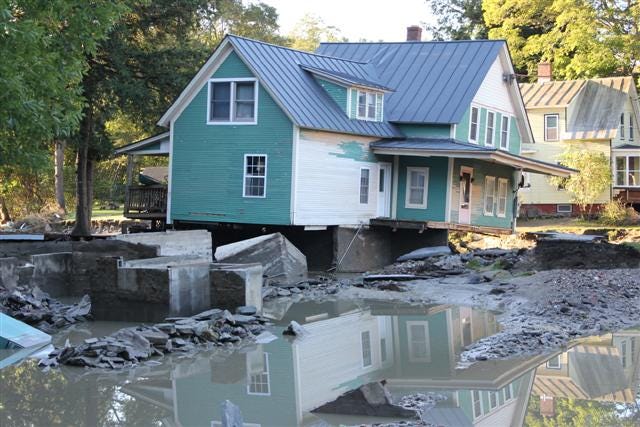
Houses in Bethel, VT sustained severe damage from Hurricane Irene in 2011. Credit: U.S. Fish and Wildlife Service Northeast Region via Flickr
All across the United States, households are facing a mounting affordability and cost-of-living crisis. Costs are rising across the board, from groceries and electric utility bills to health insurance and housing. Part of the rising cost of housing is the increasing price of homeowners insurance – a very real increase that is hitting Americans hard in their pocketbooks.
In Hollywood, Florida – a city of over 154,000 residents located roughly 20 minutes north of Miami – windstorm property insurance premiums have more than doubled over the past five years, the city’s mayor Josh Levy testified during a spotlight hearing held by Senate Democrats in May. “My own premium for homeowners’ coverage jumped from $3,200 a year to over $7,000 in a single year,” Levy said.
“We’re marching toward an uninsurable future” - Former California Insurance Commissioner Dave Jones
Massachusetts Senator Elizabeth Warren noted during the hearing that in her state, home insurance rates went up by 16 percent just last year. In Texas, Houston resident Rocky Kneten testified that he has seen “significant premium increases in the last half dozen years.” Kneten said his homeowners’ insurance premium has more than doubled since 2010.
Experts say it is clear that climate change, which is supercharging extreme weather and ‘natural’ disasters like hurricanes, flooding, and wildfires, is a big factor driving the rising costs of home insurance. Philip Mulder, assistant professor of risk and insurance at the University of Wisconsin, said that his research “shows an unmistakable connection between disaster risk and rising premiums.” With extreme weather on the rise, insurance companies are taking on more risk and losses, and in some especially high-risk areas they are dropping coverage altogether.
“As losses go up, insurers pull back and raise prices,” Dave Jones, former insurance commissioner for the state of California, explained during a press briefing hosted by Covering Climate Now earlier this year. His state has been particularly hard hit by wildfires in recent years, including the devastating blazes that torched the greater Los Angeles area in January. These types of catastrophic events are occurring across the country as the climate crisis unfolds, and as a result, Jones warned, “we’re marching toward an uninsurable future in the United States and across the globe.”
Senator Sheldon Whitehouse of Rhode Island has repeatedly been raising the alarm about the climate change-fueled homeowners’ insurance crisis and the prospect that it could cascade into the broader economy. Rising costs and unavailability of homeowners’ insurance impacts mortgages (since you generally can’t get a mortgage without insurance) and in turn, property values and the wider real estate market. The chief economist for Freddie Mac, Whitehouse says, has warned that there is likely to be another 2008-style economic recession on the horizon.
But that is not the whole story, because, as Whitehouse says, “this is a story with a villain in it.” The senator says it is imperative to spotlight this villain, which is, of course, the fossil fuel industry and its web of front groups and enablers. This operation, Whitehouse said during a press briefing last month ahead of the COP30 UN climate summit, “has engaged in a decades-long campaign of climate denial fraud.”
That part of the story, that the climate emergency we are experiencing today has in large part been engineered by the fossil fuel firms whose products and extractive business model result in climate-destabilizing pollution, is supported by evidence uncovered through multiple investigations in recent years by journalists, academics, and Democratic members of Congress. As Jones said during the CC Now press briefing, there is strong evidence demonstrating “that the oil majors knew that their emissions were going to cause this very outcome, and yet they misled, deceived, and lied to the American public about it.”
In an op-ed published in The New York Times in January in the wake of the Los Angeles wildfires, Jones called for holding oil companies accountable for climate-related damages including rising insurance costs. “As the former insurance commissioner of California, I can confirm that private insurance companies cannot continue to provide coverage at anything approaching affordable rates in the face of increasing climate-driven disasters,” Jones wrote. “States, cities and regulators urgently need to hold the oil and gas industry accountable for the devastation that fossil fuels cause.”
Some municipal and state governments are already taking oil and gas majors to court over alleged climate deception and consequent damages. And now, for the first time, Big Oil is facing a class action lawsuit seeking accountability for the skyrocketing costs in homeowners’ insurance.
The lawsuit, filed last week in federal district court in Washington State, alleges that the oil and gas industry has engaged in a decades-long campaign of deception on climate change that has effectively delayed the transition to clean energy and worsened the damaging impacts that are resulting in rising insurance rates. The two plaintiffs, Richard Kennedy and Margaret Hazard, are both Washington residents who have seen sharp increases in their homeowners’ insurance premiums. Hazard’s premiums have doubled since 2017 while Kennedy’s has more than doubled over that time. They are representing a larger class of homeowners who have or will purchase insurance after 2017 in both the US and Washington State.
“We see a direct correlation between Big Oil’s lies and the alarming increase of homeowners insurance due to the rising threat of natural disasters,” said Steve Berman, lead lawyer on the case who previously served as special assistant attorney general for 13 states in the litigation against Big Tobacco. Just as the tobacco industry misled the public about the damaging impacts of its products, resulting in significant public health costs, the fossil fuel industry has lied about the harms of its business, resulting in huge costs that are falling on the public, the case contends.
“Big Oil’s deception has become the most costly lie – a lie worth hundreds of billions of dollars,” Berman said.
Defendants include ExxonMobil, BP PLC, Chevron, ConocoPhillips, Shell and its subsidiary Equilon Enterprises, and the industry’s chief trade association - the American Petroleum Institute. The case brings federal claims including violations of the Racketeer Influenced and Corrupt Organizations (RICO) Act, as well as state law claims of fraudulent misrepresentation, civil conspiracy, unjust enrichment, nuisance, and violation of the Washington Consumer Protection Act. Plaintiffs seek compensatory damages, including an award of treble damages, and restitution and disgorgement of profits as well as an order for defendants to cease their deceptive conduct.
A similar class action RICO case brought by Puerto Rican municipalities against many of those same defendants (plus additional ones) was recently dismissed by a federal district court over a procedural statute of limitations issue, though the municipalities are now pursuing an appeal. That case sought to hold the industry liable for damages associated with the 2017 hurricanes that decimated Puerto Rico.
The new lawsuit is the first to target Big Oil for rising home insurance costs, and just the second climate deception case brought by individuals. In May a woman in Washington State who lost her mother in the 2021 Pacific Northwest heat dome brought a wrongful death suit against Exxon and other big oil companies.
The litigation likely has a long journey ahead in the courts, and Big Oil lawyers are currently turning once again to the US Supreme Court in an attempt to stop all climate cases pending against Exxon et al. before any case can get to trial. There is certainly no guarantee that the lawsuits will succeed or that the oil companies will be forced to pay for some of the damage they have brought about. But without these accountability efforts, it is guaranteed that the costs will continue to fall entirely upon everyday Americans.
As Prof. Mulder, the expert in risk and insurance, noted during the Senate Democrats’ hearing, “The rising cost of homeowners insurance is a reminder that climate change creates real costs for household budgets.”
Fighting for climate justice in the courts is a great way to enact change. Once a precedent is set it opens the doors for others to take action too.