

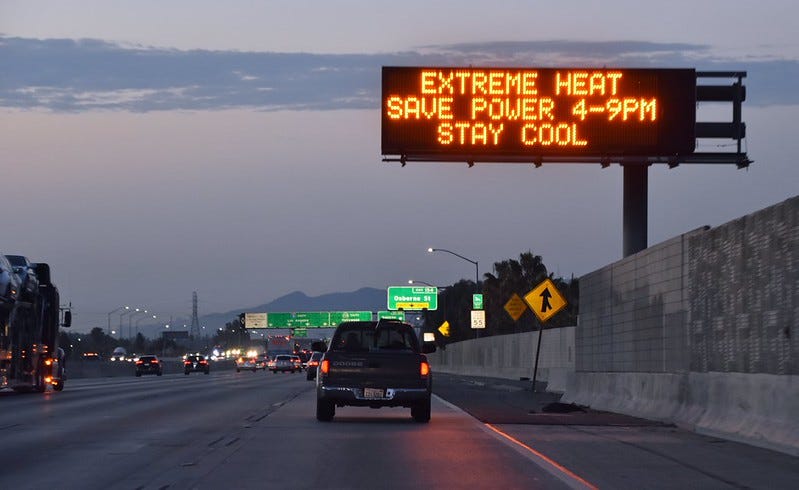
Credit: fourbyfourblazer via Flickr, CC BY 2.0
June 1 marked the start of meteorological summer. It goes without saying that summers have been heating up as the concentration of heat-trapping greenhouse gases in the atmosphere continues to rise. The planet is rapidly warming – the last three years were the three hottest years on record so far. This year could be the warmest one yet, or perhaps 2027 will rank in the top spot. Regardless, climate scientists are warning that even more perilous heating and turbulent extreme weather is in store – and on top of that, an El Niño is developing, which is poised to amplify the warming and greatly increase the risk of severe weather.
According to a recent update from the World Meteorological Organization (WMO), there is an 80 percent likelihood of an El Niño forming from June through August, and a 90 percent chance that it will continue through at least November. El Niño is a natural part of the climate system and the warmer phase of a cycle known as the El Niño-Southern Oscillation, fueled by above average sea surface temperatures in the equatorial Pacific Ocean. The most recent El Niño occurred in 2023-2024 and was a strong one, playing out under a baseline of anthropogenic warming that scientists warn is accelerating. That combination led 2024 to register as the hottest year on record. Now, this pattern appears likely to repeat, with man-made warming continuing and some forecasts indicating a strong or potentially very strong El Niño is on its way.
“The science is clear: El Niño is arriving on our doorstep in the coming months with 90% certainty. The world must treat it as the urgent climate warning it is,” UN Secretary-General António Guterres said in a video message commenting on the WMO update. “El Niño conditions will pour fuel on the fire of a warming world. Impacts will hit even harder, travel even farther, and cross borders with devastating speed. The only effective response is climate action equal to the crisis – ending the addiction to fossil fuels, accelerating the shift to renewables, protecting the most vulnerable, and delivering early warning systems for all.”
During a media briefing last month on the extreme weather outlook for 2026, climate experts also called attention to the worsening climate crisis and the urgent need to curb planetary heating – caused largely by burning fossil fuels – noting that El Niño is a natural phenomenon that is beyond our control.
“While El Niño could lead to very extreme conditions later this year, it’s not the reason to freak out,” said Friederike Otto, professor in climate science at the Centre for Environmental Policy, Imperial College London, and co-founder of World Weather Attribution. But climate change, she said, “gets worse and worse and worse as long as we do not stop burning fossil fuels,” and it is “already a much stronger influence on many extremes than most natural modes of variability.”
“Climate change is the reason to freak out,” Otto said.
“What is not natural is [El Niño] is now operating on a planet that human activity has fundamentally destabilized,” said Jemilah Mahmood, executive director of the Sunway Centre for Planetary Health.
“Climate change is not going away unless we do something about it,” she added. “The physics hasn’t changed, the science hasn’t changed, only the political will has wavered.”
Extreme heat has already made its mark in 2026. Europe recently sweltered through a heat wave that shattered temperature records; Otto said this heat event “has the fingerprints of climate change all over it.” In January a blistering heat wave that was made five times more likely by climate change gripped southeastern Australia – the area’s most severe heat wave in six years. And in March an unusually early and record-breaking heat wave impacted millions of people in the U.S., mainly out west. Researchers say this early spring extreme heat event would have been “virtually impossible” without climate change.
Heat waves are the deadliest type of extreme weather. As Mahmood explained, an estimated 546,000 people die every year from heat-related causes. And that figure is almost certainly an undercount. As long as the planet continues to heat up, more and more lives will be lost or put at risk. According to Otto, 2026 is sure to “become extremely hot because of human-induced climate change,” regardless of the impact of a potentially strong El Niño.
Wildfires are another weather-related hazard that are becoming worse with climate change. More than 150 million hectares of land burned globally from January through April this year, which is a record for this four-month period. “This year the global fire season has got off to a very fast start,” Theodore Keeping, researcher at the Centre for Environmental Policy, Imperial College London, said during the media briefing. “This rapid start, in combination with the forecast El Niño, means that we’re looking at particularly severe [fire] year materializing.”
Yet despite the clear evidence of more extreme and dangerous weather supercharged by an overheating planet, the policy responses have not been commensurate with the scale of the crisis that is unfolding.
“In the last few years, we have seen a retraction from climate commitments in some countries,” said Patricia Espinosa, former executive secretary of the UN Framework Convention on Climate Change (UNFCCC).
This retreat has been especially stark in the U.S., where the Trump administration has taken a wrecking ball to climate policies and climate science. It has gutted key scientific agencies like the National Oceanic and Atmospheric Administration (NOAA) and NASA and undermined federal disaster response through FEMA. The Environmental Protection Agency earlier this year rescinded its science-based finding that greenhouse gas emissions endanger public health and welfare, cementing climate denial as the official policy of the federal government. And President Trump has moved to withdraw the U.S. not only from the Paris Agreement, but also the underlying bedrock global climate treaty – the UNFCCC.
It is hard not to conclude that the only beneficiaries of these actions are billionaire fossil fuel executives, because serious climate action is a threat to their profits and business model. It is why the fossil fuel industry purposefully engineered climate denial.
“Most people in the world are severely impacted by climate change, and for those [people] it is a crisis,” Otto during the media briefing. “It’s just not a crisis for those who profit from selling oil, gas, and coal, and those are unfortunately the ones who set at the moment the tone of the global debate.”
In a new report, Public Citizen’s Climate Accountability Project director Aaron Regunberg lays out the case for why Big Oil deserves to be blamed for the increasingly dangerous – even lethal – extreme weather and climate-fueled disasters that are effectively ruining our summers in the U.S.
“Summer has always been a time for fun: family vacations, beach days, block parties. But for millions of Americans, this excitement has shifted to anxiety over the threat of heat waves, hurricanes, drought, and wildfires that continue to get worse every summer. These are not natural disasters. They’re exactly the kind of climate harms that Big Oil companies predicted their fossil fuel products would cause, as climate attribution science can demonstrate in increasingly precise ways. And this summer could be dangerous on a whole new level thanks to a climate-intensified El Niño,” Regunberg said in a statement.
“Americans deserve to know that their summers haven’t simply gotten worse,” he added. “They have been made worse by specific companies that knew their conduct would cause these harms, and spent decades orchestrating fraudulent campaigns of climate denial to cover up this reality.”
With people’s health, safety, and even their lives on the line, climate action cannot wait. As Mahmood said: “We need to speak uncomfortable truths to power.”
Now we must stop drilling for gas & leaking methane at every step of the process, from harvest through transport and burning, etc,.