

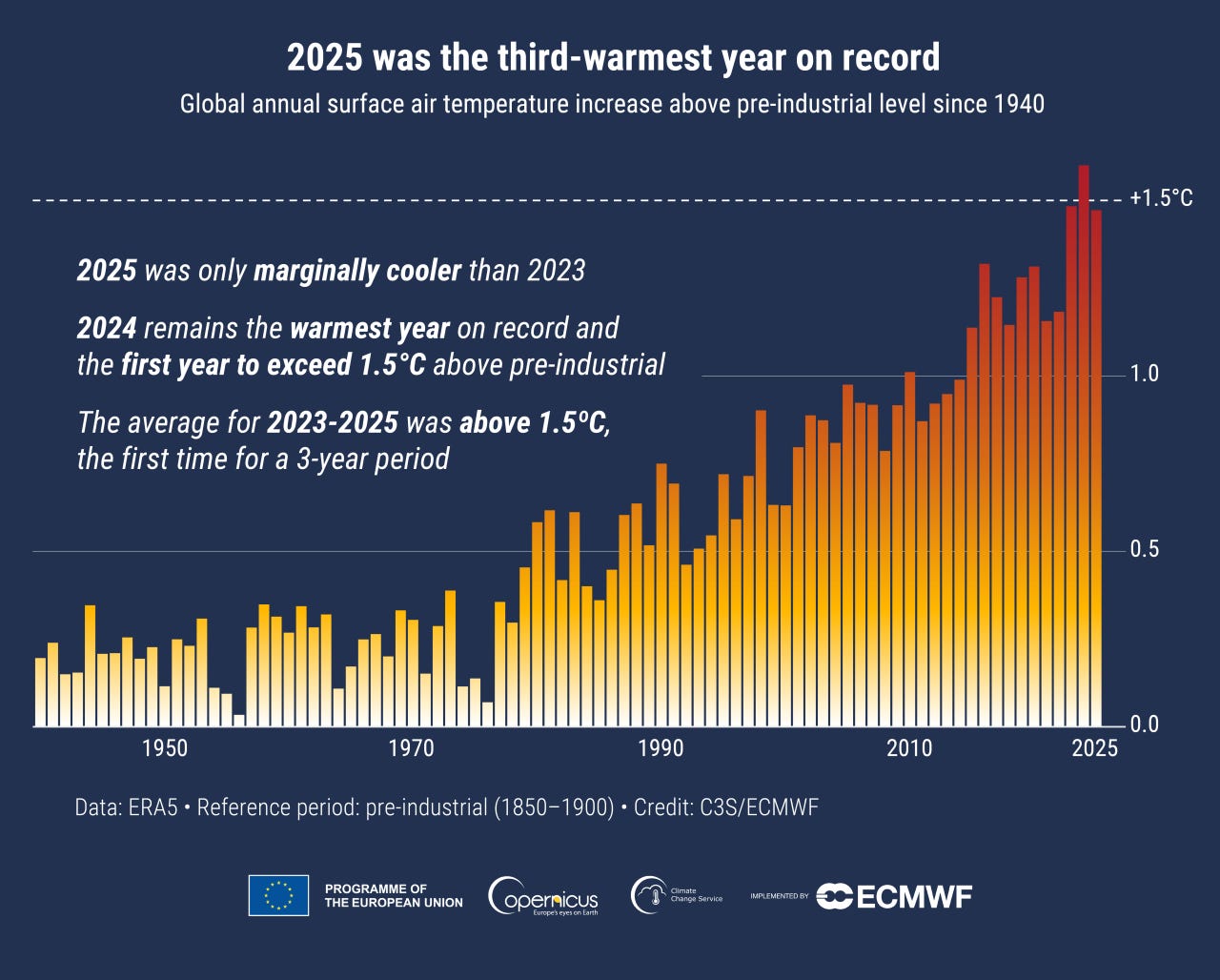
Credit: C3S/ECMWF
Multiple climate monitoring services have reported that 2025 was the third hottest year on record globally, behind only 2023 and the current record-holder 2024. Over these last three years, global average temperatures exceeded 1.5°C above pre-industrial levels, according to the Copernicus Climate Change Service. The level of long-term heating is now at about 1.4°C and could reach 1.5°C - the threshold that countries said in the Paris Agreement they would strive to not exceed – by the end of this decade, 2030.
This is not an anomaly but rather a clear sign of a rapidly warming planet, scientists say. The period of 2015 through 2025 has been the hottest ever recorded, with each of those eleven years being among the 11 warmest years yet.
“The fact that the last eleven years were the warmest on record provides further evidence of the unmistakable trend towards a hotter climate,” said Carlo Buontempo, Director of the Copernicus Climate Change Service. “The world is rapidly approaching the long-term temperature limit set by the Paris agreement. We are bound to pass it; the choice we now have is how to best manage the inevitable overshoot and its consequences on societies and natural systems.”
Ocean heat in 2025 was also at record levels. And as World Meteorological Secretary General Celeste Saulo explained, “High land and ocean temperatures helped fuel extreme weather – heatwaves, heavy rainfall and intense tropical cyclones.”
The impacts of intensifying and more frequent extreme weather are becoming ever-more costly and severe. “Another year in the top three hottest on record, and communities everywhere are feeling it. Extreme weather isn’t rare anymore—it’s driving up food prices, insurance premiums, water shortages, and upending daily life across the globe,” Savio Carvalho, managing director for campaigns and networks at the climate action group 350.org, said in a statement.
Scientists say such impacts will only get worse absent urgent action to curb greenhouse gas emissions, which are primarily caused by burning fossil fuels.
“2025’s extreme events are another warning: human-caused climate change is intensifying, and without reducing greenhouse gas emissions, the risks to society and ecosystems around the world will get worse,” said Zachary Labe, climate scientist at Climate Central.
“The fact that the 1.5°C limit has been exceeded for an average three-year period means that everyone should be prepared for more adverse weather, especially heat-related extremes. Their number will continue to increase every year until we end our toxic relationship with fossil fuels,” warned Karsten Haustein, a climate scientist at Leipzig University.
Bill McGuire, professor emeritus of geophysical and climate hazards at University College London, said the latest climate data indicates a situation that is grim but not unexpected. “Whichever way you look at it, dangerous climate breakdown has arrived, but with little sign that the world is prepared, or even paying serious attention.”
McGuire called for more action “to stop every tonne of carbon being emitted, and prevent every fraction of a degree rise in the global temperature.” Not doing this, he warned, “will inevitably consign our children and their children – and countless generations down the line – to a hothouse hell.”
“It is hard to describe just how serious the risks to humanity are, as we rapidly take ourselves out of the climate our entire agriculturally-based civilization is based on,” John Marsham, professor of atmospheric science at University of Leeds, said in commenting on the latest data. “Impacts on ecosystems, and human food and water systems are rapidly escalating and we are risking a climate that, in my kids’ lifetimes, is almost as different from our natural climate as the last ice-age was, only hotter instead of colder.”
Marsham warned that this “will be catastrophic for ecosystems, human health, and our food and water systems.”
“We need people to call for urgent action,” he added, “and hold both politicians and the media to account.”
Indeed, with limited exceptions (such as The Guardian), the mainstream media tends to not treat the climate crisis as the emergency that scientists say it is. Media coverage that focuses only on political realities without communicating the scientific realities of climate change does a disservice to readers. As Mark Herstgaard, executive director and co-founder of Covering Climate Now, writes in this week’s The Climate Beat newsletter, “gaming out the politics of climate change has to be weighed against what thousands of alarmed scientists have been saying for years: Civilization is hurtling toward irreversible catastrophe, and the only realistic escape route is to phase out fossil fuels as quickly as possible.”
The United States under President Donald Trump is doing the exact opposite, doubling down on the very fuels that are dangerously overheating the planet while aggressively trying to thwart clean energy, abandon all domestic and international efforts to address the climate problem, and dismantle scientific research and misrepresent climate science.
Last July the U.S. Department of Energy released a controversial report authored by five climate deniers with ties to fossil fuel interests that disputed the scientific consensus on climate change risks and downplayed the dangers of global heating. The report was widely criticized by the scientific community; more than 85 scientists submitted a detailed response arguing that the DOE report “misrepresents the state of climate science by cherry-picking evidence, exaggerating uncertainties, and ignoring decades of peer-reviewed research.”
Now, it appears that the Climate Working Group – the same group of contrarians that authored the DOE climate report – has been asked to work on the next National Climate Assessment, as E&E News reported. The National Climate Assessment is a Congressionally mandated climate report that synthesizes the latest science on climate change risks and impacts in the United States.
“In the past this was something that was done with a careful process involving federal government agencies, hundreds of independent scientists, lots of opportunity for public comment and comment from the National Academies. It was a rigorous process that led to its credibility,” Rachel Cleetus, senior policy director in the climate and energy program at the Union of Concerned Scientists, told me. She was one of the experts who had been working on the sixth NCA before the Trump administration ordered they all be dismissed. “[The administration] wants to come up with some trumped up version that essentially is designed to further their goal of not acting on climate and continuing to boost fossil fuels,” she added.
Trump’s EPA, meanwhile, is about to finalize its repeal of the endangerment finding – a science-based determination that the agency made in 2009 that greenhouse gases endanger public health and welfare. That finding requires EPA to regulate greenhouse gases under the Clean Air Act, so doing away with it effectively destroys one of the federal government’s primary tools to curb these emissions.
Trump is not just attacking climate action here at home. He is also trying to slow global efforts to tackle this threat. He is withdrawing the U.S. not only from the Paris Agreement, but from the overarching international climate treaty known as the UN Framework Convention on Climate Change.
All of these moves may increase short term profits for fossil fuel billionaires, but will ultimately be harmful to ordinary Americans and people around the world as the climate crisis accelerates.
“The Trump administration is not simply refusing to face the realities of climate change we are experiencing, it is actively lying about the science and undermining our nation’s federal scientific resources. Acting like there’s no tomorrow by trying to force even more burning of coal, oil and gas will cost lives and make the Earth a harder place to live in the years to come. The administration is also abdicating any semblance of international leadership through its radical actions to increase heat-trapping emissions and drop out of global climate agreements designed to limit warming and help protect people and ecosystems,” Carlos Martinez, senior climate scientist at the Union of Concerned Scientists, said in a statement.
“We have the technology and scientific knowledge to power the world through clean energy while also investing in climate resilience,” he added. “Clinging to an obsolete and dangerous fixation on fossil fuels will bring profits to a few and deprive billions of others on the planet of a secure and livable future.”