

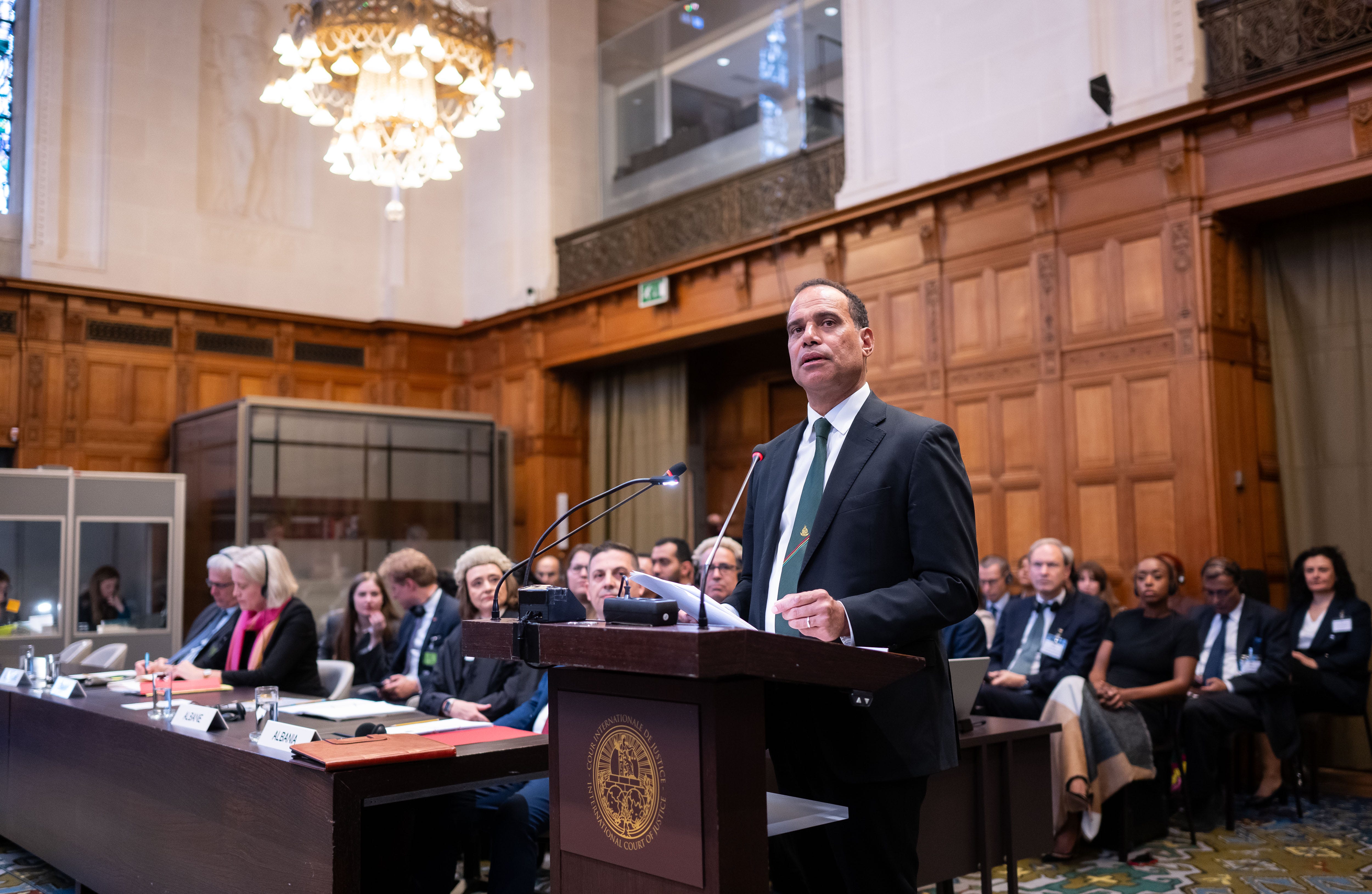
Vanuatu’s climate and environment minister Ralph Regenvanu addresses the International Court of Justice in December 2024. Credit: UN Photo/ICJ-CIJ/Frank van Beek. Courtesy of the ICJ
It’s been nearly a year since the world’s highest court, the International Court of Justice (ICJ), delivered a landmark advisory opinion that clarified that climate action is not optional, but is in fact a legal obligation. The unanimous ruling from the court on July 23, 2025 confirmed that all countries are required, under multiple sources of existing international law, to do their utmost to mitigate and adapt to the climate crisis. Obligations are not limited to participation in the UN climate treaty regime, as customary international law principles – like the duty to prevent transboundary harm – apply to all countries regardless of whether or not (as is the case now with the U.S.) they are party to the Paris Agreement and the UN Framework Convention on Climate Change.
In short, the court drew a line in the sand, clarifying for the first time what the law demands in terms of the global response to what is for many vulnerable populations and countries an existential threat.
Now, it is up to UN member countries to decide what to do with the court’s opinion. This week the United Nations General Assembly is expected to vote on a resolution spearheaded by the small island Pacific nation of Vanuatu that endorses the opinion and calls upon countries to act on it. Experts and climate justice advocates say the resolution is a key step towards implementing the court’s guidance, and the vote – scheduled for May 20 – will be a major test of countries’ commitment to international diplomacy (or in UN parlance, multilateralism) and the rule of law.
“This resolution is such a critical piece of the implementation puzzle,” Joie Chowdhury, senior attorney and climate justice and accountability manager at the Center for International Environmental Law (CIEL), said during a March 9 webinar. Now that the court has spoken, what remains is the “political will to act” on the ruling, she noted, adding that it’s “very much about reaffirming faith in multilateralism and the rule of law.”
“We celebrated last year’s ICJ Advisory Opinion as an unparalleled moment of legal consensus on the climate crisis,” said Vishal Prasad, director of Pacific Island Students Fighting Climate Change. “This resolution is a call for all countries to turn that legal consensus into political action. The Pacific did not campaign for years to win legal clarity only to watch it sit on a shelf.”
How We Got Here
Pacific Island Student Fighting Climate Change initiated the campaign to, as they described it, take the world’s biggest problem to the world’s highest court. For many communities in the Pacific region, especially small island nations like Vanuatu, climate change threatens their long-term survival. Climate justice is therefore a top priority for young Pacific Islanders, and their campaign gained the backing of the government of Vanuatu and other countries in the region. These countries lobbied other UN member states to support their initiative to request an advisory opinion on climate change from the ICJ – the principal judicial body of the United Nations.
On March 29, 2023 the UN General Assembly took up a resolution that would formally make this request and begin the ICJ advisory opinion process. The resolution, backed by 132 countries as co-sponsors, passed by consensus or general agreement without an official vote. Not all countries supported it – the U.S. for example abstained – but no country tried to block its adoption.
The court proceeding that followed saw a record level of participation; representatives of nearly 100 countries gave oral statements during a two-week hearing in December 2024. It was the biggest case, in terms of engagement, in the court’s history.
The court’s opinion was unanimous, and was hailed as a historic moment for climate justice. The opinion itself is nonbinding, but experts say it carries authoritative weight and could be used as persuasive guidance in domestic climate court cases and in diplomatic fora like the annual UN climate negotiations.
Will the Resolution Pass by Consensus?
Since the ICJ’s climate advisory opinion arose from a UN General Assembly resolution, it is therefore standard practice to follow up in the UNGA with another resolution endorsing the opinion, according to Lee-Anne Sackett, Vanuatu’s special envoy on climate justice. “The purpose of bringing it back to the UNGA is to get the political-level endorsement and to also look for ways for it to be operationalized,” she said.
Margaretha Wewerinke-Singh, associate professor of sustainability law at the University of Amsterdam, who served as co-counsel for Vanuatu in the ICJ proceedings, said that the resolution does not create new obligations and that the “General Assembly is not turning itself into a court.” Instead, it is “doing what a political organ should do, supporting compliance, cooperation, and coherence.”
“Participation in the ICJ climate advisory opinion proceedings before the court was unprecedented, and the court responded unanimously,” Wewerinke-Singh added. “Moments like this are rare. Legal clarity was delivered with unanimity on an issue that touches every state. The question is now whether UN Member States can respond with the same seriousness and unity.”
Although the original resolution requesting the advisory opinion passed by consensus, it is not clear whether the current resolution will pass with the same level of support. Sackett noted that some countries’ positions and governments have changed since 2023, and the current geopolitical climate is even more fractured. “If it’s not possible to pass it by consensus, at the very least we need to make sure that it’s broadly supported by a large number of states,” Sackett said.
Some major fossil fuel producing countries like the U.S. and Saudi Arabia not only oppose the resolution, but have tried to block it. As reported in February, the U.S. had been pressuring other countries to demand that Vanuatu withdraw its draft resolution, claiming that it threatens U.S. industry. This pressure campaign was just one example of how the Trump administration has been attempting to sabotage global climate action.
While Vanuatu did not withdraw the resolution, it did have to compromise on some of the language and contents. The initial draft included a call for countries to phase out fossil fuels, for example, but this was replaced in the updated version with a reference to transition away from them, using phrasing that countries had already agreed upon in the outcome document of the COP28 UN climate summit in Dubai in 2023. Another contentious item in the initial draft was the establishment of an International Register of Damage that would have allowed for a transparent record of climate-related loss and damage, in order to help strengthen accountability efforts. The U.S. in particular aggressively pushed back against this, and it was dropped from the final version of the resolution in what Sackett said was a “really significant compromise and concession from Vanuatu’s side.”
“For Vanuatu, and for many other climate-vulnerable states, this is ultimately about survival. But it is also about something wider – whether multilateralism can still respond to reality with unity.” - Ralph Regenvanu, Vanuatu’s climate and environment minister
“A Critical Moment”
The resolution, like the advisory opinion itself, does not assign responsibility or liability to any particular country. It simply welcomes the court’s opinion, calls upon UN member states to act in accordance with their international obligations as clarified by the court, and requests the UN Secretary-General to follow up with a report exploring ways to advance compliance.
“This is a critical moment, not just for the climate but also for the future of international cooperation. The entire postwar, post-colonial multilateral order is under significant pressure…In this context, reaffirming the role of institutions like the ICJ would be a shot in the arm for multilateralism,” Ralph Regenvanu, Vanuatu’s climate and environment minister, wrote in a new opinion piece titled “International Climate Law Needs Teeth.”
Speaking at a UN briefing on the resolution on May 1, Regenvanu reiterated the stakes. “For Vanuatu, and for many other climate-vulnerable states, this is ultimately about survival,” he said. “But it is also about something wider – whether multilateralism can still respond to reality with unity.”
The science on climate change is clear. And now so too is the law. The vote on May 20 will be a test on whether countries are willing to act on it, or whether they will continue defying science and the law, as the U.S. under the Trump administration is intent on doing.
“It’s an invitation for countries to show they uphold the rule of law, at a time when it is under pressure globally, I’m sorry to say including in one particular important country,” said former president of Ireland and climate justice advocate Mary Robinson, (obviously referring to the U.S. here).
“Standing with Vanuatu means standing with the international rule of law, with science, and frankly with solidarity,” Robinson added. “Backing this resolution is a reaffirmation that international law matters, that multilateralism matters, that justice matters.”