

On his first day back in office in January, President Donald Trump declared a national energy emergency and directed his administration to “unleash” American energy, but these orders deliberately excluded the fastest growing and cheapest forms of new energy – renewable solar and wind. The administration has been especially hostile to the latter, halting federal leasing and permitting for new wind projects, cancelling funding for port facilities to service offshore wind, and even revoking permits or issuing stop work orders for wind projects already under development or construction.
In August, for example, the acting head of the Bureau of Ocean Energy Management ordered an immediate halt to construction of Revolution Wind, a 704-megawatt offshore wind farm located off the southern coast of Rhode Island. The project was 80 percent complete, and thus the move sparked outrage among clean energy advocates and elected officials in the region who were counting on the resource to meet both rising energy demand and decarbonization goals. New England’s electric grid operator warned that delaying Revolution Wind would increase risks to reliability. And Rhode Island’s attorney general said that without Revolution Wind, the state’s Act on Climate – a law mandating 45 percent emissions reduction by 2030 – would be “dead in the water.”
The project’s developer Orsted took the Trump administration to court over the stop work order, and succeeded in getting it overturned. Offshore construction is nearing completion, and absent any further hurdles, Revolution Wind is expected to start operating sometime in the second half of 2026. The project, consisting of 65 turbines, is designed to generate enough electricity to power the equivalent of over 350,000 homes across Rhode Island and Connecticut.
Opponents of offshore wind, including some representatives from the commercial fishing industry, have been particularly vocal, disseminating misleading or unsubstantiated messaging that echoes anti-wind talking points from fossil fuel interests. As investigative reporter Rebecca Burns explained in an article published last year in Sierra magazine – “For more than a decade, climate deniers and fossil fuel interests have quietly cultivated ties with these activists, equipping them with talking points, legal muscle, model ordinances, and other tools to try to subvert renewable energy adoption.” The claim that offshore wind is killing whales, for example, is not supported by scientific evidence, NOAA Fisheries points out.
“The majority of Rhode Island residents want us to deploy offshore wind,” Christian Roselund, co-director of Climate Action Rhode Island’s Yes to Wind campaign, told me. He helped organize a rally in Newport, Rhode Island in response to the stop work order on Revolution Wind that drew over 100 people, which he said “was largest protest I know of in favor of offshore wind.”
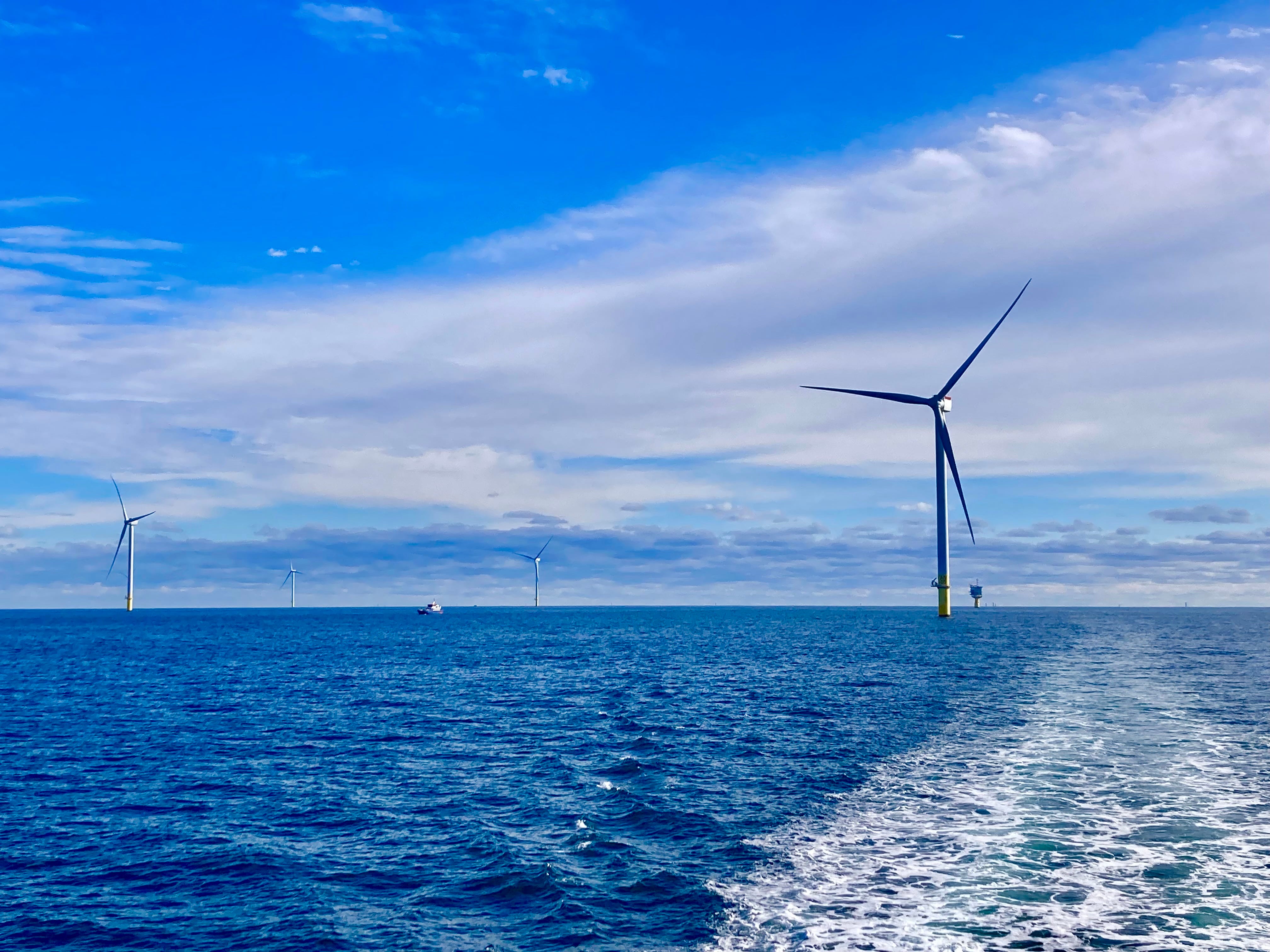
Three months later, on a sunny day in November, Roselund and several others from his organization joined dozens of other community and environmental activists from the region on a boat tour to see offshore wind up close. I tagged along as well, on assignment with Sierra magazine to report on a wind project “success story” – in this case, the first fully operational, commercial-scale offshore wind farm in the U.S. called South Fork Wind.
Developed by Orsted, South Fork Wind is a 132-megawatt project consisting of 12 turbines, located 35 miles east of Montauk on the tip of Long Island, New York. The project was completed in 2024 and is designed to provide enough clean electricity to power the equivalent of over 70,000 New York homes.
We passed right by Revolution Wind as we approached the South Fork project, as the two wind farms are sited in adjacent offshore lease areas. The boat had already slowed down at that point, reducing its speed from 30 knots to roughly 10 knots in accordance with vessel speed restrictions since the area we were traveling through is a seasonal management area for the North Atlantic right whale.
“People on our vessels look out for protected species and stop work if they see them,” Orsted’s Kevin Hansen, head of government and stakeholder relations for the Northeast region, said during a recent webinar about South Fork Wind. “As part of delivering this wind farm, we have a lot of environmental monitoring that goes into our project development. Just tons of safeguards,” he explained.
Benthic monitoring results indicate that the project is actually co-existing with the marine environment, as the turbine foundations function as artificial reefs supporting a variety of species. “We have some amazing underwater photos showing the sea life that’s developed around the foundations of the South Fork, and it’s beautiful – mussels, star fish, barrel fish surrounding the site,” National Wildlife Federation’s Amber Hewett, one of the organizers of the boat tour, told me. She said that fishermen, even ones who fish recreationally, have testified during hearings that the fishing has actually improved in this area.
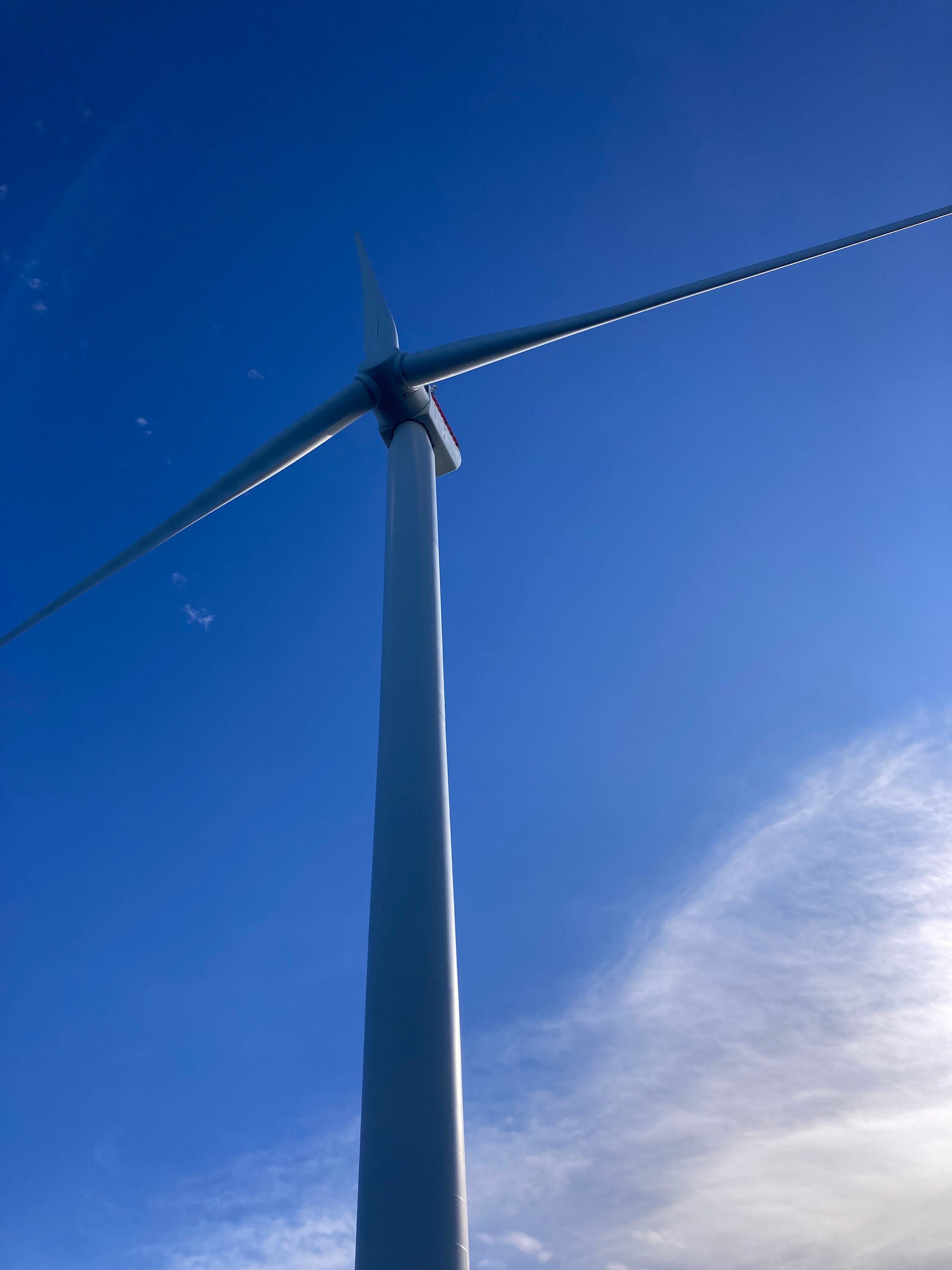
As for generation output, South Fork has achieved an average capacity factor of about 46 percent for its first year of operation, and for the first half of 2025 the capacity factor average was even higher at 53 percent, which is on par with performance data for natural gas plants in New York. “It’s doing really, really well and probably exceeding our expectations for power production,” Hansen said of the wind farm’s performance. Moreover, he noted that South Fork Wind was found to be generating about 92 percent of the time. “[The project] is not very intermittent. It’s pretty consistently producing power almost all the time,” Hansen said.
Hansen mentioned one example of how South Fork Wind is contributing to improving electric grid reliability. During a heat wave in June, the grid operator for New York had to declare a major emergency, calling on every available resource to try to meet surging electricity demand. At that moment, South Fork Wind happened to be generating power at nearly full production capacity, helping to bolster the power supply when the grid needed it most.
Offshore wind is also critical for supplying power especially during the winter months, clean energy advocates say. That is because wind speeds tend to be highest during the colder months, which is when the Northeast experiences rising demand on the natural gas system, since gas – the largest source of electricity in the region – is also the primary energy source used for heating.
“We have significant issues with having adequate gas capacity to meet those needs, and what we end up with is very high power prices and importing LNG [liquified natural gas],” Roselund told me. Offshore wind is certainly important for decarbonization, he said, but it is also “particularly strategic” for addressing those high winter power prices.
Roselund works as an energy policy analyst in the solar and energy storage industry and has been involved in the energy transition professionally for about 16 years, so he brings some expertise to his advocacy. “We’re on a good pace for solar deployment [in New England]. Where we’re really lacking in is power in the fall and winter. And that’s where offshore wind comes in,” he told me. “For me, it’s really clear there is no resource more important to the energy transition in New England than offshore wind.”
And yet, the offshore wind industry faces enormous headwinds from a federal administration that seems to be intent on shutting it down and preventing any further development. “Windmills, we’re just not going to allow ‘em. They’re ruining our country,” President Trump said in an Aug. 26 cabinet meeting, just days after his administration issued the stop work order on Revolution Wind.
While that project is now moving forward, others may be stymied or at least delayed as the administration moves to reconsider, and potentially revoke, construction and operation plan approvals for multiple projects, including Maryland Offshore Wind, SouthCoast Wind, and New England Wind 1 and 2. The SouthCoast and New England Wind projects, located south of Martha’s Vineyard, were all slated to provide clean power to Massachusetts (SouthCoast would also provide some power to Rhode Island).
Another offshore wind farm located just a little south of the Revolution Wind and South Fork projects, called Sunrise Wind, is under construction and has not (or at least not yet) been targeted by the Trump administration. Sunrise Wind will consist of 84 turbines and will be 924 megawatts, capable of powering approximately 600,000 homes in New York. Orsted’s Hansen said it is expected to be completed in 2027.
Offshore wind is happening in the U.S., despite the Trump administration’s hostility to it, and it has significant potential to contribute to the clean energy transition. I saw it up close, and from what I saw, these offshore turbines are co-existing with the marine environment and generating a reliable source of zero-carbon electricity.
“They were really magnificent,” Roselund told me in reflecting on the boat tour to South Fork Wind. “I saw us moving off of burning things for energy for the first time in a meaningful way in human history.”