

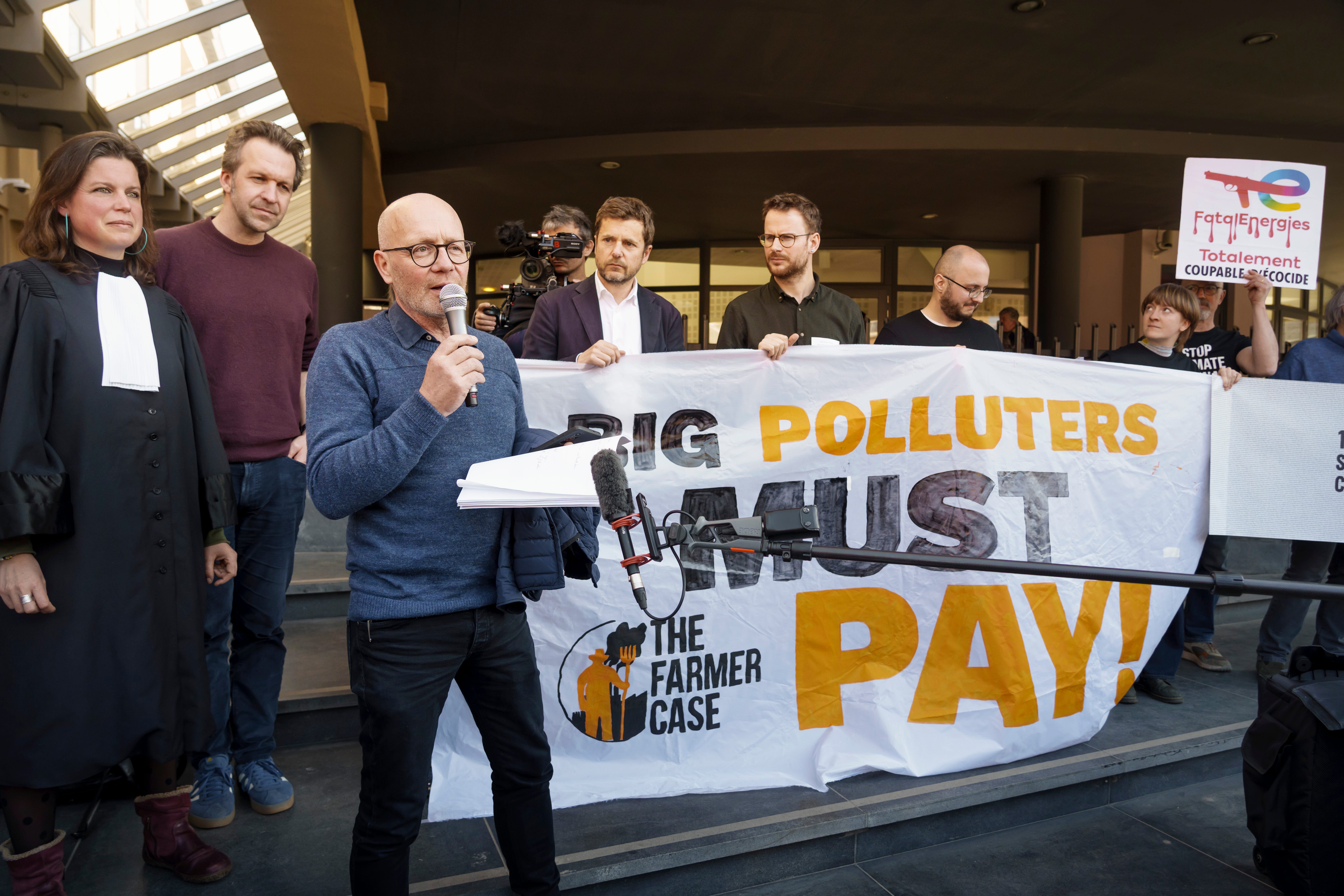
Hugues Falys, a peasant farmer from the Belgian province of Hainaut, speaks outside the courthouse on March 18, 2026. Credit: Eric de Mildt
During the summer of 2022, record-breaking monsoon rains dumped massive quantities of water that submerged entire fields and villages across Pakistan. The unprecedented, “biblical-style” floods inundated roughly one-third of the country and displaced millions of people; 33 million Pakistanis were affected by the disaster and more than 1,700 lost their lives, while 2.2 million homes were damaged or destroyed.
The province of Sindh, a predominantly agricultural region, was hit especially hard. The floods submerged 4.8 million acres of farmland and wiped out more than a year’s worth of crops. “That was a very big tragedy for us,” Abdul Hafeez Khoso, a Pakistani farmer from the Sindh province, said during a virtual press conference last October. “Our crops were destroyed, and agriculture is the main source of income for people living in the villages,” he explained.
With crops destroyed and market access disrupted, the floods triggered a food crisis since the Sindh province accounts for nearly one-quarter of Pakistan’s agricultural output. Farmers were pushed into debt or poverty, and the impacts continue to be felt to this day.
“Three years on, recovery remains incomplete. Many communities continue to struggle with displacement and economic hardship,” said Dr. Shaikh Tanveer Ahmed, chairman of HANDS Welfare Foundation, a Pakistani humanitarian organization.
Smallholder farmers whose livelihoods are deeply tied to the environment are on the frontlines of the climate emergency. From extreme flooding to scorching heatwaves and devastating drought, the impacts of a rapidly warming planet are undeniable for farmers who literally make their living off of the land. They are facing rising hardship with damaged crops and fields, sickened or dead livestock, and increasingly unpredictable and erratic weather patterns that threaten their operations and make it difficult to plan around. And with damages mounting, some farmers are looking to the law in the hopes that it can be leveraged to make major carbon polluters and fossil fuel companies pay compensation for climate-related losses and adaptation needs.
Khoso said the flooding disaster was clearly linked to climate change, which is happening largely due to “big companies” that are “damaging the environment.” Now, he along with 38 other farmers from Sindh are turning to the courts seeking some relief and accountability from several of these big companies.
In December the 39 Pakistani farmers filed a lawsuit in Germany against two of the largest generators of carbon pollution in that country – the energy utility company RWE and the cement producer Heidelberg Materials. The farmers are seeking partial compensation for their losses stemming from the 2022 floods.
Their case builds upon a landmark climate lawsuit brought by a Peruvian farmer and mountain guide, Saúl Luciano Lliuya, against RWE that tested the question of whether a corporation that has historically been a significant contributor to the carbon emissions driving climate change – the so-called ‘carbon majors’ – can be sued by an individual suffering from climate-related damage in another country. The German courts say the answer is yes. Lliuya’s case was ultimately dismissed last year because the evidence of an imminent flood risk to the plaintiff’s home wasn’t strong enough, but the court did affirm the principle that major polluters could be held liable for their contributions to climate change.
In the new case brought by the Pakistani farmers, the damage has already occurred, so the evidence of harm might be strong enough to overcome dismissal.
“For [these farmers], damage caused by the climate crisis means destroyed crops, homes, and livestock, declining yields, poverty, debt, and losing dignity,” Karin Zennig, climate policy officer at medico international – an NGO supporting the farmers’ case – said during an online briefing held in January. “The Pakistani farmers are opening now a new chapter in the fight for climate justice.”
Belgian Farmer Takes Oil Giant to Court
In Belgium, Hugues Falys practices ecologically sustainable farming in the Hainaut province. Since 1993 he has cultivated vegetables, strawberries, cereals, and legumes and raised grass-fed livestock for organic beef production. A “pioneer of the agroecological transition,” Falys has experienced firsthand the impacts of extreme weather such as heatwaves and drought. Scorched pastures have left him having to source feed from elsewhere for his livestock, while heat stress has also reduced yields for his cash crops. In recent years he has had to downsize his herd to adapt to decreased forage production.
With support from NGOs FIAN, Greenpeace Belgium, and Human Rights League, Falys brought a lawsuit two years ago against the French multinational oil company TotalEnergies. Dubbed “the farmer case,” the suit aims to hold the company responsible for its role in contributing to the climate crisis. It is the first lawsuit of its kind in Belgium and part of a growing wave of climate accountability litigation worldwide targeting the carbon majors. In bringing the legal action, Falys is seeking compensation for damages he has suffered; he is also asking the court to order TotalEnergies to implement a credible transition plan that includes sharp cuts to its greenhouse gas emissions and a swift phase out of its oil and gas production.
The court held hearings late last year, and in March it issued a ruling on a preliminary procedural matter, finding the case to be justiciable (able to be handled by the judiciary). The court held off on deciding the merits of the case for now, since a court in France is due to rule on a similar case against TotalEnergies in June. Still, the decision allowing the case to advance was a positive sign for Falys.
“The court recognizes today that agriculture is directly affected by the climate crisis, that farmers are its victims (8 out of 10 farmers in Belgium are suffering from climate change), and that the justice system has a role to play in holding those responsible for this crisis accountable,” Falys said in a March 18 press release, commenting on the court’s ruling. “Things are starting to change!”
The Belgian court is expected to issue its decision on the merits in September.
Major Flooding Threatens Small Farms in Vermont
Meanwhile, farmers and other stakeholders in the U.S. state of Vermont are now awaiting a decision from a federal court about whether Vermont’s landmark Climate Superfund Act is constitutional and can survive legal challenges, at least for now. The court held a hearing on Monday, March 30 in which the plaintiffs challenging Vermont’s law – the U.S. Chamber of Commerce and the American Petroleum Institute along with 24 Republican state attorneys general plus the Trump administration – argued that the state law conflicts with federal law and runs afoul of the Constitution. The plaintiffs want Vermont’s superfund law – which the legislature passed (with tri-partisan support) in 2024 – to be overturned by the courts.
Vermont’s law is the first law of its kind in the world that holds the world’s largest fossil fuel producers strictly liable for their climate pollution and requires them to help pay for climate adaptation costs in the state. It is grounded in the “polluter pays” principle and modeled after the federal Superfund program that authorizes regulators to charge polluters for clean-up costs associated with remediating hazardous waste sites. But this is the first time that the concept has been applied to climate change.
State lawmakers in Vermont quickly passed the climate superfund bill in just one legislative session, spurred into action after the state experienced its worst flooding in nearly a century in July 2023. Heavy downpours caused rivers to overflow their banks, inundating the capital city of Montpelier and temporarily submerging farms and villages across the state.
Intervale Community Farm in Burlington, for example, lost 99 percent of its crops during that summer flood. The 55-acre organic farm is situated within a floodplain, so some flooding is expected. But typically in the past the floods would occur outside of the peak summer growing season and would be more manageable. The July 2023 floods destroyed $200,000 worth of crops, according to farm manager Andy Jones.
The following year, in 2024, major flooding occurred once again on the same day in July, inundating the Intervale Community Farm and neighboring farms in the area. As Jones wrote in a declaration filed last year with the court: “These floods threaten the farm’s survival.”
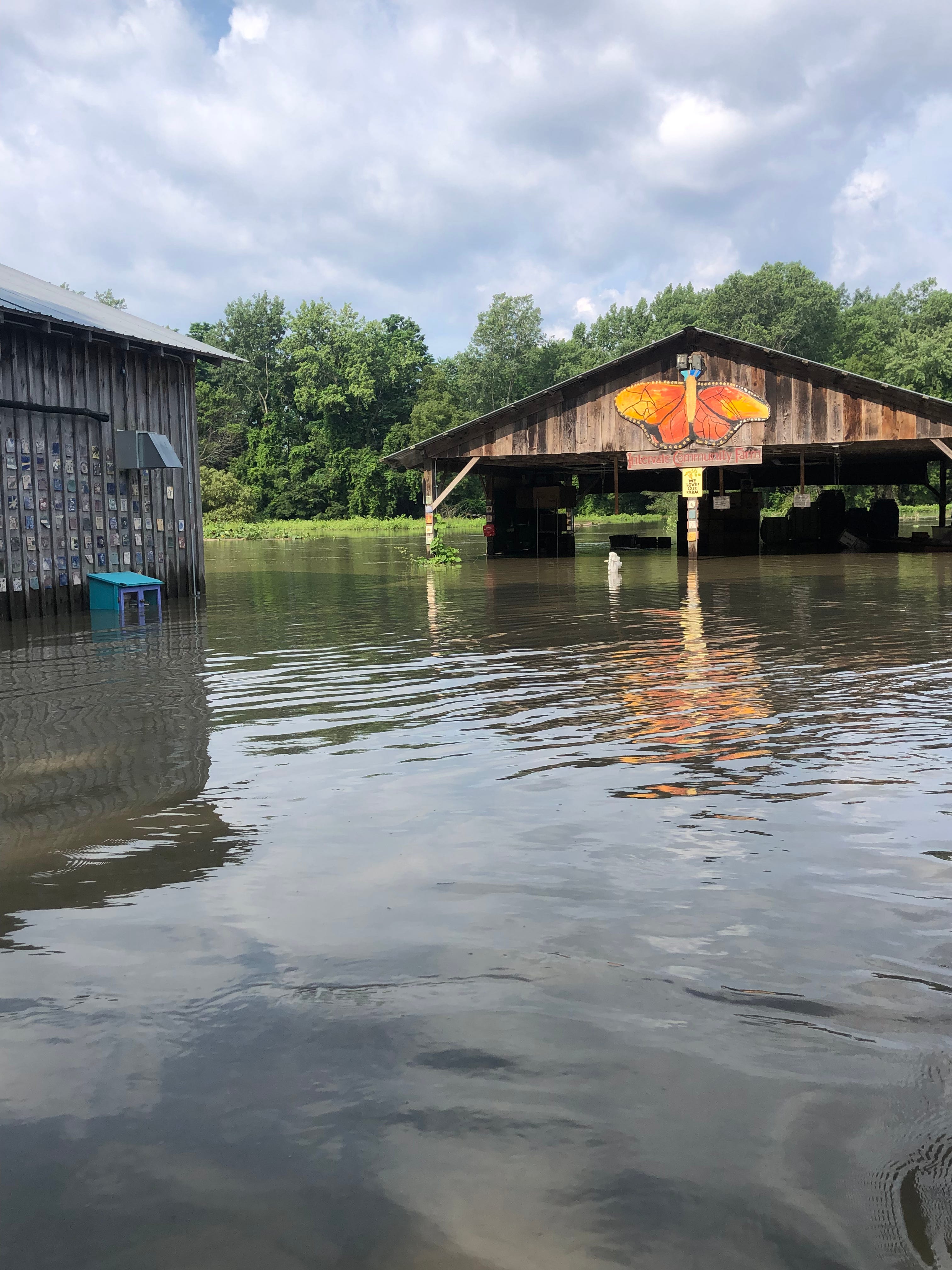
Flooding at Intervale Community Farm in July 2023. Credit: Intervale Community Farm
Small farmers all over the state are already struggling to make a living with increasing economic pressures, and climate change further compounds the stressors, Grace Oedel, executive director of the Northeast Organic Farming Association of Vermont (NOFA-VT), explained.
“This marketplace of consolidation and corporate ownership of the food system means it’s really hard to survive already. And then layer onto that just climate devastation caused by extreme, erratic weather events that are increasingly common. Those are the conditions we are facing in Vermont, which is part of why we need a climate superfund,” Oedel told me.
“We know that over the last couple years of the floods, climate impacts caused at least $60 million in losses to Vermont’s farms,” she added. “Farms are going out of business. For some farms, climate impacts along with the rising land costs they face are creating a really depressed economic situation. And we need, for long-term food security, farms to be able to survive.”
NOFA-VT has intervened as a defendant backing the state in the court cases challenging Vermont’s climate superfund law. Oedel told me that the organization’s member farms “are very affected by the climate crisis” and want to see Vermont’s law be upheld, because the funding it would secure could help the organic farming community as it tries to adapt to a climate crisis that it did not cause.
“Every year on our farm we make significant infrastructure investments to protect our crops, and every season we face significant crop-destroying challenges from weather extremes: frosts, excessive heat damage, wind, tornadoes, flooding, soil saturation, and overall impossibly hot work conditions,” Scott Greene, a farmer at Singing Cedars Farmstead, a vegetable and livestock farm in Orwell, Vermont, said in a statement following the March 30 court hearing.
“Farmers globally have been, and will continue to be, enormously impacted by the climate crisis,” Oedel said in the statement. “We know what’s behind the worsening extreme weather affecting our farms, and it’s fair for fossil fuel companies to bear some of the cost of critical climate adaptation projects.”
Further Reading
Check out my latest published articles:
“As Vermont Defends Its Law to Make Fossil Fuel Firms Pay for Climate Adaptation, the Bill Is Already Coming Due” (co-authored with Nathaniel Eisen), Inside Climate News, https://insideclimatenews.org/news/05042026/vermont-defends-climate-superfund-law/
“Affordability and Race Play a Major Role in Whether People Live in Nature-Deprived Areas,” Sierra, https://www.sierraclub.org/sierra/affordability-and-race-play-major-role-whether-people-live-nature-deprived-areas